



At a glance
- Birds are crucial bio-indicators, especially shorebirds that can only thrive on beaches, making them essential for monitoring coastal health and management efficacy.
- Shorebirds are useful bio-indicators — or 'coastal canaries' — as they can provide early warning signals on the state of the health of coastal areas. They can provide feedback on the efficacy of management efforts — or the lack thereof.
- Long-term monitoring of migratory shorebirds in Tasmania since the 1960s provides valuable data for developing and assessing coastal management strategies.
- Anthropogenic threats, such as off-road vehicles and dogs, significantly impact shorebirds and seabirds, with invasive plants further fragmenting coastal habitats.
Shorebirds are useful bio-indicators and have been monitored for decades
Birds are recognised universally as excellent bio-indicators and are widely used in this role around the world. Beaches and foreshores are critical habitats for a number of shorebirds and seabirds in Australia and globally.
Many beach-nesting birds are uniquely adapted to this environment and so are unable to live elsewhere – they can only nest and feed on beaches, they can only raise their chicks successfully on beaches, and without beaches, these birds will die, their populations will likely decrease and the species may become locally wiped out, and at worse, extinct. Thus, shorebirds are appropriately considered as 'coastal canaries', providing early warning signals on the state of the health of coastal areas. They can provide feedback on the effectiveness of management efforts – or the lack thereof.
can you identify common shorebirds? Birdlife Australia has produced an identification guide to help.
shorebird
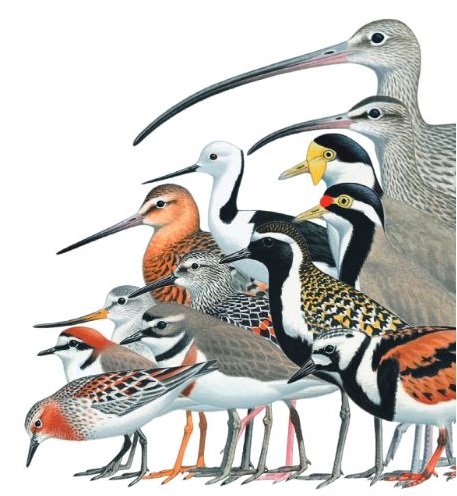
© Birdlife Australia
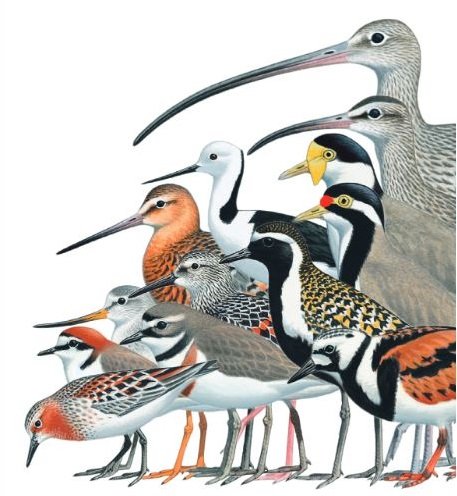
shorebird
© Birdlife Australia
Long term monitoring of shorebirds in Tasmania
In Tasmania, there has been long-term monitoring of migratory shorebirds since the 1960s, which has provided 60-year data sets for migratory species at key sites around the state. These data on shorebird numbers, distributions and trends offer an excellent basis for the development of new coastal management regimes and for assessing the effectiveness of past efforts.
about how Tasmania is a global refuge and destination for shorebirds in an article by Eric J. Woehler.
Threats to shorebirds
There are a wide range of anthropogenic threats to resident and migratory shorebirds and to seabirds and these are well documented throughout Australia.
Natural processes and events such as high tides and storm surges that wash out nests are not considered threats as the species have evolved strategies in response to these. Rising sea levels exacerbate the broad spectrum of existing threats.
Off-road vehicles and dogs pose the greatest threats to resident and migratory shorebirds, and seabirds in Tasmania, while invasive plants exacerbate these primary threats by alienating and fragmenting the remaining coastal shorebird habitats.
to ecologist Dr Eric Woehler in the podcast Moving oceans discuss how to minimise the impacts of our coastal leisure and recreation on shorebird beach habitats.
Threats from off-road vehicles
Off-road vehicles (four wheel drives, trail bikes, motorbikes, quad-bikes and dune buggies) threaten breeding efforts of shorebirds by driving over nests and crushing eggs and flightless chicks. The increasing use of off-road vehicles on beaches increases disturbance to nesting shorebirds during summer, the peak of the breeding season. Repeated vehicular traffic over the same stretch of beach, can compact the sand above and below the high tide line, decreasing the density of aquatic invertebrates upon which shorebirds feed.
about the coastal stressor of Impacts of 4WDs on beaches, its impacts on coasts more broadly and of attempts to educate drivers or a cast study of Ballina Shire Council's attempts to restrict them from some beaches.
Threats from dogs on beaches
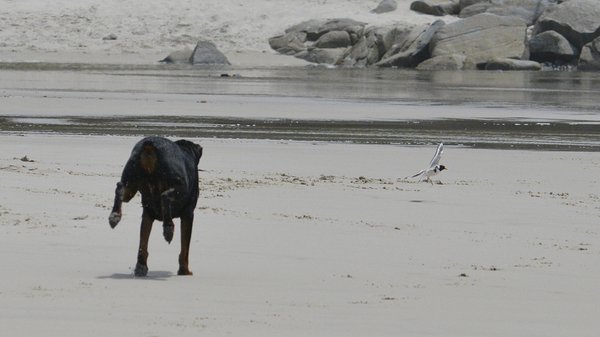
A unleashed dog chases a Hooded Plover.
- © E.J. Woehler11. Dog Hooded Plover 22527
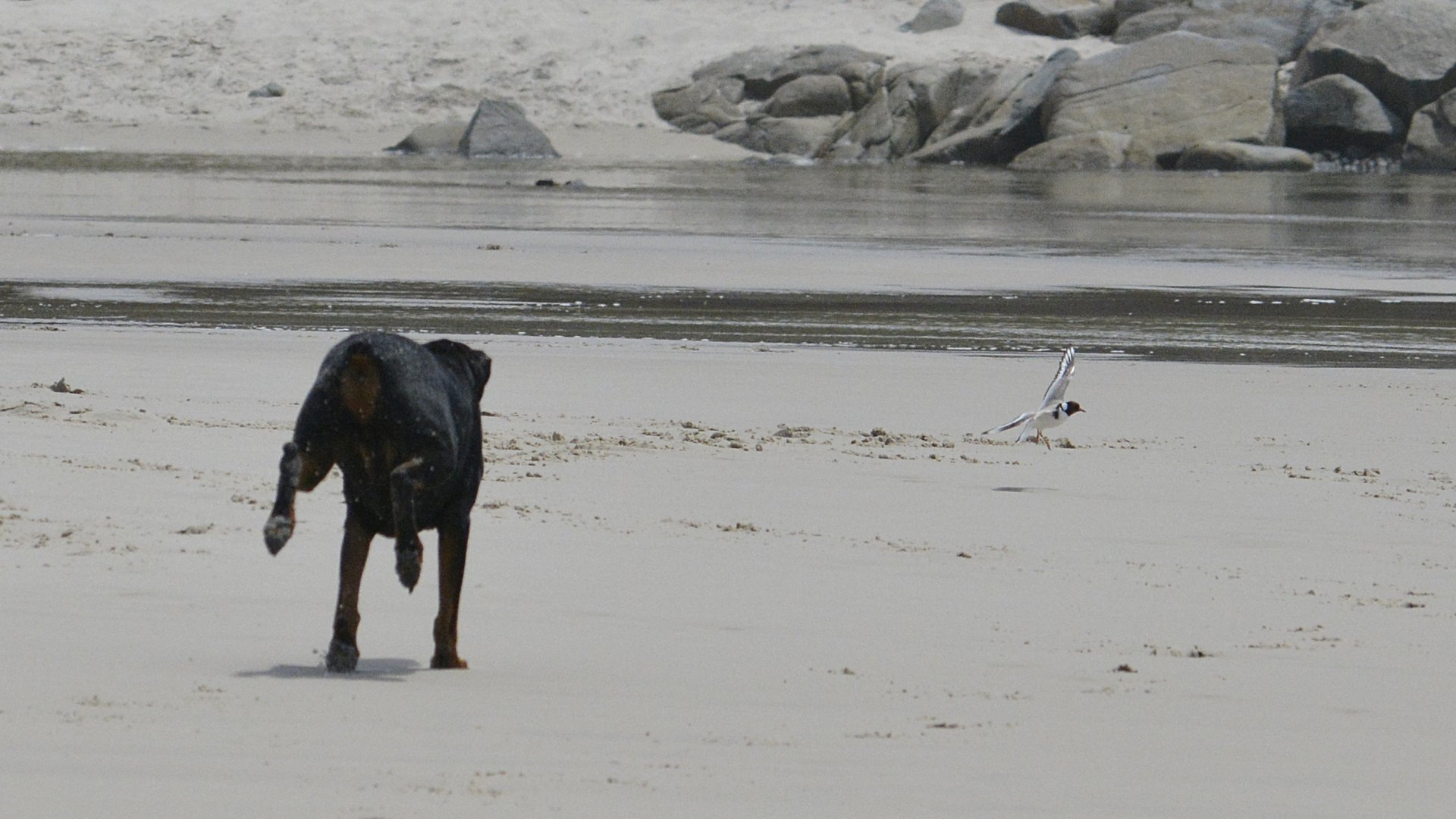
A unleashed dog chases a Hooded Plover.
© E.J. Woehler
Dogs are a significant component of recreational life in the community, and beaches are popular places for dog owners to take their pets.
However, unleashed dogs are highly disturbing and will eat eggs and kill shorebird chicks; dogs are a major killer of Little Penguins. Dog attacks on Little Penguins can kill more than 50 penguins in a single event – and colonies will take decades to recover, if they recover at all.
Free-ranging dogs on beaches may draw unwanted attention to breeding sites: while dogs inspect shorebird nests, they may be watched by predatory birds such as Forest Ravens, Silver and Pacific Gulls.
Most coastal councils around Australia have a policy to limit dogs on beaches through a combination of 'on-leash', 'off-leash' or 'no dogs' areas. Yet, lack of compliance with these policies remains high: a phenomena also common in many other countries.
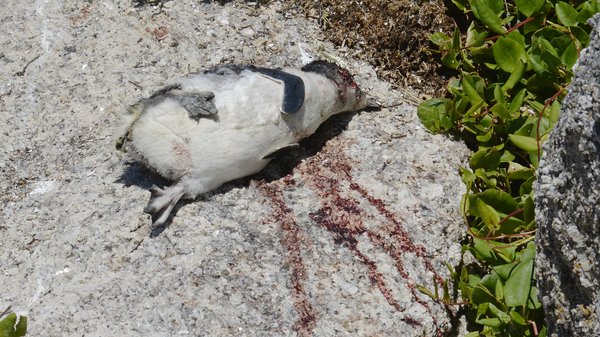
Little Penguin killed by a dog
- © E.J. Woehler12. Little Penguin dog kill 23011
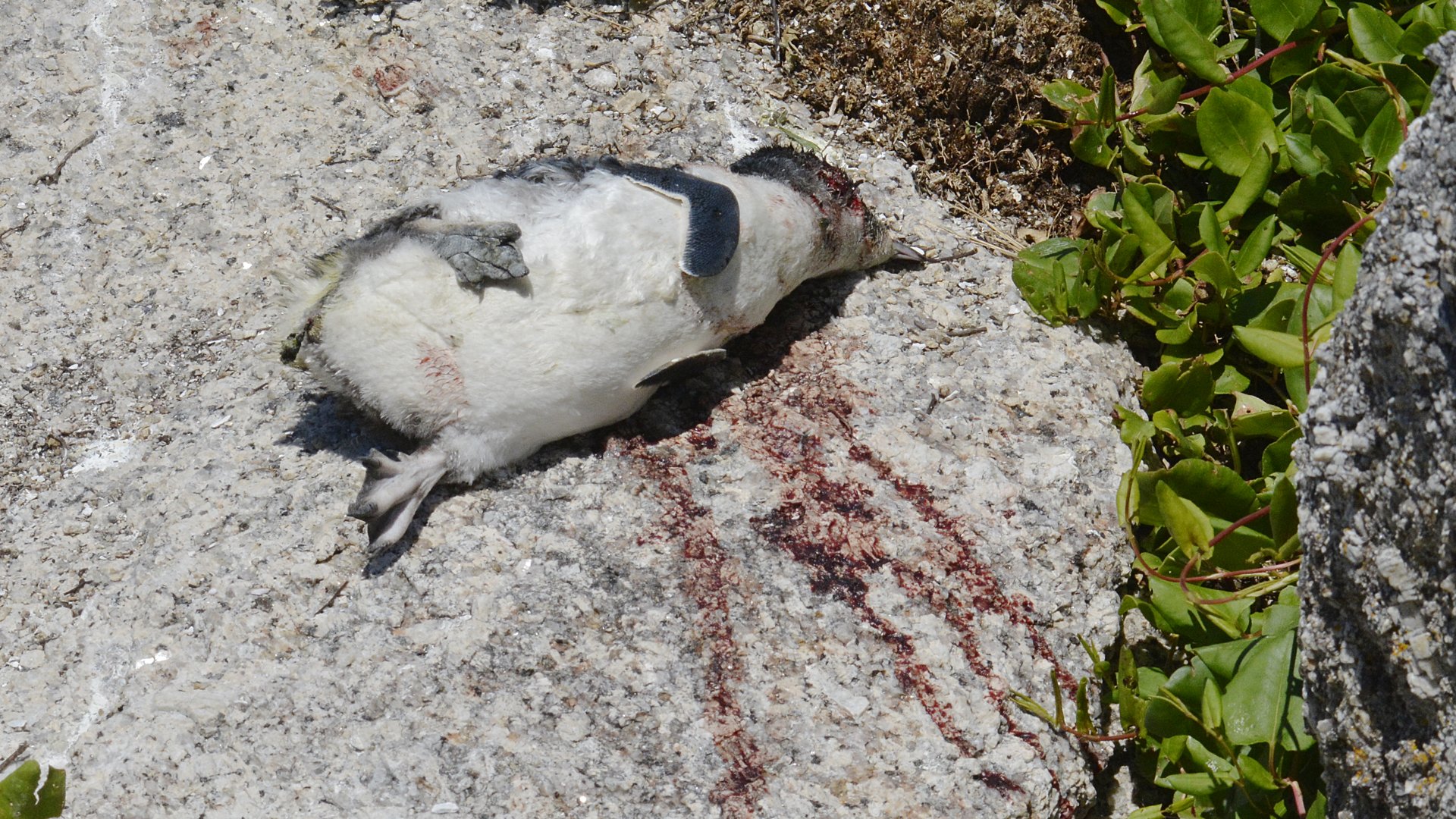
Little Penguin killed by a dog
© E.J. Woehler
a CoastAdapt case study about Tweed Shire Council's efforts to develop more effective dog off leash campaigns such as Take the Lead.
Threats from invasive plants
Resident shorebirds typically nest on an open, native grassed and gently sloping dune face. This nesting choice makes inundation less likely, as they nest higher up the beach, and provides excellent visibility of approaching predators.
Introduced invasive plants fundamentally alter coastal habitats. Marram Grass (Ammophila arenaria) allows high tides and storm surges to erode the base of dunes, while their roots bind the top of the dune, thus forming a near-vertical dune face that prevents nesting by shorebirds and access to nesting burrows by penguins farther inland.
Extensive expanses of Sea Spurge (Euphorbia paralias) and other plants alienate large areas of the foreshore, preventing nesting, feeding or roosting (resting).
about dune regeneration and how it is helping provide habitat in the CoastAdapt case study Plover Coast of Fleurieu Peninsula in South Australia
about reducing the transfer of weeds from nearby gardens and other neighbourly tips in LIving lightly on the coast: how to be a good coastal neighbour.
What the community can do to help protect shorebirds
There are many actions that communities and individuals can take to share the responsibility of keeping shorebirds safe from human-related activities. Several organisations are producing information and educational resources to let the community know how they can help.
Tasmania Parks and Wildlife provides a guide for beach users on how they can act to help protect shorebirds.
To help look after our shorebirds on the beaches, please practice these few little things:
- Walk only on the wet sand, below the high tide mark (between October and April)
- Keep your distance from nesting birds on beaches
- De-sex cats and keep both them, and pet dogs, in at night
- Dispose of waste responsibly
- Safely pick up any litter and fishing line
- Walk your dog away from known shorebird nesting areas and keep them on a lead
- Do not drive vehicles on nesting beaches
- Do not collect seaweed, or other beach materials.
Sunshine Coast Council has undertaken a series of activities in developing a plan to protect shorebirds in their area, including:
A Shorebird Conservation Plan 2025-2030, which was adopted by Council in 2025.
This included a Community consultation plan
SC visioning activity
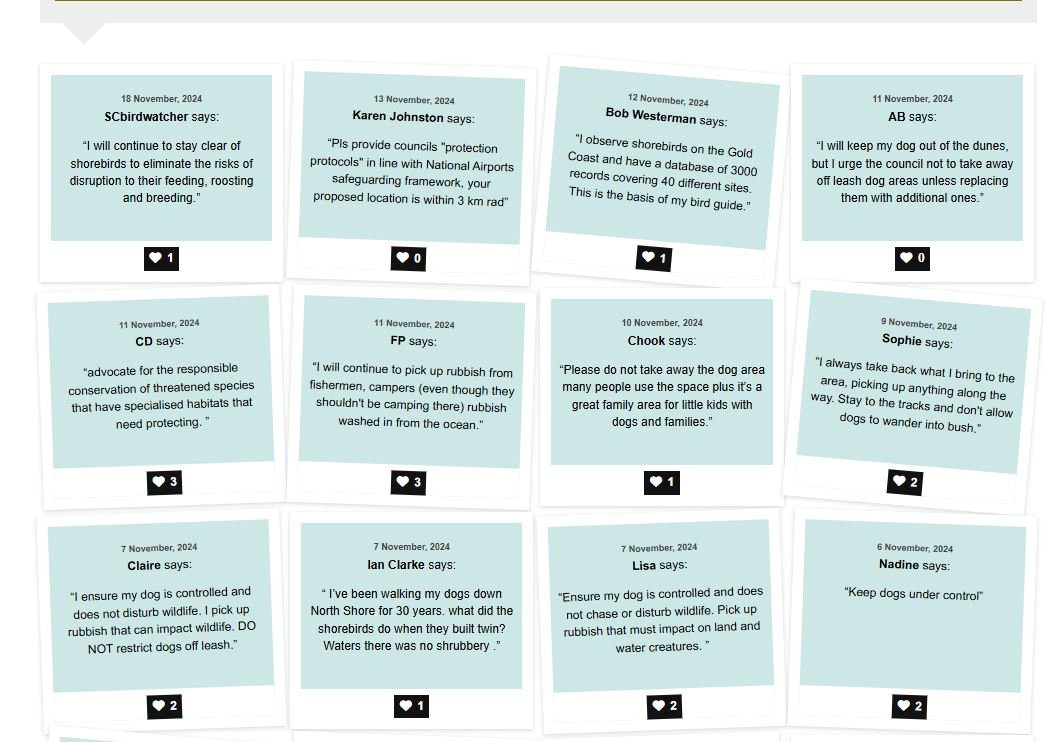
A selection of statements from the participants of a 'visioning activity' held during the community consultation on Sunshine Coast Council's shorebird planning .
© Sunshine Coast Council website 2024.

A selection of statements from the participants of a 'visioning activity' held during the community consultation on Sunshine Coast Council's shorebird planning .
- © Sunshine Coast Council website 2024.SC visioning activity
A selection of statements from the participants of a 'visioning activity' held during the community consultation on Sunshine Coast Council's shorebird planning .
© Sunshine Coast Council website 2024.
Council has also developed a short video to outline responsible behaviour around shorebird areas.