


At a glance
- Short-term rental accommodation can create significant challenges for councils, especially in regions already affected by population shifts and extreme events.
- It can reduce long-term rental supply, drives up rents, and worsen housing shortages. Frequent visitor turnover erodes social cohesion, increases noise and amenity issues, and weakens community networks that are vital for disaster resilience.
- Flexible housing systems and permanent residents are essential for recovery after extreme events, but short-term rentals undermine this adaptive capacity.
- Councils also face enforcement gaps due to limited platform data, dispersed properties, and political pressures. Stronger data-sharing and registration systems are needed to improve management and compliance.
The rise and rise of short-term rental accommodation
Digital platforms that offer short term rental accommodation (STRA) have transformed how tourists and visitors can access lodging, offering flexibility in timing and type of accommodation, while creating new income streams for property owners.
STRA refers to properties rented for short periods, typically through digital platforms. There are three main types:
- shared residence (hosted): a room within a host’s home
- primary residence (non-hosted): a whole property rented occasionally, usually less than 90 days per year, which might be while the host is away for short stints
- secondary residence (non-hosted): a whole property is rented and the property is primarily used for STRA, and often available year-round.

Byron Bay is the LGA with the highest proportion of properties available for STRA
- © NCCARFByron Bay view
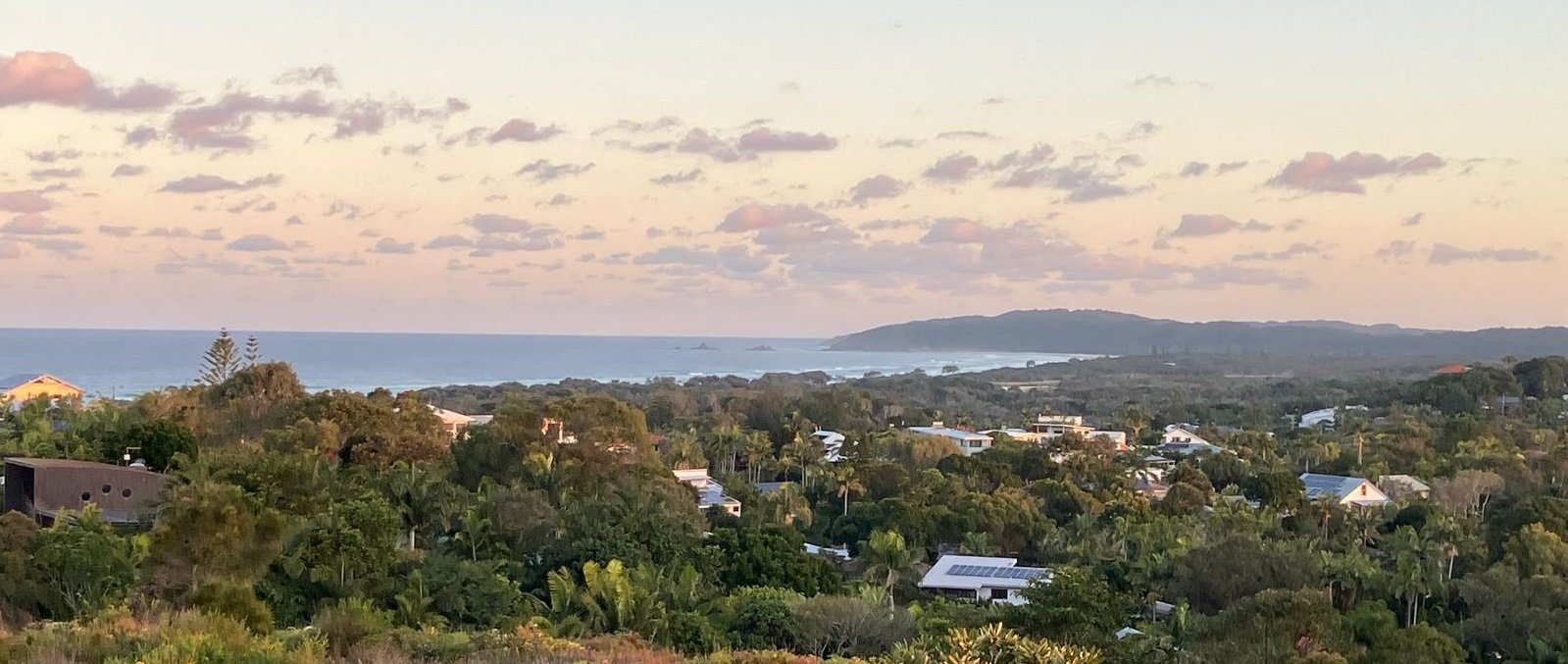
Byron Bay is the LGA with the highest proportion of properties available for STRA
© NCCARF
While hosted arrangements may have minimal impact, research is emerging that non-hosted STRA – especially in secondary homes – can significantly affect housing markets and neighbourhood dynamics and drain councils' resources through the of managing compliance.
| Type of STRA | Impacts on housing market | Impacts on neighbourhood | impacts for councils | Consequences for climate adaptation |
|---|---|---|---|---|
| Shared residence (also known as 'hosted') | Minor impacts (but host may benefit from income) | Low risk | Safety concerns/ compliance with building code. | Low |
| Primary residence (non-hosted) | Low risk | Low risk | Safety concerns. | Visitors may be unaware of emergency protocols for extreme events |
| Secondary residence (non-hosted) | Loss of permanent rental properties; high rent and housing prices | Turnover in neighbours leading to loss of social capital; increase in noise, antisocial behavior; decrease in privacy; | Burden on local waste,parking, infrastructure | Visitors may be unaware of emergency protocols for extreme events. Neighbourhood turnover can undermine community reseilience. |
While Airbnb is the most widely referenced platform, there are several others that operate STR or 'peer-to-peer' accommodation bookings including A Perfect Stay, Vrbo, Stayz, and Booking.com.
- © NCCARFPerfect_stay3
While Airbnb is the most widely referenced platform, there are several others that operate STR or 'peer-to-peer' accommodation bookings including A Perfect Stay, Vrbo, Stayz, and Booking.com.
© NCCARF
Types of tourism affected with short term rental accommodation
The emergence of STRA has changed the nature and experience of tourism in communities, but not in the same way. Particularly influential are place-based characteristics particularly visitor economy and housing market dynamics, settlement location, neighbourhood structure, local governance and planning frameworks for tourism and urban development. Gurran et al. 2020 describes a typology that ranges from 'pop up tourism' to 'invasive tourism'.
Pop-up tourism
- Characteristics: Seasonal destinations with latent holiday homes that can be mobilized during peak events or festivals.
- Council example: Moyne (Port Fairy).
- Impacts: Supports tourism without major infrastructure investment; minimal neighborhood conflict but some housing pressure.
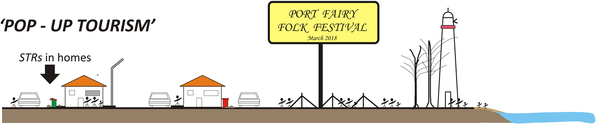
Popup tourism
Resort tourism
- Characteristics: Areas with strong formal accommodation sectors (hotels, resorts) and established planning frameworks.
- Local government examples: Sunshine Coast, Douglas, Port Macquarie.
- Impacts: STRA diversifies accommodation options rather than dominating; few neighbor complaints.
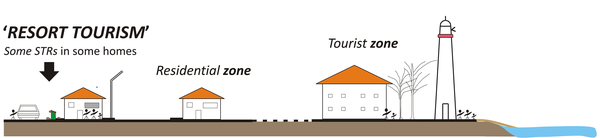
Resort tourism
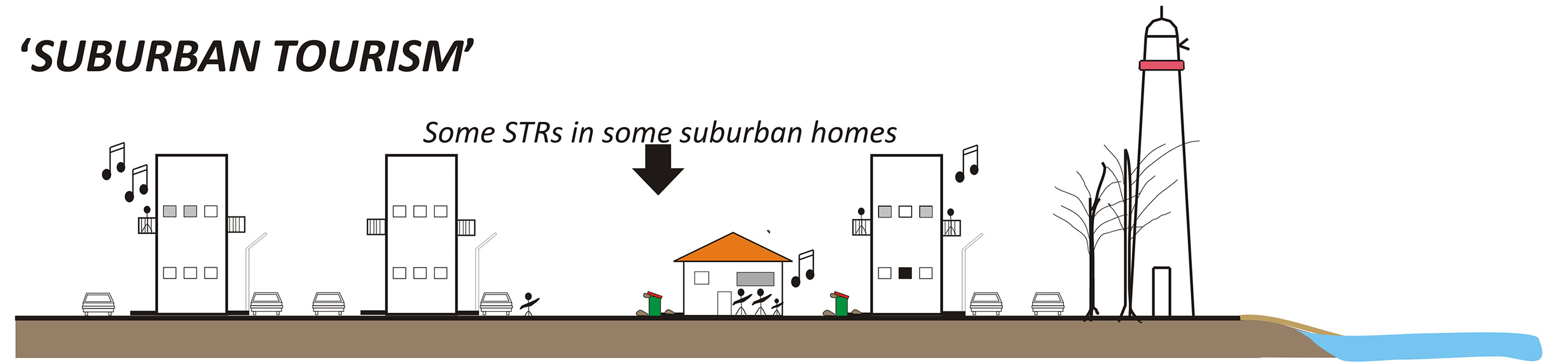
Suburban tourism
- Characteristics: Urban fringe or suburban areas where large homes or granny flats are rented short-term.
- Local government example: Moreton Bay.
- Impacts: Occasional issues with “party houses” and safety risks; listings remain a small share of housing stock.
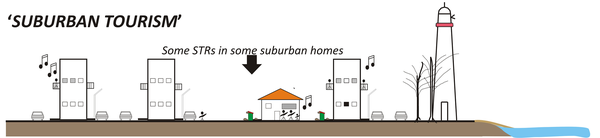
suburban tourism
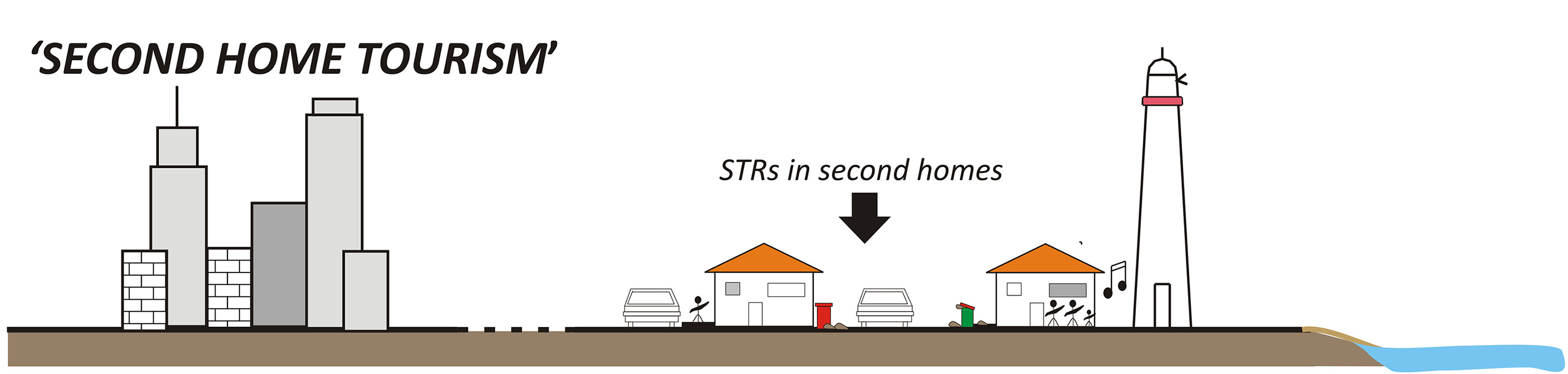
Second home tourism
- Characteristics: Regions with long-standing traditions of second homes and holiday rentals.
- Local government examples: Shoalhaven, Kiama, Bass Coast, Eurobodalla.
- Impacts: STRA amplifies existing patterns; rising housing costs and absentee management issues.
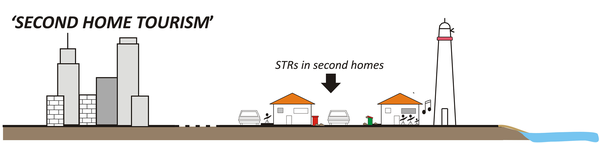
Second home tourism
Invasive tourism
- Characteristics: High STRA density relative to housing stock; tourism dominates residential areas.
- Local government examples: Byron Bay, Mornington Peninsula.
- Impacts: Severe housing shortages, gentrification, neighborhood conflicts, displacement of local residents.
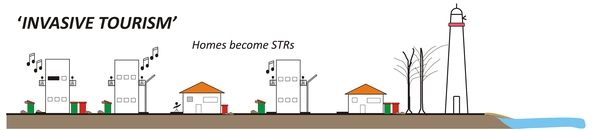
invasive tourism
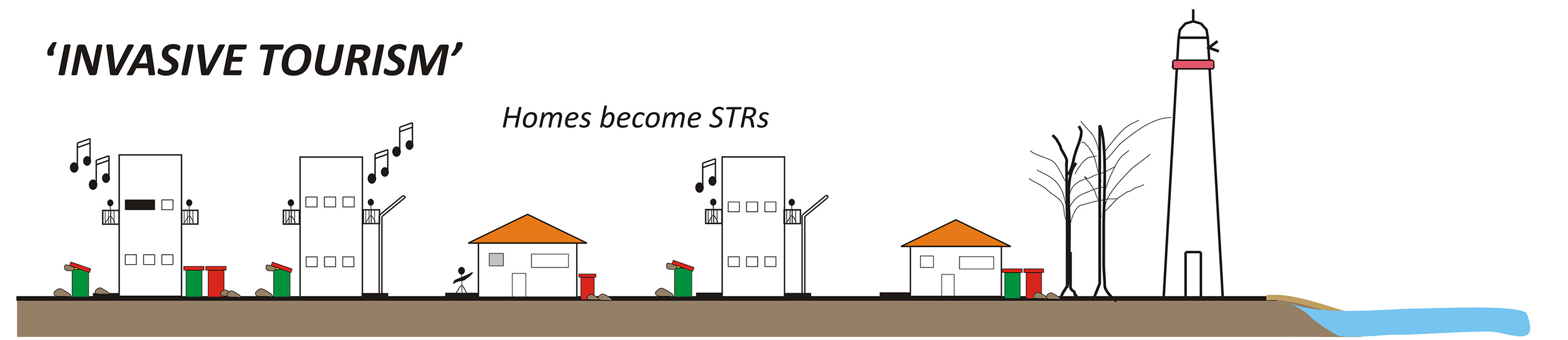
Gurran et al. 2020 CC BY-NC-ND 4.0.
Short-term rental accommodation affects coastal communities
There has been a rapid growth of short-term rental accommodation as a disruptor of tourism accommodation. These platforms offer economic opportunities for property owners and options for flexible lodging for visitors, yet can also create significant challenges for some councils and communities.
STRA has changed the nature of residential and tourism land uses, e.g. older holiday apartments offering long-term leases; short-term let apartments located within residential units. These changes can create problems where holiday units are not designed for residential living and lead to conflicts between neighbours and tourists in residential buildings.
Communities can experience living with a transient population, noise from 'party houses' and a broader loss of social capital. Councils can struggle with planning, compliance and pressure on local infrastructure and traditional tourist accommodation (known as 'approved accommodation providers').
Community experiences of STRA
A 2025 study reports on a survey and 12 case study councils describes a number of positive and negative impacts (from most to least important).
Positive impacts
- Tourism accommodation is increased and supports a visitor economy.
- Tourism is extended beyond peak periods.
- Local residents are able to host visitors in their homes or while away, offering economic opportunities.
- The capacity for tourist accommodation to be flexibly increased for spikes in demand, for example for special events.
- The potential for some people to maintain dual addresses with maintaining employment in the city and lifestyle in a coastal area.
- The potential for flexible accommodation for people relocating to the area for employment.
Negative impacts
- Impacts on availability of rentals
- Impacts of house prices
- Reduced amenity for neighbours (noise, anti-social behavior of guests, poorly managed dogs.
Gurran et al. 2025.
Community disruption
STRA can accelerate gentrification resulting in displacement of long-term residents and increase in transients that weakens local networks and place attachment.
A constant turnover of visitors in the neighbourhood that often have different values and weak ties to the community – including limited regard for 'neighbourliness', the local environment or community resources – tends to lower the everyday interactions that fosters mutual assistance, community connectedness and informal monitoring,
Impacts on housing
Rapid growth in STRA is credited with creating housing shortages, pushing up rents, and displacing locals. Growth in STRA listings can be associated with higher rents and house prices when landlords and investors reallocate dwellings to the more lucrative short-term market, reducing long-term rental supply.
Concurrent with the rise in STRA, a crunch in local housing availability may be exacerbated by other events. The COVID-19 pandemic – including through new opportunities for remote working and changing patterns in travel due to border closures – drove a sudden population shift to regional areas that was not matched by housing supply.
This was further exacerbated in some areas affected by extreme events. The 2019-2020 Black Summer bushfires, followed by the 2022 NSW-Qld floods, resulted in around 5000 houses being destroyed or badly damaged and so removed from the available housing pool.
Impacts on local infrastructure and approved accommodation
STRA increases pressure on local infrastructure such as roads, water supply, waste management, and emergency services. Communities may not be designed to accommodate the fluctuating and often high volumes of visitors that STRA can attract, leading to congestion, strain on public utilities, and higher maintenance costs for local councils.
This style of tourism accommodation booking platform can also undermine traditional accommodation providers, such as hotels, motels, guest houses and caravan parks. Traditional businesses are required to comply with safety, zoning and taxation regulations, while STRA has been able to operate outside these frameworks – although state and local governments are trying to catch this up.
How to regulate and monitor compliance
STRA can present regulatory challenges for local governments that may struggle with capacity and resources to balance tourism, housing, as well as compliance and enforcement.
These platforms operate as booking services - an intermediary not property manager - which can limit or avoid their responsibility for compliance with planning, safety, and zoning laws. Increasingly states are trying to address this by introducing obligations to register properties, verify permits and share data (e.g., WA and NSW).
This lack of platform accountability shifts the burden of enforcement to local governments, which often lack access to accurate, real-time data on property addresses, booking frequency, and occupancy patterns. This lack of data makes it hard for councils to monitor compliance with caps, safety standards, and local planning rules.
Short term rental accommodation can challenge adaptation to climate change
In a changing climate, STRA can be an additional stressor for communities and for local governments.
STRA can disrupt community cohesion, a key attribute of climate resilience. Strong community networks help communities to share resources, coordinate emergency responses and recover from disasters. These networks can be disrupted by the displacement of long term residents and eroding neighbourhood social capital through loss of neighbours and the informal safety nets of mutual assistance.
STRA can also hamper climate adaptation efforts through adding to housing shortages, pushing up rental costs and housing prices. The resources required to manage compliance can also drain council resources.
State responses to STRA
Australia does not have a national regulatory approach to STRA. Despite experiencing similar challenges, states have taken different responses that broadly include:
- registration / mandatory data
- caps or night-limits
- local laws to manage behaviour
- state levies to fund housing
- planning reforms to clarify when STRAs require approval.
| State government approach | Policy / regulation |
|---|---|
| New South Wales | Mandatory state register of STRA listings. 180 cumulative night cap in Sydney and other self-nominated LGAs, 60-day cap in residential zones in Byron Bay and Brunswick Heads but no limit in tourist zone. |
| Queensland | Councils regulate STRA through their local planning schemes. Some LGAs require registration, fees and/or development approval. |
| South Australia | Local councils regulate STRAs and may require development approvals. City of Adelaide classifies STR properties (offered for ore than 90 days per year) as non residential and applies a commercial rating. The Legislative Council has established a Select Committee on the Short Term Accomodation Sector. |
| Tasmania | Local planning permission may be required. Owners are offered a financial incentive (one year land tax exemption) to revert property to permanent rental. Platforms are required to report on listings quarterly. |
| Victoria | Levy on STRA bookings (7.5%). Second home property tax. State registration to replace local lsystems and fees. |
| Western Australia | STRA planning policy and register. 90 day cap in Perth for un-hosted properties without permissions. $10,000 incentive to convert un-hosted STRAs to long term rental for at least 12 months. Hosted property exempt from needing planning approval. |
Local responses
A number of councils around the coast have tried various strategies to manage STRA. Below are two examples and both show that housing policy and STRA regulation can affect a community’s ability to adapt to climate risks. Flexible housing systems and strong social cohesion are vital for community resilience.
Shoalhaven City Council's pandemic attempt to convert STRA to long term rental
The City Council's experience showed that STRA can't be easily flipped into sustainable long-term rental supply without detailed planning. This is significant as it shows structural inflexibility in the housing system, even in an extreme event.
During the COVID-19 pandemic, there was a pronounced gap between STRA and permanent rental supply. Several councils in NSW urged non-resident ratepayers to make vacant or STRA properties available for long-term rental.
In October 2022, Shoalhaven City Council’s Mayor sent about 44,000 letters to property owners requesting them to support affordable housing. Similar campaigns were run by Eurobodalla Shire Council and Bega Valley Shire Councils. Shoalhaven’s initiative generated about 40 enquiries to council and 35 responses to affordable housing providers: ultimately, about four properties were made available for lease.
Reported barriers included: properties failing to meet standards or they had poor access to employment and services, restrictive lease conditions or unreasonable expectations of rental returns, and homes offered fully furnished, which is unsuitable for long-term tenants.
Affordable housing providers also noted that, if the campaign had been more successful, then managing a larger number of dispersed properties would require significant funding and staff.
Byron Shire's cap on STRA to improve supply of long-term rentals.
Byron’s experience illustrates that caps can be politically popular but there can be ambiguous housing outcomes in the short term. This is significant as the loss of neighbours has implications for community resilience.
In 2023, Byron Shire was the LGA with the highest proportion of properties available for STRA in Australia. Despite the NSW government introducing a 180 day per year non-hosted cap, Byron Shire Council introduced a 60-day per year non-hosted cap for some urban areas from September 2024. Byron's CBD and nearby Brunswick Heads were exempt from the cap.
Early evaluations a year later show there are fewer STRA listings in some areas (dropping during 2019-2025 from approximately 3500 to 2200 properties). There is some evidence that the caps have improved long-term rental supply (Gurran et al., 2025): anecdotal reports also say the rental market is a little easier. (There are also anecdotal reports that houses are sitting empty not being returned to the long term rental market.) Negative Impacts on local businesses and the visitor economy are also reported.
Strong local networks and permanent residents are essential for disaster preparedness and recovery. However, ambiguous outcomes – such as empty homes and economic trade-offs – suggest that caps alone may not guarantee adaptive capacity. If housing remains unavailable or unaffordable, vulnerable populations may still be displaced during climate events.
Byron Shire map of STR accommodation area
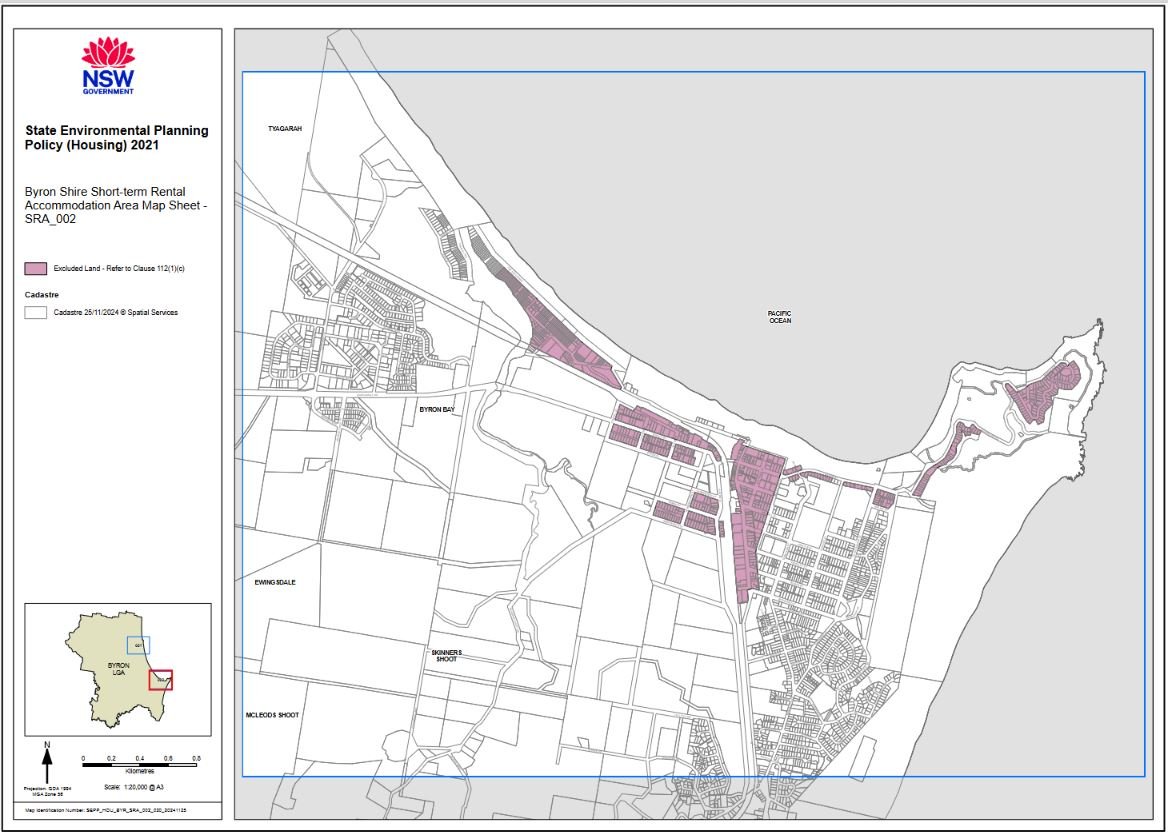
@ Byron Shire Council website, 2025.
Byron Shire map of STR accommodation area
@ Byron Shire Council website, 2025.