


At a glance
- This guidance aims to help coastal decision-makers to select appropriate spatial scales for coastal hazard mapping (inundation and erosion), understand limitations, and determine when finer-scale assessments are needed for adaptation planning.
- Mapping scales and applications include:
- national/state-level assessment: broad-scale maps for strategic planning and first-pass risk screening.
- local government area assessment: medium-scale mapping for planning schemes and second-pass risk assessments.
- Coastal compartment and site-based assessments: high-resolution studies for detailed risk analysis, development applications, and major adaptation options.
- Key considerations include that higher-resolution mapping requires more data and modelling effort; physical processes like bathymetry, wave dynamics, and sediment transport must be accurately represented; limitations of simplified approaches (e.g., bathtub method) should be recognized when assessing hazards.
Scale matters in coastal adaptation planning
Regional and local government decision-makers require a range of mapping products and tools to support coastal adaptation planning. The complexity of modelling and detailed assessments that underpin these products varies significantly across different spatial (or geographic) scales.
This guide is designed to help coastal planners and managers determine whether a mapping product is fit for purpose, understand its limitations, and identify when more detailed assessment and mapping are required to inform adaptation decisions.
The focus is on the spatial scales of coastal hazard and risk mapping products. (Note that out of scope is the selection of the appropriate timing (temporal scale) for hazard and risk assessment.)

How to use this guidance
Prepared by experienced coastal planning and engineering consultants, this guide describes:
- different approaches to coastal hazard assessment and the varying spatial scales of coastal hazard mapping products that consider coastal inundation and/or coastal erosion
- physical processes that may not be sufficiently resolved or represented in the different levels of assessments and therefore are not captured in the mapping
- level of assessment and mapping resolution required for different adaptation planning decisions.
The requirements and expected outcomes of coastal hazard and planning studies are typically defined by State and Territory policies and guideline documents.
When planning, it’s important to make sure objectives and targets match these policies and are developed in consultation with local councils, stakeholders, and the community.
the coastal adaptation context of different jurisdictions
The scope of this guidance
To guide decisions on the appropriate level of effort, Eliot (2013) describes a ‘geomorphic framework’ for assessing sea-level rise impact. Figure 1, adapted from Eliot (2013), shows the relationship between mapping scale, data requirements, and modelling effort discussed in this guide.
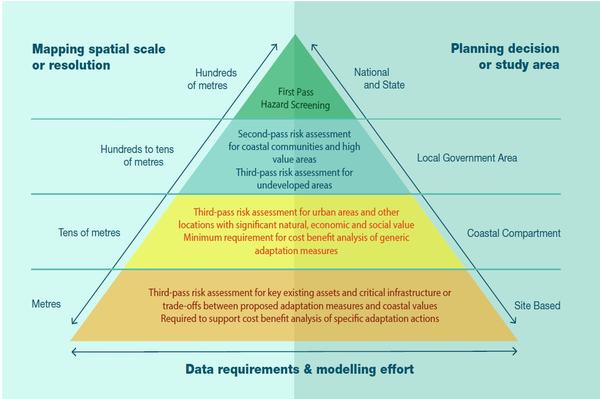
Figure 1: Coastal hazard mapping scale and level of data and modelling effort.
- © Eliot, 2013.Figure #809
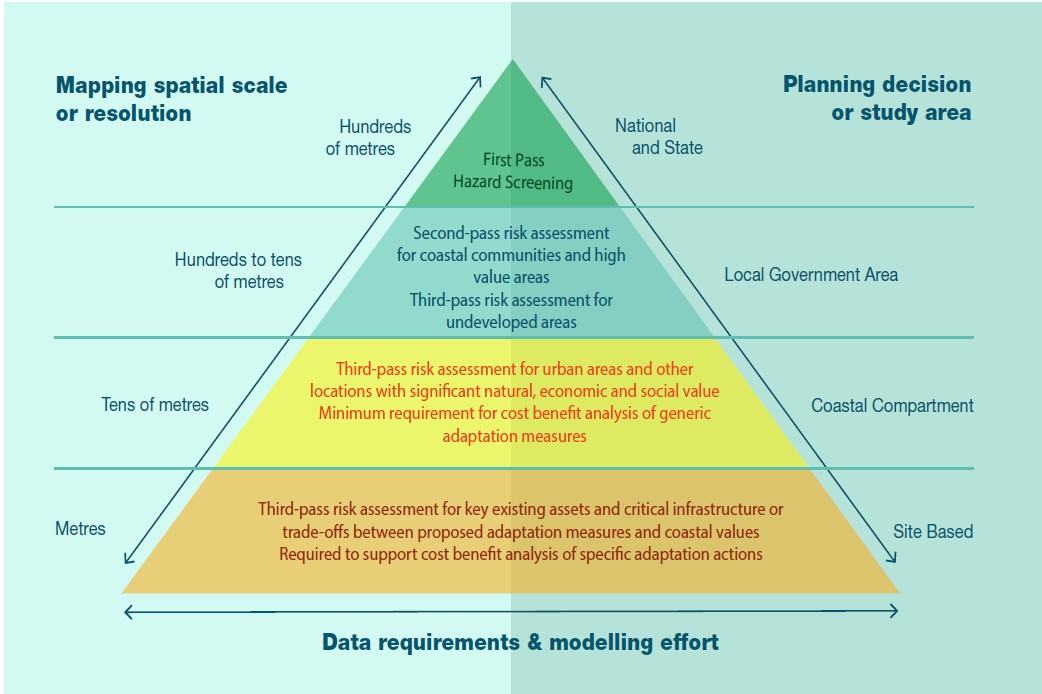
Figure 1: Coastal hazard mapping scale and level of data and modelling effort.
© Eliot, 2013.
It is also useful to clarify hazard assessments versus risk assessments.
- Hazard assessment (and its associated mapping) focuses on estimating the likelihood or probability of a coastal hazard occurring.
- Risk assessment goes further by considering both the likelihood of the hazard and its potential consequences for built assets, communities, and natural environments.
- Tolerance to a particular hazard can vary across a local government area or region, so this variation must be carefully considered during the risk assessment process.
- This guidance considers only:
- hazard assessment and mapping, not the assessment of risks to assets or values within the hazard areas identified by the mapping
- the hazards of coastal inundation and coastal erosion.
Approaches and geographic scales for coastal hazard assessments
Mapping products and other tools for coastal adaptation planning, include:
- National and state-level mapping: Broad-scale datasets for high-level strategic planning and low-risk decisions that affect multiple local government areas or regions. These maps also help identify knowledge gaps and guide more detailed assessments.
- Local government area mapping: Medium-scale assessments used for strategic planning and to develop coastal hazard overlays for planning schemes.
- Coastal sediment compartment mapping: Targeted assessments for decisions impacting a specific coastal compartment or estuary.
- Site-based mapping: Lot-scale assessment and mapping studies for development applications (usually prepared by the applicant) or for evaluating specific adaptation options.
The method used to assess coastal hazards and the level of mapping detail required should match the level of risk to coastal assets and values. For example, evaluating the vulnerability of a densely populated urban area will require a more rigorous approach than assessing an undeveloped stretch of coastline.
The level of modelling and detailed assessment behind different mapping scales can vary considerably. Coastal planners and managers need to understand these limitations and recognise when they require more detailed analysis to support decision-making.
Usually, the preferred approach will involve significant investment in data collection and numerical modelling, which can be time-consuming and costly. Higher-resolution mapping or smaller-scale studies generally demand more extensive data and modelling.
1. National and state-level assessments and mapping
National and state-level coastal hazard maps and visualisation tools provide a broad overview of regional vulnerability and are generally suitable for high-level strategic decision-making.
National and state-level mapping is generally suitable for first-pass risk screening and, in some cases, second-pass risk assessment. Both can help identify knowledge gaps and guide more detailed studies.
However, national and state-level hazard maps are not appropriate for detailed risk assessments. They do not capture critical physical processes or potential adaptation measures, such as seawalls or levees, with sufficient detail. This is because the underlying data (such as digital elevation models) may be relatively high resolution, and the assessments are generally based on regional-scale assumptions. Key coastal processes like nearshore bathymetry, hydrodynamics, and shoreline dynamics are often not accurately represented.
1.2 Summary of data inputs and modelling effort necessary to develop mapping scales: National and state scale
High-level assessment and mapping for low risk decision-making
- Key physics and local scale topography, geology and coastal barrier unresolved
- Hazard mapping is based on inundation or erosion extents
- Single climate change and planning horizon scenarios considered
- Use for first pass risk screening and some second pass risk assessments
Storm tide & inundation
- Present-day HAT + SLR component
- Bathtub or bucket fill mapping approach
- Example: Coastalrisk Australia
Coastal erosion
- Erosion risk based on • permanent inundation of land by present day HAT + SLR component
- Large factor of safety to account simplification
- Example: Qld Coastal Hazard Map index
Minimum data required
- Regional scale coastal geology
- Tidal plane information
- SLR projection
- Topographic LiDAR
resources for national and state-level assessments and mapping:
- Coastal Risk Australia
- CoastAdapt's Shoreline Explorer
- CoastAdapt's Sea-Level Rise and You
2. Local government area assessments and mapping
Local government planning schemes in coastal areas are usually required to include coastal hazard overlay mapping. This level of mapping is commonly used for second-pass risk assessments and, in some cases, third-pass assessments and adaptation planning studies. However, some coastal compartments or communities may need higher-resolution mapping to support detailed risk analysis and informed adaptation decisions.
This section explains the level of assessment and the key physical processes represented in local government area-scale coastal hazard studies. Mapping at this scale typically has a resolution of tens to hundreds of metres and provides the foundation for more detailed methods discussed in later sections.
from examples across Australia, where increasingly councils are implementing this approach.
- Sunshine Coast Council developed a Coastal Hazard Adaptation Strategy (CHAS) with mapping for erosion and storm-tide inundation under future climate scenarios.
- Moreton Bay Regional Council uses coastal hazard overlays in its planning scheme to manage development in storm-tide and erosion-prone areas.
- In Western Australia, many local governments have prepared Coastal Hazard Risk Management and Adaptation Plans (CHRMAPs), which include detailed hazard mapping and modelling to guide local planning decisions.
2.1 Summary of data inputs and modelling effort necessary to develop mapping scales: Local government scale
High-level assessment and mapping
- Assessment and mapping to support regional scale decision making (e.g. hazard overlays for planning schemes)
- Assessment and mapping resolution typically tens to hundreds of metres
- Key physics and local scale topography, geology and coastal barrier unresolved
- Hazard mapping is based on inundation extent and depth and coastal erosion extent and considered likelihood
- One or two climate change and planning horizon scenarios considered
- Suitable for second pass risk assessment and somtimes third pass risk assessment (undeveloped or low value areas).
Storm tide & inundation
- 2D Hydrodynamic modelling to derive HAT variation along study area coastline
- Wind and atmospheric pressure modelling
- Spectral wave modelling to determine offshore wave conditions
- Regional model calibration to nearby tide and wave recording locations
- Wave setup and runup estimates following empirical relationships to determine the influence of waves on storm tide level
- Present-day HAT + Wave influences +SLR component
- Bathtub or bucket fill mapping approach
- Hazard areas defined by depth.
Coastal erosion
- Short term erosion and ‘storm bite’ estimates based on design water level and wave height statistics and simple ‘one-line’ modelling (e.g. Vellinga, 1983)
- Long term recession based on analysis of historical record and longshore sediment transport modelling
- Morphological response to SLR based on simple ‘one-line’ modelling, (e.g. Bruun, 1962)
Minimum data required
- Regional scale coastal geology
- Tidal plane information
- SLR projections
- Topographic LiDAR
- Coastal geology
- Regional scale bathymetry
- Nearshore bathymetry for key locations
- Regional scale wind and atmospheric pressure fields (e.g. CFSR)
- Design water level statistics
- Design wave statistic
- Present day beach profile survey data
- Historical beach profile data
- Beach sediment sample and analysis.
2.2 Coastal inundation hazard
Local government area storm tide hazard studies typically rely on extensive data analysis combined with numerical and parametric modelling of meteorological conditions, coastal processes, and probabilistic methods.
These assessments aim to calculate offshore water level statistics (known as design water levels) and require accurate representation of key physical processes, including:
- regional climatology and modelling of atmospheric pressure and wind fields to drive hydrodynamic and wave models
- bathymetry at sufficient resolution to capture nearshore features, especially where depths are less than 20 m
- tidal variation along the coastline and within estuaries
- surge development and propagation
- wave growth and nearshore conditions, which can significantly influence extreme water levels on open coasts.
The primary goal of these studies is to establish design water levels at multiple locations along the coastline and within estuaries, considering both current and future climate scenarios. These water levels are then used to create coastal inundation hazard maps, often through a simplified 'bathtub' or 'bucket-fill approach, which extrapolates water levels over land.
This method produces consistent mapping across the local government area and is commonly used for planning scheme overlays and strategic land-use decisions, as well as second-pass risk assessments.
Development applications or critical assets usually require site-based assessments (see section below on site-based assessments).
At some locations, you might need to consider additional coastal processes, and you ight require an overland flow velocity to support a comprehensive risk assessment. In these cases, it is also useful to have higher-resolution mapping. The outputs from a storm tide study can serve as inputs for more advanced numerical models, enabling detailed mapping for specific coastal compartments or communities.
This approach is discussed further in Section 3 on coastal compartment assessments and mapping.
2.3 Coastal erosion hazard
Local government coastal erosion hazard assessments generally aim to:
- describe local coastal geology and evolution
- identify and map coastal compartments based on attributes such as wave exposure, geological framework, sediment availability, and orientation
- understand contemporary coastal processes, including:
- sediment supply and transport pathways
- historical shoreline trends
- design water levels and wave conditions (often informed by storm tide studies)
- provide erosion hazard assessments for key locations or communities, considering:
- long-term trends driven by sediment transport gradients between compartments
- storm erosion potential under current climate conditions
- risks of land loss from dune slumping or coastal landslip
- shoreline response to sea-level rise
- map the erosion hazard area likelihood for specific planning periods of interest.
Local government-scale erosion mapping typically provides enough detail for second-pass risk assessment. For undeveloped or low-value areas, it may also sufficient for third-pass assessments.
However, densely populated coastlines or areas with significant economic, social, or environmental value usually require more detailed studies to support sound adaptation decisions. These cases are likely to require site-based assessments of erosion potential and mitigation measures for development applications or critical infrastructure.
These approaches are discussed further in Sections 3 and 4.
3. Coastal compartment assessments and mapping
Identifying coastal compartments provides a robust framework for assessing hazards and risks and for developing adaptation pathways tailored to local conditions. Coastal compartments are organised in a hierarchical system with nested primary, secondary, and tertiary elements.
CoastAdapt's coastal How to use the sediment compartment approach.
This describes the characteristics and susceptibility to change of 359 compartments around the Australian coastline. This can support first pass risk screening and, for some instances, also a second pass risk assessment.
Urban areas or locations with significant economic, social, or environmental value are likely to need a third pass risk assessment: typically, this will require refined compartment-scale hazard mapping underpinned by the output of a calibrated and validated numerical model.
These coastal compartment assessments often build on national, state, and local assessments and use higher-resolution mapping (in the order of tens of metres). They aim to represent additional coastal features and processes, such as:
- geology across the compartment, possibly informed by geotechnical surveys
- coastal inundation flow velocity (not just depth and extent like the more limited bathtub approach)
- overtopping of coastal barriers by waves
- coincident catchment flooding and coastal inundation hazard assessment
- short-term storm erosion potential due to storm events
- long-term erosion trends due to gradients in sediment
- changes in shoreline and beach profile due to sea-level rise
- cyclic behaviour of river entrances or channel migration (if relevant.
This level of assessment is generally required for 'residual risk' or 'risk treatment' assessments of major adaptation options that influence an entire coastal compartment. Examples include a large-scale beach nourishment, seawall construction, or land-use controls.
These residual risk assessments are often combined with decision-making tools like multi-criteria analysis and cost-benefit analysis to identify the most suitable adaptation strategy for a specific location or asset.
3.1 Summary of data inputs and modelling effort necessary to develop mapping scales: Coastal compartment scale
Hazard mapping & assessment scale
- Assessment and mapping to support individual coastal compartment or community decision making.
- Assessment and mapping resolution typically tens of metres.
- Typically needed to support a specific management action or adaptation strategy.
- Key physics and local scale topography, geology and coastal barrier considered.
- Hazard mapping is based on inundation extent and depth and velocity and coastal erosion extent.
- Multiple climate change and planning horizon scenarios considered.
- Needed to support third-pass risk assessment for urban areas and locations with significant economic, social and natural value.
Storm tide & inundation
- 2D Hydrodynamic modelling to derive HAT variation along study area coastline.
- Wind and atmospheric pressure modelling.
- Spectral wave modelling to determine offshore wave conditions.
- Wave setup and runup estimates following empirical relationships to determine the influence of waves on storm tide level.
- Detailed model calibration and validation to locally recorded datasets.
- Overtopping of coastal barriers modelled and considered detail (e.g. EurOtop II, 2016).
- Mapping based on inundation modelling.
- Hazard areas defined by depth and velocity considerations.
- Coincident catchment flooding scenarios to assess lower river and estuarine impacts.
- Potential hazard mitigation option assessment.
Coastal erosion
- Short term erosion and ‘storm bite’ based on process-based models (e.g. Roelvink et al., 2009)
- Parametric equilibrium shoreline evolution models such as CEMOD (e.g. Rollason et al., 2010b; Patterson,2013) for short term and long term combined alongshore and cross shore erosion impacts
- Long term recession based on analysis of historical record, longshore sediment transport and/or shoreline evolution modelling such as EVO (Teakle et al., 2013)
- Probabilistic coastal response modelling (refer to Woodroffe et al., 2012)
- Landslip considerations
- Erosion due to lower river and estuary channel migration
- Potential hazard mitigation option assessment.
Minimum data required
- Detailed coastal geology
- Detailed nearshore bathymetry
- Local water level, wave, wind and atmospheric pressure recordings
- Beach profile survey data
- Historical beach profile data
- Local geotechnical survey data
- Beach sediment sample and analysis
- Lower river water level and stream flow recordings.
4. Site-based assessments and mapping
Site-based assessment and mapping are often required to evaluate the current and future hazard vulnerability of key assets and critical infrastructure, understand how risk profiles may change over time, and develop appropriate adaptation strategies.
These detailed investigations are also commonly needed when assessing proposed developments located within a local government coastal hazard overlay. Such technical studies are usually commissioned by the applicant and reviewed by local government and other regulatory agencies.
A site-based coastal hazard assessment typically considers the key physical processes outlined in previous sections but at lot scale (resolution is in the order of metres).
This level of detail goes beyond what is required for most strategic planning or adaptation studies. However, it becomes essential when evaluating specific adaptation options as part of a broader design process or when you need to carefully consider trade-offs between proposed measures and coastal values.
4.1 Summary of data inputs and modelling effort necessary to develop mapping scales: Site-based scale
Hazard mapping and assessment scale
- To support the assessment of key existing assets, critical infrastructure or proposed development on land within the local government coastal hazard overlay.
- Assessment and mapping resolution typically less than ten metres
- Assessments and mapping commissioned by the applicant and assessed by local government and other regulatory agencies
Storm tide inundation
(same as coastal compartment scale)
- 2D Hydrodynamic modelling to derive HAT variation along study area coastline
- Wind and atmospheric pressure modelling
- Spectral wave modelling to determine offshore wave conditions
- Wave setup and runup estimates following empirical relationships to determine the influence of waves on storm tide level
- Detailed model calibration and validation to locally recorded datasets
- Overtopping of coastal barriers modelled and considered detail (e.g. EurOtop II, 2016)
- Mapping based on inundation modelling
- Hazard areas defined by depth and velocity considerations
- Coincident catchment flooding scenarios to assess lower river and estuarine impacts
- Potential hazard mitigation option assessment
Coastal erosion
(same as coastal compartment scale)
- Short term erosion and ‘storm bite’ based on process-based models (e.g. Roelvink et al., 2009)
- Parametric equilibrium shoreline evolution models such as CEMOD (e.g. Rollason et al., 2010b; Patterson,2013) for short term and long term combined alongshore and cross shore erosion impacts
- Long term recession based on analysis of historical record, longshore sediment transport and/or shoreline evolution modelling such as EVO (Teakle et al., 2013)
- Probabilistic coastal response modelling (refer to Woodroffe et al., 2012)
- Landslip considerations
- Erosion due to lower river and estuary channel migration
- Potential hazard mitigation option assessment.
Minimum data required
- Detailed coastal geology
- Detailed nearshore bathymetry
- Local water level, wave, wind and atmospheric pressure recordings
- Beach profile survey data
- Historical beach profile data
- Local geotechnical survey data
- Beach sediment sample and analysis
- Lower river water level and stream flow recordings
- Design details of the existing asset or proposed development.