


At a glance
Models can provide detailed insights into coastal inundation and erosion risks across a range of spatial scales and under different climate and storm scenarios. However, their complexity and the demands for input data often restrict their application to specific locations.
Detailed, local-scale modelling should generally be undertaken only after a preliminary risk assessment has identified vulnerable areas, such as low-lying regions or sites containing high-value infrastructure.
Two broad categories of models are commonly used: empirical models and process-based numerical models. Each has its own strengths and limitations, and the choice between them depends on the site context, available resources, and the relevant planning timeframe.

Why use models?
Models help represent complex coastal processes by improving predictions of sea level change and shoreline impacts that are beyond the scope of simple methods.
Historically, a simple 'bathtub' or 'bucket-fill' approach has been used to assess coastal inundation and associated erosion risk from rising sea levels. Bathtub models assume that all areas below a projected sea level rise, plus the highest astronomical tide, will be inundated.
Bathtub modelling is a relatively simple and efficient means of identifying areas likely to be at risk and has been completed for much of Australia’s populated coastal areas (e.g. CoastAdapt's Sea-level Rise and You and Coastal Risk Australia).
Beyond the bathtub
The bathtub approach, while useful, has a range of limitations. The bathtub approach assumes the land elevation and geomorphology remain constant but neglects the dynamic components of sea level that can increase sea levels further.
The bathtub approach also provides no information on the amount of shoreline erosion other than the shoreline recession due to the increase sea level alone. Sea levels fluctuate across a number of time scales, from seconds to weeks associated with a range of processes in the ocean. In addition to tides, sea levels vary due to waves (set-up and run-up), storm surge (wind driven and barometric set-up) and changes in ocean circulation. Each of these processes can increase sea level by tens of centimetres to more than a metre (Figure 1).
An example of the importance of dynamic processes:
A study of historic extreme sea level events in Western Australia found all occurred as a result of a combination of components including astronomic tides and non-tidal sources, such as storm surge. Only in recent years did sea level rise begin to be an important component of the total sea level during extreme sea level events (Lowe et al 2021).
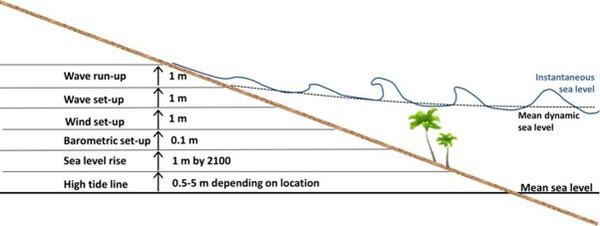
Figure 1: Example of some of the components of sea level and indicative orders of magnitudes.
Bold black line indicates current mean sea level. Dashed black line indicates the mean sea level profile including all dynamic components (the variation in the cross-shore is due to the wave set-up profile). Blue line is the instantaneous sea level including wave run-up.
- © Jeff Hansen.Hansen fig 1
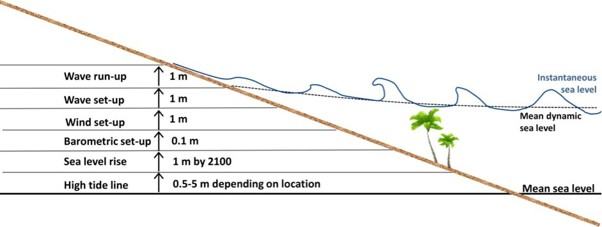
Figure 1: Example of some of the components of sea level and indicative orders of magnitudes.
Bold black line indicates current mean sea level. Dashed black line indicates the mean sea level profile including all dynamic components (the variation in the cross-shore is due to the wave set-up profile). Blue line is the instantaneous sea level including wave run-up.
© Jeff Hansen.
The physical processes that result in these dynamic sea level variations are generally well understood and included in a range of modelling approaches. These models can provide a detailed local scale assessment of inundation risk if based on appropriate input data. Similarly, a range of models can be used to understand erosion risk as a result of climate change.
In many numerical models, erosion (and accretion) can be modelled simultaneously with inundation; or erosion can be modelled independently using empirical relationships between numerically modelled or statistically derived physical forcing (e.g. waves and winds) and erosion.
Predictions of erosion risk are typically less accurate than those for inundation due to the inherent complexity of sediment transport. However, a range of models can still provide detailed and useful information on areas that are likely to erode in response to climate change.
An overview of models
There are two primary classes of models used to predict coastal inundation and erosion: empirical (data-driven) models and process-based numerical models. Neither type of models is perfect: each has strengths and limitations that directs how they can be usefully applied.
Empirical models
Empirical models are created by developing a mathematical model that best reproduces a set of observed data: the model can then be applied predictively. For example, empirical models have been created to predict wave run-up from offshore wave height and beach slope.
Empirical models generally, do not directly account for the relevant physical processes; rather, the relevant processes are implicitly included in the derived empirical relationship.
- The advantage of empirical models is that they are relatively simple and easy to apply.
- The key disadvantage of empirical models is that their development requires extensive local observations, which also means they are specific to the sites at which they were developed or to sites with similar morphology.
Process-based models
Process-based numerical models consider the relevant physical processes and the resulting inundation and erosion. For the coast, these processes include wave propagation, growth due to wind, wave breaking, as well as the currents and sea level variations (see Figure 1).
Process-based numerical models are important for:
- estuary environments: rising sea levels may alter estuary area, tidal circulation and dynamics, salinity, and freshwater inputs, making areas more or less likely to experience inundation and erosion.
- high-risk areas where dynamic processes (e.g. waves and storm surge) significantly influence inundation and erosion outcomes.
Advantages of process-based models are:
- results are related directly to the site being modelled
- they range in complexity: from predicting wave height and set-up across a simple cross-shore transect, to predicting inundation within an estuary using a three-dimensional coastal model that includes wind, waves, salinity, and atmospheric pressure.
Disadvantages of process-based models are:
- complexity: this advantage is also a disadvantage as the modelling and analysis are likely to require specific training and experience and access to appropriate computing resources
- data requirements: accurate predictions depend on detailed input conditions; for example, without reasonably detailed bathymetry, numerical predictions of inundation and erosion are unlikely to be accurate enough to warrant the cost and effort required.
- uncertainty in sediment transport modelling: most coastal and estuarine numerical models also include sediment transport modules that can estimate erosion and accretion over a range of spatial and temporal scales. However, the sediment transport formulations can be prone to error (see a review by Amoudry and Souza 2011).
Combining the two types of models
Empirical and process-based models can be combined to take advantage of their respective strengths. For example, the output of several process-based numerical simulations can be used as the basis of an empirical probabilistic model of inundation and erosion; or an empirical statistical model can be used to generate the input conditions for a process-based numerical model (e.g. Callaghan et al. 2008).

a useful overview on coastalwiki about:
- numerical models: Modelllng coastal hydrodynamics
- applying models: How to apply models
Using models: screen first, model later
1. Start with a first pass risk assessment using readily available data
Due their complexity and input requirements, using detailed models across large spatial scales is often impractical, and may not be necessary. A practical first step is to undertake a first pass (screening) risk assessment using existing bathtub inundation predictions under a range of sea-level rise scenarios. This approach can identify areas where a numerical model is needed to provide additional information on inundation and erosion risk, such as those associated with a storm event.
For example.
- For a high relief coastline fronted by stable sea cliffs, the bathtub approach may be sufficient, with little additional value gained from more complex modelling.
- However, for a coastal area with low crested dunes, better understanding the contributions of dynamic sea level variability could determine if inundation will occur under different sea level rise scenarios. This would warrant the use of a more complex model.
- guidance for a first pass assessment
- the basics of different types of risk assessment
- undertaking a first pass risk assessment
- resources for undertaking risk assessments in Explainers, templates and 'how to'
Data sources for a first pass assessment
There are a number of Australian data sources to support a first pass assessment. For example.
- CoastAdapt's Sea Level Rise and You has inundation mapping for each coastal council to 2150.
- Coastal Risk Australia has a wide range of sea-level scenarios
(Both sites use bathtub modelling and have inundation mapping only for areas where LiDAR or similarly high accuracy/resolution survey data is available.)
Data portals
- Data portals such as AusSeabed and Elvis provide coastal topographic and bathymetric data sets useful for first pass assessments and subsequent analysis.
2. Then, if necessary, use more a detailed model
Where a more detailed assessment is required, a more complex model can be used in low-lying coastal and estuarine areas, where detailed information will help assess, for example,
- communities or structures at risk
- locations where additional inundation may alter the mitigation strategy
- locations identified to be at risk by regional scale modelling.
Any local scale erosion modelling will also need to consider regional sediment transport patterns and sediment availability. These may change as a result of climate change and human intervention and structures along the coast. For example, a decline in rainfall may result in a decrease in sediment delivered to estuaries and the coast from catchments: this could result in erosion irrespective of sea level changes.
about the likely climate change impacts on sediments in the CoastAdapt resources:
- Explaining coastal sediments
- Shoreline Explorer, which includes data on sediment compartments and Smartline. This information can be used in concert with any local scale modelling.
What data are needed for modelling and what is available?
Bathymetry and topography data
For areas or locations where modelling will provide additional detail, there needs to be sufficient data available to initialise the models. Numerical models, in particular, rely on bathymetry/topography at a high enough spatial resolution to resolve features that will impact the waves, currents, tides and ultimately the inundation and erosion. Generally, this will be gridded elevation data with a resolution of about 5-25 m.
Accurate bathymetry in shallow water is critical for realistic predictions of inundation and erosion for both empirical and process-based models. Therefore, if an initial screening through a first pass assessment identifies an area as high risk, then it may therefore be necessary to collect detailed bathymetric data for the area.
This is particularly important for estuaries where increasing sea levels will alter the estuary area, geometry and corresponding tidal dynamics. These changes will subsequently impact patterns of inundation and erosion.
It is also important to consider changes in bathymetry over time in shallow nearshore areas: older survey data may no longer reflect current bathymetry or topography.
Suitable resolution topographic and bathymetric data sets are available on public portals such as AusSeabed and Elvis.
Suitable resolution topographic and bathymetric data sets are available on public portals such as AusSeabed and Elvis.
The availability of these datasets at a national scale is increasing through a range of state based and Commonwealth programs, such as the Australian Hydrographic Office HydroScheme Industry Partnership Program, which aims to map all of Australia’s Exclusive Economic Zone by 2050.
Environmental data
Environment conditions are required to drive both empirical and process-based models. However, running high-resolution coastal models over long time periods to understand coastal inundation and erosion is often impractical.
To address this, methodologies have been developed to statistically synthesize a vast array of variables (i.e. combinations of wave height, rainfall, wind speed, storm sequences etc.) into a subset of conditions likely to cause the most inundation and erosion.
This often involves developing synthetic conditions using statistical models based on time series of observed or predicted environmental conditions.
For example:
- Callaghan et al. 2008 applied a comprehensive method to determine the beach (Narrabeen, NSW) erosion hazard using statistical methods
- Ranasinghe et al. 2012 developed and applied a process based model (PCR model) which provides probabilistic estimates of SLR driven coastal recession that is more defensible than use of the Brunn Rule.
- Cagigal et al. 2020 developed a stochastic climate-based wave emulator as a tool for probabilistic assessments of coastal hazards and it generates infinitely long data series maintaining historical properties at different time scales.
The advantage of synthetic conditions is that they can be based on historic extreme events or on expected average return interval (ARI) events under a range of climate scenarios.
Recent investment by Commonwealth and State Governments has greatly increased both the number and geographic distribution of wave buoy observations - described and linked in the box below.
- Data from wave buoy observations via:
- Auswaves, part of the Integrated Marine Observing System (IMOS), hosts the Coastal Wave Buoys facility that collects essential data for understanding coastal processes and changes driven by waves and ocean water temperature.
- Australian Ocean Data Network, the data portal for Australian marine and climate science data.
- Some of these datasets have relatively high resolution (<500 m) in coastal areas that can be used to derive synthetic conditions and examine past events.
- Numerical hindcasts
- e.g. Wave Hindcast for the Australian Climate Service (WHACS), an ocean wave hindcast running from 1979 to the present (currently 2023) (Smith et al. 2024).
- These numerical hindcast can also be used to provide boundary conditions for high-resolution numerical models used to assess erosion and inundation risks.
Available models and their limitations
Empirical models
There are a vast array of empirical models, with most developed and tailored to produce a specific output (e.g. shoreline erosion). For example, those by:
- Stockdon et al. (2006) that predicts wave set-up and run-up using offshore wave height, wave period and beach slope
- Hapke and Plant (2010) that probabilistically predicts coastal cliff erosion.
- Yates et al. (2009) that predicts shoreline change based on the dis-equilibrium between the current beach morphology and wave conditions.
However, empirical models do not explicitly model physical processes and so are often only relevant at the sites they were developed, or at those with very similar morphology.
For example, a commonly used empirical model for coastal recession due to rising sea levels is the Bruun rule (Bruun 1962). Essentially, the Bruun Rule predicts that the coastal profile will maintain a constant shape and will just migrate landward to accommodate rising sea level. However, it assumes an entirely sandy coast backed by dunes and thus would be completely inappropriate to apply along rocky or reef coasts.
- a simple explanation in CoastAdapt's Explainer: The Bruun Rule
- a more detailed mathematical explanation of the Bruun Rule is on the coastal wiki Bruun Rule for shoreface adaptation
Process models
The performance of process-based numerical models at predicting inundation and erosion has improved in recent decades (see box below). Each of these models operates somewhat differently, but all are capable of predicting inundation and erosion.
Process-based numerical models aim to explicitly account for a range of processes, and therefore they can be applied in a wider range of environments (e.g. rocky and sandy coasts).
Similar to empirical models however, it is important to select a numerical model that considers processes that are likely to be important. For example, XBeach does not account for salinity variations and so it would be an inappropriate model to use in an estuarine environment.
Examples of commonly used process-based numerical models include:
- modelling suite software, Delft3D, coupled with the wave model SWAN, a third-generation wave model that computes random, short-crested wind-generated waves in coastal regions and inland waters
- XBeach, an opensource community website, is a two-dimensional model for wave propagation, long waves and mean flow, sediment transport and morphological changes of the nearshore area, beaches, dunes and backbarrier during storms.
- Mike21, a commercial software solution for water modelling and simulation by DHI.
(all sites accessed 1 May 2026).
Calibrating models
Once a model is selected and set up it will need to be calibrated and validated using observations to ensure realistic predictions are being made. This may include comparing predicted waves, currents, and shoreline erosion with conditions observed during a large storm. Before deciding to use a model to assess erosion and inundation risk it is import to consider what if any data is available for model calibration and validation. The complexity and computational infrastructure required to run numerical models and interpret their results will generally require contracting consulting companies or universities with expertise in modelling.
Emerging AI-based methods
Increasingly, machine learning or other data driven methods are being developed to predict:
- shoreline change
- e.g. Simmons and Splinter, 2025, an autoregressive neural network approach has been applied to predict shoreline change over daily to yearly timescales
- e.g. Manamperi et al., 2026 describe deep learning (DL) techniques, particularly for shoreline forecasting at monthly to inter-annual timescales, under two modelling approaches - direct input (DI) and autoregressive (AR)
- coastal water levels
- e.g. Shahabi and Tahvildari, 2024, outlined field measurements including wave, current, and suspended sediment concentration around a nature-based strategy in Virginia, USA.
These models often have the advantage of being much faster than transitional numerical models, while being able to make predictions of similar variables and skill. However, these approaches are nascent and still require development and validation. Like many traditional empirical models they may also be site specific or limited in application to settings and conditions similar to the data from which they were trained.
Examples of using models to assess inundation and erosion
Coastal Storm Modelling System: California example
One example of the use of models to assess coastal inundation and erosion risk is the Coastal Storm Modelling System (CoSMoS, Barnard et al. 2014) established by the US Geological Survey along portions of the California (USA) coastline.
CoSMoS is a comprehensive approach to estimate coastal inundation and erosion risk. The system uses a nested modelling system in which different process-based numerical models are run sequentially, with each providing the boundary conditions for subsequent models.
- An advantage of the nested approach is its scalability: once the modelling system has been set up, it is relatively easy to add additional local area models.
- Although complex, this approach captures the physical links between the larger scale processes (such as, in an Australian context, this could be an East Coast Low in the Tasman Sea) and local-scale inundation and erosion. Therefore, this will give the most realistic assessment of inundation and erosion risk.
How it works
The nested approach begins by creating regional (~100 km scale) or global wind and wave boundary conditions for both historical and projected conditions.
Historical conditions are derived from direct observations (e.g. wave buoys and weather stations) as well as global coupled ocean-atmosphere numerical simulations available for previous decades (reanalysis products). Historical conditions are useful for model calibration/validation as well as for evaluating model performance from past events that led to coastal inundation and erosion.
Predictions of future wind, atmospheric pressure and waves are available from global ocean-atmosphere models based on a range of the Intergovernmental Panel on Climate Change (IPCC) CO2 emissions and concentration scenarios (e.g. from the Coupled Model Intercomparison Project). These are used to develop projected annual, 20 and 100 year ARI events. Climate change is expected to alter storm tracks and characteristics and so, in many locations, historical ARI events are likely to differ from the projected events.
The regional wave, water level, wind and atmospheric pressure conditions produced from the global models are then used as boundary conditions for a higher resolution coupled circulation-wave model (e.g. Delft3D coupled with SWAN) that extends to offshore of the continental shelf break (~100 m depth) and has an intermediate resolution (~25-250 m). The coupled wave-flow model propagates waves onshore while also including wind growth of waves, currents and atmospheric set up.
The regional models are then used to provide the boundary conditions for local-scale models that cover the area(s) identified to be at most risk in the first-pass assessment. These local models will have a higher resolution (~5-15 m), needed to adequately resolve the wave and wind setup at the shoreline, and thus provide better predictions of inundation.
- CoSMoS uses Delft3D and SWAN for the regional models and XBeach for the local models.
- XBeach has the advantage that it includes wave run-up from infragravity waves (waves with periods of 30-300 seconds that often account for the largest amount of run-up at the shoreline).
Using the nested approach, CoSMoS has produced inundation and erosion maps for portions of the California coast and compiled the output into a publicly available web tool: Our Coast Our Future (Ballard et al. 2014). This allows inundation, wave heights, currents and duration to be examined under a range of different sea-level rise scenarios coupled with projected ARI storm events.
Figure 2 shows example output from CoSMoS from Mission Beach, California, and considers a 1m static rise in sea level (Figure 2a) as well as with a 1m rise in sea level plus the projected 20-year ARI storm (Figure 2b). This example shows that including the wave and atmospheric effects results in considerably more inundation than the bathtub approach.
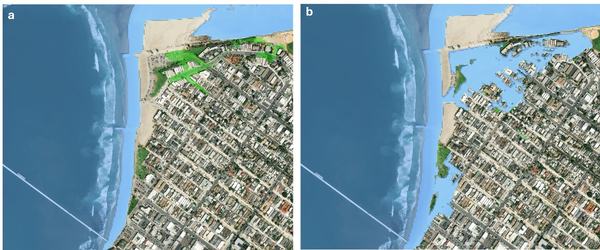
Figure 2: Inundation map of Mission Beach, California (USA), produced by CoSMoS .
a: Inundated (blue) or flood-prone (green) areas with sea level 1m above present.
b: Inundated and flood prone areas considering 1m of sea-level rise as well as the projected 20 year ARI storm event.
Data source: Data are from the USGS Coastal Storm Modeling System (CoSMoS v3.0), accessed via the Our Coast Our Future web platform (Point Blue Conservation Science and USGS 2026).
- Barnard et al. 2018.Fig 2
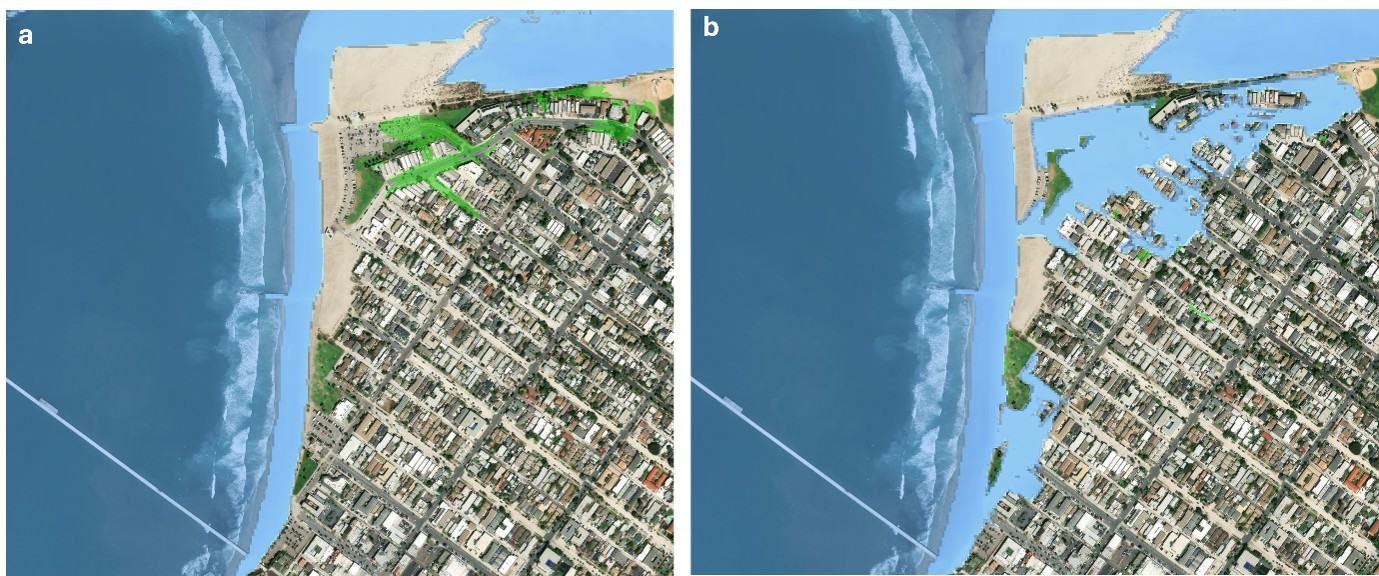
Figure 2: Inundation map of Mission Beach, California (USA), produced by CoSMoS .
a: Inundated (blue) or flood-prone (green) areas with sea level 1m above present.
b: Inundated and flood prone areas considering 1m of sea-level rise as well as the projected 20 year ARI storm event.
Data source: Data are from the USGS Coastal Storm Modeling System (CoSMoS v3.0), accessed via the Our Coast Our Future web platform (Point Blue Conservation Science and USGS 2026).
Barnard et al. 2018.
Example: Busselton, Western Australia
In Busselton, Western Australia, a similar approach was undertaken by Martin et al. (2014) to investigate projected inundation and erosion under a range of climate scenarios. In this study, the inundation was predicted using process-based numerical models with numerous combinations of:
- sea-level rise
- riverine flooding
- increased water levels due to a cyclone modelled after Tropical Cyclone Alby that impacted the area in 1978.
In this example, shoreline erosion was modelled over a range of time horizons (out to 2300) empirically considering rising sea levels, sediment supplies, and substrate.
Unlike the CoSMoS example, erosion was modelled independently of inundation in order to incorporate regional scale variability in sediment supply and substrate, which may dominate shoreline erosion patterns farther in the future (>2100).
Similar to the CoSMoS example, this example showed that storm conditions results in considerably more inundation than from sea-level rise alone (Figure 3).
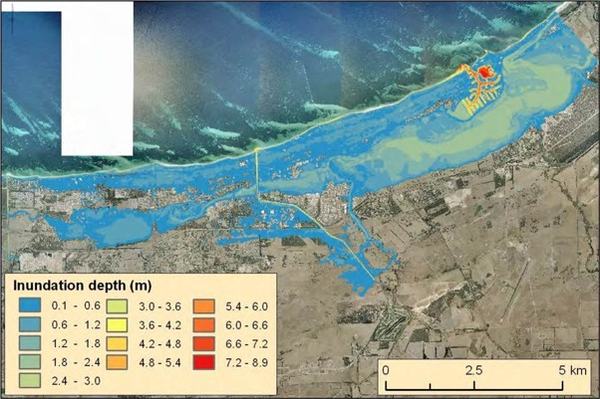
Figure 3: Predicted inundation of Busselton, WA, with 1.1 m of sea level rise, a 100 year ARI flood and worst case cyclone track.
- Source: Martin et al. 2014, © Commonwealth of Australia (Geoscience Australia) and Government of Western Australia (Department of Planning and Planning Commission) 2014.Fig 3
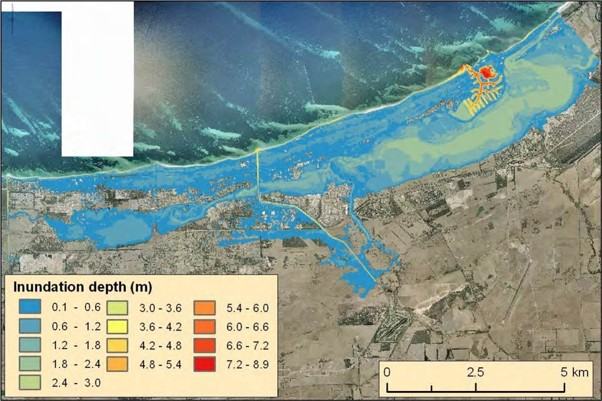
Figure 3: Predicted inundation of Busselton, WA, with 1.1 m of sea level rise, a 100 year ARI flood and worst case cyclone track.
Source: Martin et al. 2014, © Commonwealth of Australia (Geoscience Australia) and Government of Western Australia (Department of Planning and Planning Commission) 2014.
Future framework
For predicting present day coastal erosion and inundation risk in Australia, Turner et al (2024) present a framework based on a similar approach to that of CoSMoS with downscaling of global models to the beach scale. However, further efforts are needed to operationalise such a framework nationally and extend it into the future under different climate projection scenarios.
To cite:
Hansen, J. 2026. Modelling tools to assess local scale inundation and erosion risk. CoastAdapt, National Climate Change Adaptation Research Facility, Gold Coast.