


At a glance
- Marine heatwaves are prolonged periods of unusually warm ocean temperatures that can dramatically disrupt marine ecosystems.
- Australian coastal waters are projected to experience more intense and frequent marine heatwaves in the future.
- They pose serious challenges to coastal and marine species and ecosystem, industries, and coastal communities that depend on them.
- They can also exacerbate land-based heatwaves and amplify extreme weather events like hurricanes and storms.
- Recent marine heatwaves – particularly in nationally significant ecosystems from the Great Barrier Reef to the Great Southern Reef and also around Ningaloo Reef and Shark Bay in Western Australia – highlight the urgent need for adaptive management through increased research and monitoring, communication and community engagement.
- However, there are some opportunities that arise from marine heatwaves: they can lead to new opportunities as some species move into an area.

Marine heatwaves in Australia
Marine heatwaves (MHWs) are increasingly recognised as a significant consequence of anthropogenic climate change, with far-reaching ecological and socio-economic implications. These events, characterised by sustained periods of anomalously high sea surface temperatures, are intensifying in frequency and duration as oceans absorb the majority of excess heat from greenhouse gas emissions.
Globally, MHWs contribute to the degradation of critical marine habitats such as coral reefs, kelp forests, and seagrass meadows, disrupting biodiversity, fisheries, and carbon storage. They also interact with atmospheric systems, amplifying terrestrial heatwaves and extreme weather events, thereby reinforcing broader climate change impacts.
Australia is particularly vulnerable to MHW due to its exposure to warm ocean currents and its reliance on diverse and sensitive marine ecosystems. Iconic regions such as the Great Barrier Reef and the Great Southern Reef have already experienced severe consequences due to MHW, including mass bleaching and habitat loss. These changes pose substantial risks to ecological integrity, economic sectors, and cultural practices, especially for Indigenous communities.
What is a marine heatwave
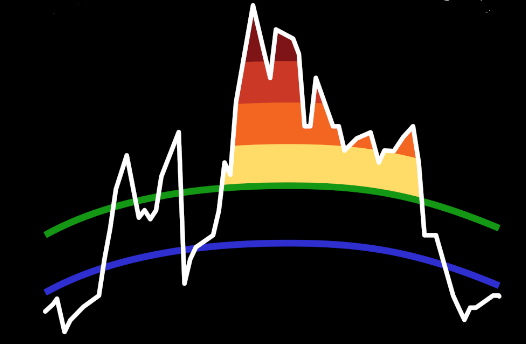
A marine heatwave is a prolonged period of unusually warm ocean temperatures
Specifically, it occurs when sea surface temperatures exceed the 90th percentile of the long-term average for at least five consecutive days. This definition depends on the location and season, which means a marine heatwave in the Great Barrier Reef in northern Australian is significantly warmer that a marine heatwaves in the Great Southern Reef that runs across the Australian southern coast.
A marine heatwave results from a complex mix of factors that include:
- atmospheric conditions: prolonged high pressure systems that reduce cloud cover and wind to allow the rapid warming of surface waters
- ocean currents: such as shifts in the East Australia current and the Leeuwin current that then can extend warm waters into cooler areas
- large scale climate drivers such as El Niño and La Niña events can increase sea surface temperatures: for example El Niño-Southern Oscillation event can increase the intensity and length of a warming event. on Australia's east coast, while La Niña is often associated with marine heatwaves on the west coast.
There is also increasing evidence of links between land and marine heatwaves. They appear to have common drivers. Plus when land and marine heatwaves occur together, they appear to interact with each other to influence the characteristics of one or both events.
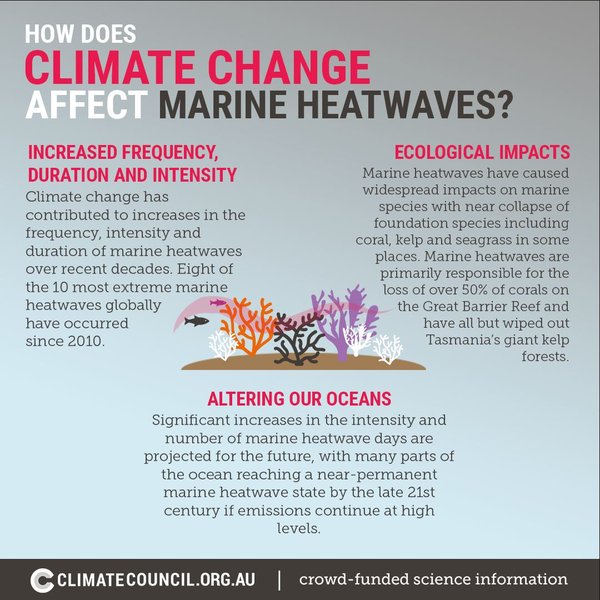
The Climate Council has produced this infographic as part of its communication guides
- @ Climate Council 2022Climate Council_marine heatwaves infographic
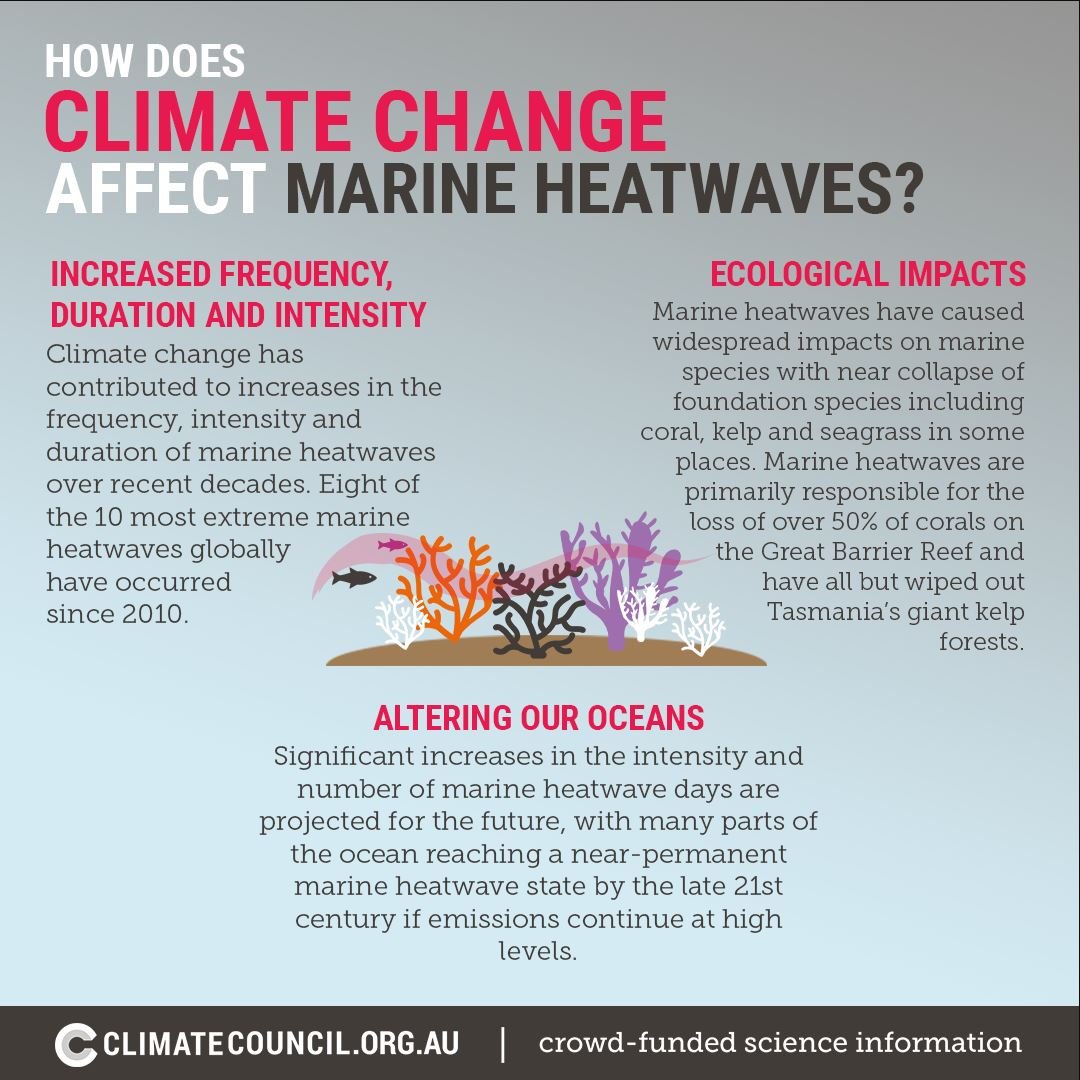
The Climate Council has produced this infographic as part of its communication guides
@ Climate Council 2022
Heatwaves can have hidden depths
Marine heatwaves may extend deep below the surface of the ocean, especially off the coast of eastern Australia.
These subsurface marine heatwaves are influenced by ocean dynamics including seasonal stratification (temperature differences that restrict mixing of layers), local winds that help the water mix, and large scale ocean currents.
Subsurface marine heatwaves need to be monitored below the surface to enable accurate detection and monitoring and modelling that is critical for adaptation. They are not easily detected by satellites. Subsurface marine heatwaves can have greater impacts in ecosystems that live on or near the seafloor.
marine heatwave working groups_icon
resources from the International Working Group on Marine Heatwaves, which also collects tracking information on marine heatwaves.

resources from the International Working Group on Marine Heatwaves, which also collects tracking information on marine heatwaves.
marine heatwave working groups_icon
resources from the International Working Group on Marine Heatwaves, which also collects tracking information on marine heatwaves.
Recent examples of marine heatwaves in Australia
Australia has experienced several significant marine heatwave events over the past two decades, each with distinct ecological and socio-economic consequences.
One of the most severe events occurred in 2010–2011, when a prolonged marine heatwave in coastal Western Australia led to sea surface temperatures rising 2–4°C above the long-term average, with peaks reaching 5°C. This event persisted for approximately ten weeks and caused widespread ecological disruption, including the loss of temperate kelp forests, mass seagrass die-off in Shark Bay, and shifts in species distributions. The ecological changes also had cascading effects on fisheries, tourism, and Indigenous communities.
In 2015–2016, the Tasman Sea experienced an unprecedented marine heatwave, which was among the most intense recorded in the region. This event contributed to ecosystem stress and was linked to broader climate anomalies, including El Niño conditions.
The Great Barrier Reef has been particularly affected by recurrent marine heatwaves, with five major bleaching events documented in 2016, 2017, 2020, 2022, and 2024. These events have led to extensive coral mortality, structural degradation of reef systems, and long-term shifts in reef ecology. The cumulative impact of these heatwaves underscores the vulnerability of tropical reef systems to thermal stress and the urgent need for adaptive management.
These examples illustrate the increasing frequency, intensity, and geographic spread of marine heatwaves in Australian waters, reflecting broader trends in ocean warming and climate variability.
Australia is projected to experience stronger, longer, and more frequent marine heatwaves. These changes are already being observed, and they are likely to worsen without action on mitigation.
Under a high-emissions scenario, areas such as the Tasman Sea may face near-permanent marine heatwave conditions by 2100. Similarly, Western Australia's coastline, influenced by the Leeuwin Current, is expected to experience recurrent thermal anomalies, with significant implications for temperate ecosystems such as kelp forests and seagrass meadows. The northern tropical waters, including the Great Barrier Reef, are also highly susceptible, with projections indicating increased frequency of coral bleaching events and ecosystem degradation.
The southern coast, encompassing the Great Southern Reef, is vulnerable to warming trends that exceed the thermal tolerance of some foundational species like kelp (Ecklonia radiata). These changes are likely to alter species distributions, reduce biodiversity, and disrupt ecological and economic systems along Australia's extensive coastline.
Projections for marine heatwaves
Impacts of marine heatwaves
Broadly, marine heatwaves disrupt marine life, ecosystems, and coastal communities and economies. They are also contributing to the loss of coral reefs, kelp forests and seagrass meadows that are important in supporting a wider range of biodiversity. Additionally, marine heatwaves can exacerbate land-based heatwaves and amplify extreme weather events like hurricanes and storms.
There are however some opportunities that arise from marine heatwaves: they can lead to new commercial opportunities as new species move into a new range. For example, after the 2010-2011 heatwave in western Australia there was: an influx of tropical fish that boosted the aquarium fish industry; an increase in whale sightings that increased whale watching tourism; a shift in range in sportfish industries that bolstered sportfishing charters. Benefits such as these are generally limited and context-specific, however they demonstrate how careful management can harness opportunities in times of transition.
Australia has a diverse range of marine ecosystems and many are at risk of – or already are – impacts through marine heatwaves.
Water temperature influences influences physiological processes of marine species. These species tend to have a specific range of environmental condition (e.g. temperature, salinity, acidity) in which they can optimally survive and reproduce. If any of these conditions change this can put that species are risk: some, but not all, marine species are able to move to more suitable conditions. Species that live in warmer waters are more likely to be affected.
Marine heatwaves cause mass coral bleaching, kelp forest loss, and fish mortality, disrupting and reducing biodiversity and fisheries productivity. They may also alter the distribution of species and ecosystem services.
Impacts on Sea Country
Marine heatwaves have significant cultural impacts as they can affect traditional practices, disrupt marine knowledge and threaten food security and community livelihoods.
In the 2010-2011 marine heatwave in Western Australia, traditional owners were impacted by changes in fish and marine fauna availability, distribution and abundance.
Marine heatwaves disrupt ecological and economic systems but also have profound cultural consequences, particularly for Aboriginal and Torres Strait Islander communities. These events can undermine traditional practices, challenge Indigenous knowledge, and threaten food security and community well-being. The cultural impacts of marine heatwaves are inseparable from broader issues of environmental justice, sovereignty, and resilience.
In the 2010–2011 marine heatwave off Western Australia, Traditional Owners reported significant changes in the availability, distribution, and abundance of culturally important marine species. These shifts disrupted customary fishing practices and seasonal harvesting cycles, which are deeply embedded in cultural identity and community cohesion.
In Shark Bay, for instance, the loss of over 1,300 km² of seagrass – a key habitat for dugongs and turtles – had cascading effects on species relied upon for both sustenance and ceremony.
snorkellers
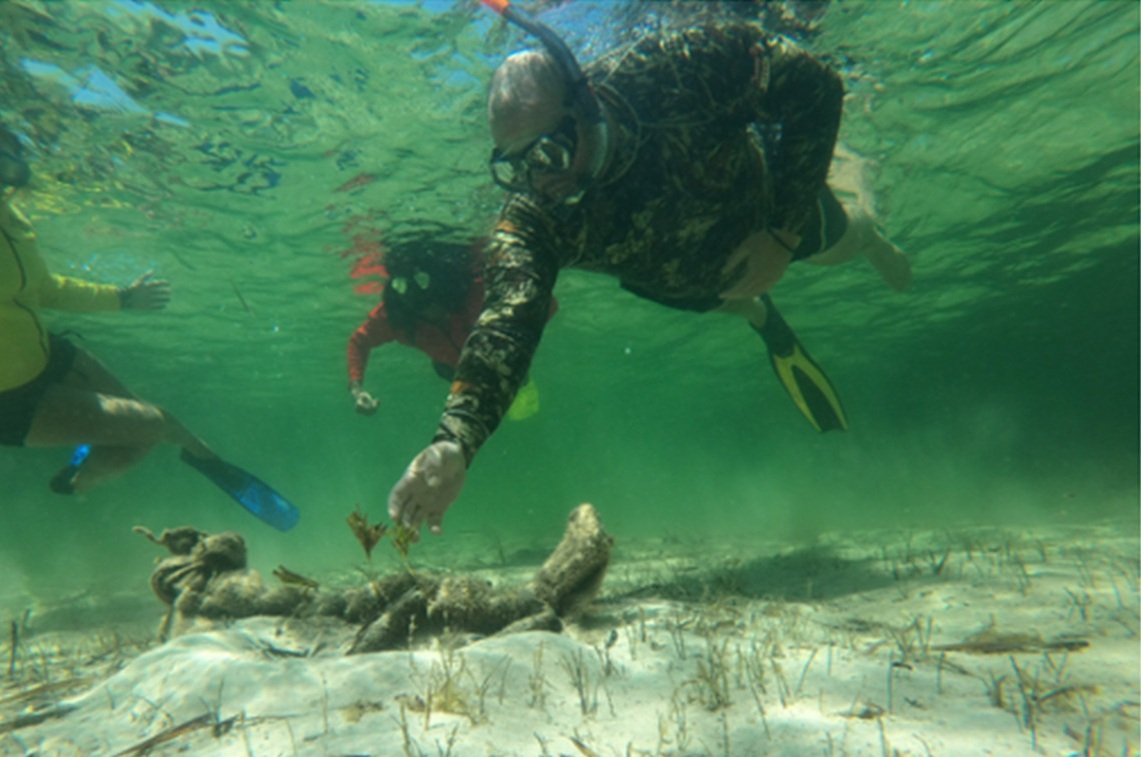
a CoastAdapt case study about work and learning from replanting seagrass in Shark Bay to heal Country after the 2010-2011 marine heatwave in Western Australia.
a CoastAdapt case study about work and learning from replanting seagrass in Shark Bay to heal Country after the 2010-2011 marine heatwave in Western Australia.
snorkellers
a CoastAdapt case study about work and learning from replanting seagrass in Shark Bay to heal Country after the 2010-2011 marine heatwave in Western Australia.
More broadly, marine heatwaves contribute to the erosion of Indigenous knowledge which is gathered by on-Country observations of marine systems over millennia by local mob . As species distributions shift and ecosystems degrade, this can challenge traditional knowledge systems.
These impacts of MHW can be compounded by limited inclusion of Indigenous voices in marine science and policy, although this gap can be helped though efforts such as the Indigenous-led research in Shark Bay.
Impacts on the Great Barrier Reef
The Great Barrier Reef is one of the most prominent and vulnerable ecosystems at risk from rising sea temperatures. Warming waters pose a threat to the coral communities that provide the reef's structural foundation. In recent years there has been five marine heatwaves that have lead to mass bleaching events in 2016, 2017, 2020, 2022 and 2024.
Corals can 'bleach' as a stress response when higher water temperatures affect the coral animal (known as a polyp) that then expels the symbiotic algae that live within their tissues. These algae, known as zooxanthellae, provide nutrition and colour. Without them, the coral tissues become transparent, and if the stress continues for too long, the corals may starve and die.
Coral bleaching 101: what are the intricacies of coral bleaching and can corals recover? Explained by the Great Barrier Reef Marine Park Authority
Marine heatwaves also cause the coral skeleton to dissolve, which speeds up loss of the coral reef 3D framework. In warming waters dead coral skeletons are quickly covered by a mix of algae and bacteria. These organisms speed up the breakdown of the coral’s calcium carbonate, eroding it faster than healthy corals can grow. This makes the skeleton weaker, less dense, and more porous.
Globally, coral reefs contribute to biodiversity by hosting about a quarter of all marine species. They provide ecosystem services that sustain the livelihoods, food security and well-being of over half a billion people.
Impacts on the kelp forests of the Great Southern Reef
Temperate kelp forests play an important role as foundational species that support rich biodiversity and habitat complexity.
The Great Southern Reef, a global biodiversity hotspot, wraps 8000 km around the southern part of the Australian mainland, from Kalbarri in the west, Tasmania, and through to Brisbane in the east. It has significant cultural and economic value, lying adjacent to 70% of the Australian population and adding around $11 billion to the national economy.
It is vulnerable to marine heatwaves, for example, in the 2010-2011 Western Australian event described above, Jurien Bay (200 km north of Perth) experienced warming waters that exceeded the tolerance limits of the dominant kelp species Ecklonia radiata, which led to widespread kelp canopy loss and a major shift in community structure.
The space created by loss of kelp was colonised by turf algae, which displaced crusting coralline algae and many associated species, dramatically reducing biodiversity. Temperate fish declined over time. Tropical fish moved in and grazers now crop new kelp, which blocks kelp forest recovery.
a video about how we value the Great Southern Reef, by the NESP Marine and Coastal Hub in 2023.
Impacts on seagrass ecosystems
Seagrass ecosystems in Australia are also impacted by marine heatwaves which undermines their role in supporting marine biodiversity, as well as their ability to store carbon.
During the 2010-2011 marine heatwave in Western Australia, Shark Bay recorded the largest global seagrass die-off that included loss of more than 1,300 km² of seagrass, mainly Amphibolis antarctica. This event disrupted food webs, affecting species like dugongs and dolphins, and led to the release of 2–9 terragrams of carbon dioxide from sediment carbon stocks and so contributed to national greenhouse gas emissions.
As marine heatwaves become more frequent and prolonged, these conditions significantly increase seagrass decline, delay recovery and even pose the possibility of localised extinction.
Impacts on commercial enterprises
Marine heatwaves have economic impacts that include affecting aquaculture operations as well as livelihoods of recreational fishers and tourism operators.
Marine heatwaves can foster disease outbreaks that lead to increased mortality in aquaculture and fishery species. Recent examples include:
- prawn stocks can be decimated by disease outbreaks (e.g., abalone viral ganglioneuritis)
- salmon farms
- viral outbreaks in shellfish, such as abalone and oysters