


At a glance
- Great Barrier Reef catchments hold over 111 million tonnes of blue carbon. Research suggests that restoring 90,000 ha of tidal wetlands could more than double this storage by 2100.
- Major trials at Blue Heart (Sunshine Coast) and Mungalla Station are testing blue carbon restoration and carbon credits. Blue carbon projects also support flood resilience, biodiversity, water quality, and Indigenous outcomes.

Blue potential
The mangrove forests and seagrass meadows of Queensland’s Great Barrier Reef catchments currently hold a blue carbon stock of over 111 million tonnes.
This figure could rise to 256 million tonnes CO2 equivalent by 2100, suggests the Blue Carbon Opportunities in Queensland report, a 2020 pilot study funded by the Queensland Government’s Land Restoration Fund (LRF) and led by Deakin University, The key action required to reach the higher figure is to remove tidal exclusion structures including levees and bund walls, to restore tidal exchange and appropriate saline conditions across approximately 90,000ha of tidal wetlands. However, this figure represents a theoretical restoration potential and actual outcomes will depend on restoration feasibility, land-use constraints and future policy settings.
blue carbon potential in the Great Barrier Reef in this story map
Two major blue carbon habitat restoration trials are underway in Queensland to assess the potential for enhanced blue carbon sequestration in the state’s coastal wetlands, and to apply new national carbon credit mechanisms for blue carbon projects. In late 2022, each project was awarded approximately $2 million of Commonwealth funding over four years, through Blue Carbon Ecosystem Restoration Grants.
On the Sunshine Coast, the council-led Blue Heart project aims to establish wetland ecosystems on the floodplain of the Maroochy River, including the restoration of former farmland into coastal wetlands. The project is targeting multiple co-benefits including flood mitigation and sea level rise adaptation, in addition to blue carbon sequestration.
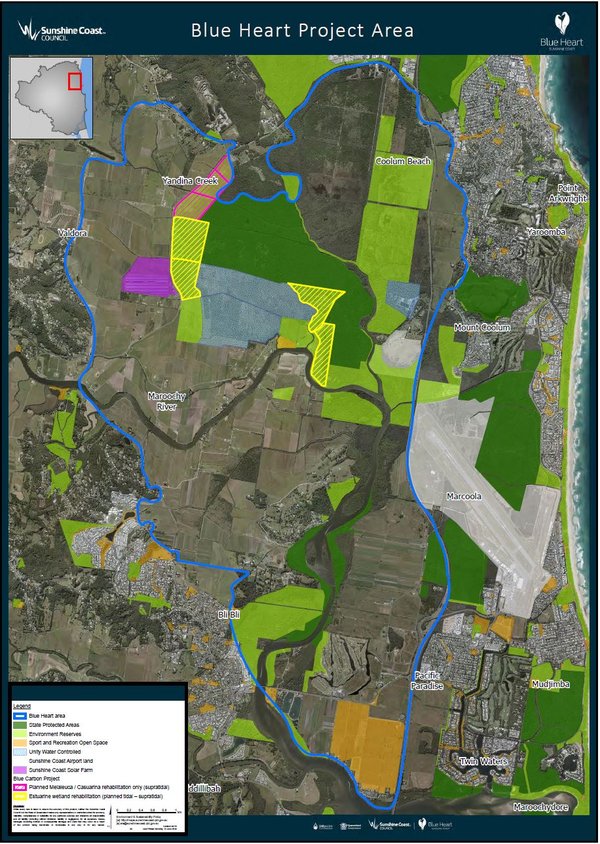
The project area for Blue Heart, the Sunshine Coast Council-led project aims to is reestablishing wetland ecosystems on former sugar cane lands
- © Sunshine Coast CouncilBlue Heart project area
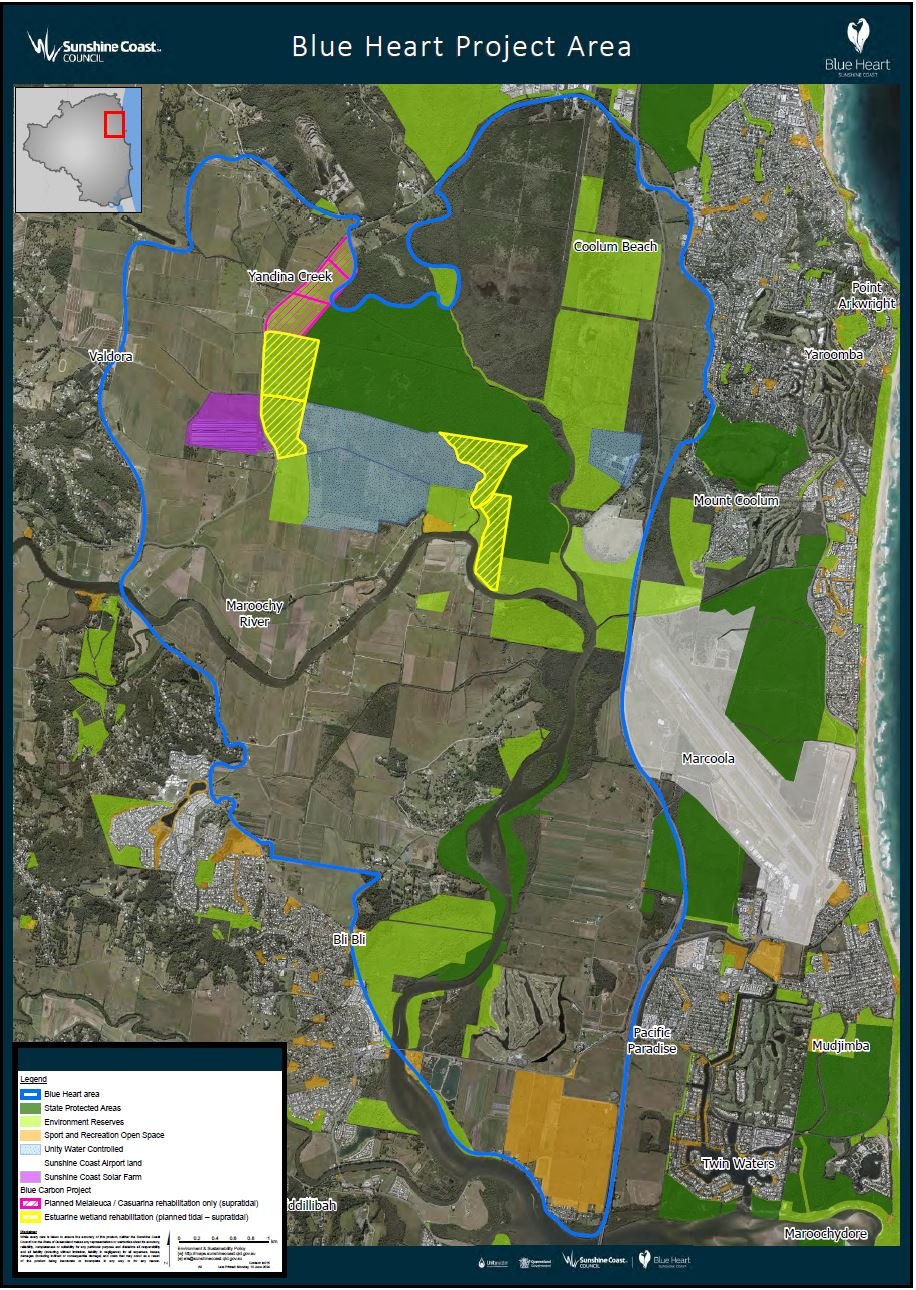
The project area for Blue Heart, the Sunshine Coast Council-led project aims to is reestablishing wetland ecosystems on former sugar cane lands
© Sunshine Coast Council
Further north, in Ingham, Greening Australia is working with traditional owners to restore salt-water tidal flows to degraded cattle grazing land at Mungalla Station through the removal of bund walls that is expected to create approx. 178 ha of new tidal area by 2056.
The project targets benefits for Indigenous heritage and ecotourism, improved biodiversity and water quality in addition to blue carbon sequestration.
a video about the Blue Heart partnership and project outcomes
more details in the Blue Heart document library
In the longer term, the Blue Carbon Opportunities in Queensland report highlighted the potential for blue carbon habitat and carbon sequestration to expand through future coastal inundation and land-use change associated with sea-level rise, where there is suitable and available accommodation space.
The report notes that sea-level rise, coastal erosion and extreme events could result in losses of existing blue carbon ecosystems. This highlights the importance of protecting and maintaining existing blue carbon habitats alongside restoration activities, while recognising that erosion management may require separate interventions tailored to local coastal processes.
about Queensland’s Blue Carbon potential, including mapping of Blue Carbon stocks and sequestration rates.
To cite:
This case study was prepared by NCCARF.
Please cite as: NCCARF, 2024: Exploring co-benefits of blue-carbon habitat restoration in Queensland. Case study for CoastAdapt, National Climate Change Adaptation Research Facility, Griffith University, Gold Coast.