


At a glance
- A series of nature assisted beach enhancement (beach scraping) campaigns have been conducted by the Shoalhaven City Council, on the south coast New South Wales.
- Initially, beach scraping was implemented as a reactive emergency response to specific beach erosion events.
- More recently, the Council has applied one of the first examples of proactive scraping to these beaches during the natural accretion phase, with the aim to help speed recovery of the beach and dune system.
- On-ground works have also included dune fencing and revegetation, and beach access modification, to maximise dune health and resilience to subsequent storm-driven erosion events.
- Each beach requires a bespoke work plan according to its unique features.
A series of eroding storms
The Shoalhaven City Council is a local government area in south coast New South Wales. The area includes 165 kilometres of coastline, from the Shoalhaven estuary and Jervis Bay in the north to Murramarang National Park in the south, and a string of coastal towns in between. The coastline is characterised by sandy beaches interspersed by small headlands. Each summer the area’s 110,000 population swells with 300,000 visitors drawn to the coast. Tourism is a significant part of the local economy.
The Shoalhaven area’s sandy beaches have been impacted by significant rapid erosion during storm events, especially between 2020 and 2022. Such events are expected to become more prevalent and severe due to the increasingly intense storm activity and sea level rise associated with climate change. Beach erosion events are typically followed by a gradual natural accretion of sand and slow recovery of the beach and dune.
While the beach remains in an eroded state, the amenity of the beach may be impaired. In addition, indigenous cultural heritage such as middens, and community and private assets behind the beach, may be vulnerable to subsequent storms. Land behind Shoalhaven’s beaches and dunes ranges from national park and council reserves to built infrastructure such as surf lifesaving clubs.
Beach scraping, also known as nature-assisted beach enhancement, is a soft engineering approach.
- © Shoalhaven City Councilbeach scraping1
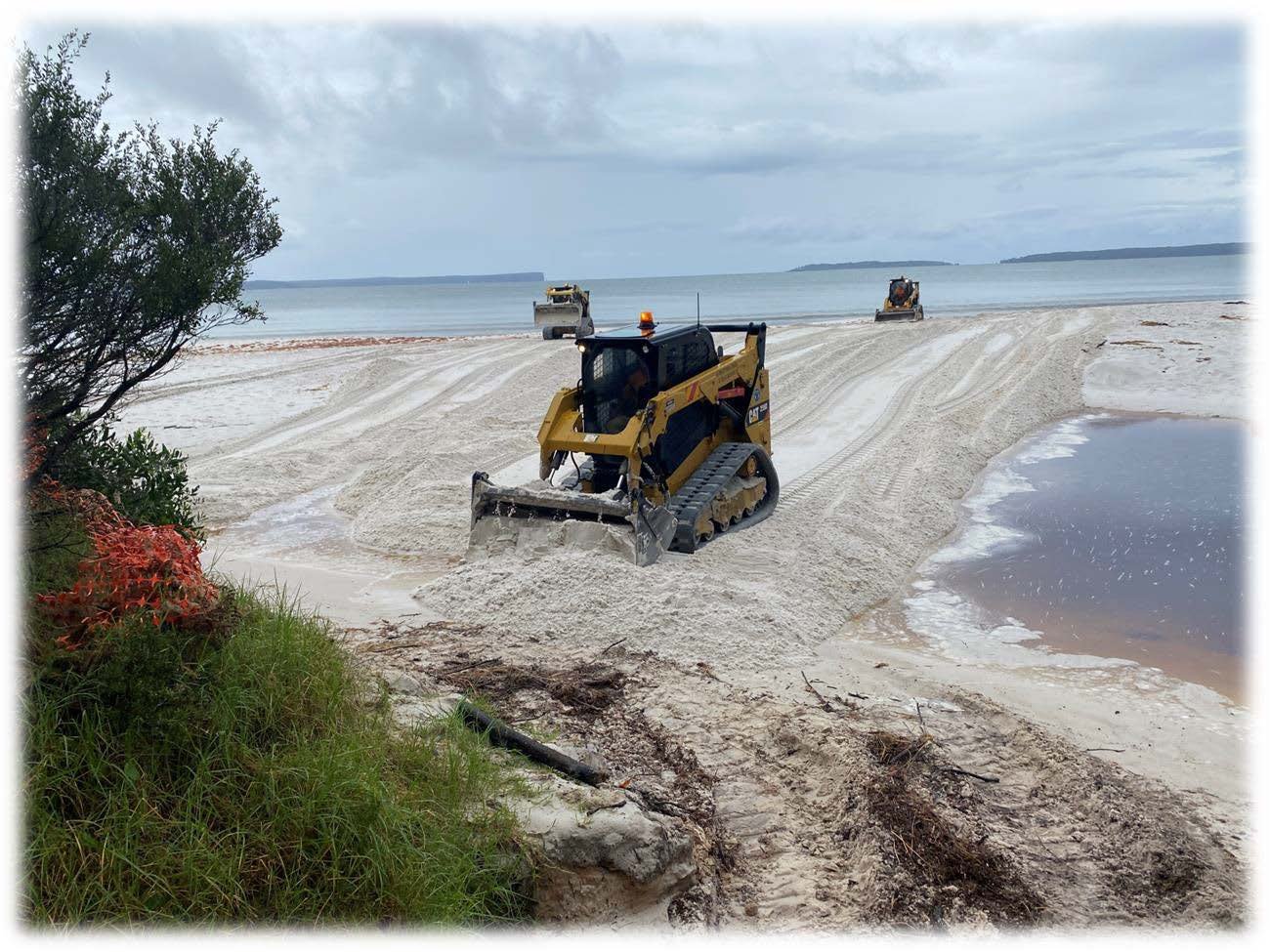
Beach scraping, also known as nature-assisted beach enhancement, is a soft engineering approach.
© Shoalhaven City Council
WATCH: a video by coastal managers at Shoalhaven City Council describe the importance of dunes and foreshore vegetation.
CZMP guides adaptation
Beach scraping, also known as nature-assisted beach enhancement, is a soft engineering approach to speed the natural onshore sediment transport process on sandy beaches, accelerating beach and dune recovery following erosion events. The process employs heavy machinery to move sand from the lower to the upper beach or dunes along targeted sections of beach.
Since developing and adopting a comprehensive coastal zone management plan (CZMP) in 2018, Shoalhaven City Council has implemented a suite of measures to combat beach erosion. Works have included constructing a groyne, diverting a creek and upgrading a stormwater drain. Also in line with the CZMP, the Council has regularly undertaken beach scraping, primarily as a reactive measure after big storm events in line with the protocols outlined in the Council’s coastal zone emergency action subplan.
In late 2023, Council also undertook its first proactive beach scraping campaign. Proactive scraping is designed to accelerate beach and dune recovery of a beach already in a sand accretion phase. The strategy was implemented at Shoalhaven after it has been successfully trialled in late 2022 by Byron Shire Council in northern New South Wales. After this first campaign’s success, Shoalhaven City Council expects to make proactive beach scraping a regular part of its coastal management repertoire.
Whether proactive or reactive, each beach scraping campaign has been preceded by a period of environmental assessment, planning, and application for approval from regulatory bodies. As part of the Shoalhaven coastline adjoins marine park or crown land, council often required a marine park permit and Crown lands licence in addition to the fisheries permit and Aboriginal Heritage Impact Permit (AHIP).
In addition to moving sand, Council also did some dune restoration and preservation work. This was further augmented by dune fencing, jute meshing, weed control, dune revegetation and beach access delineation and signage installation work.
The usual CZMP requirements were following, such as pre-work consultation of the local community, that included community meetings, social media, traditional media, newsletters and email. Council also monitored the site before and after the works. Funding for the works was largely secured through annual grant applications to the New South Wales Department of Planning and Environment (DPE) Coastal and Estuary Grants Program, and by accessing emergency funds set aside by the Shoalhaven council.
Beach scraping is a learning process
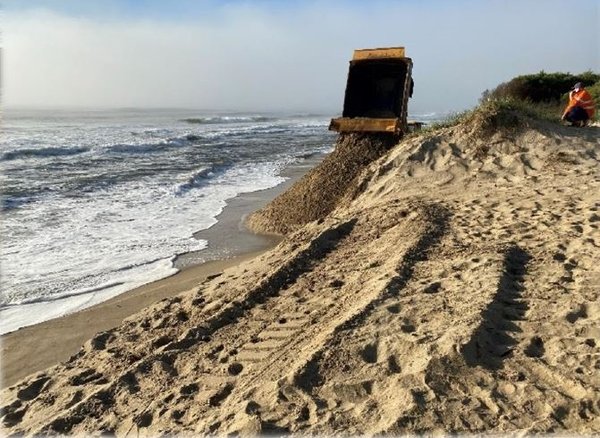
Ongoing beach site monitoring has proven valuable for monitoring success and guiding future works.
- © Shoalhaven City CouncilSholahaven heads
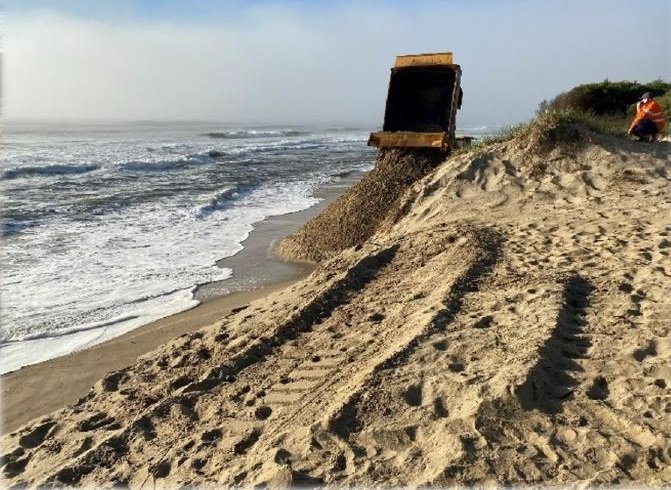
Ongoing beach site monitoring has proven valuable for monitoring success and guiding future works.
© Shoalhaven City Council
A number of beach scraping campaigns have been undertaken along the Shoalhaven coast, particularly as a reactive measure in response to storm erosion events between 2020 and 2022. In 2023, proactive beach scaping to further assist natural beach and dune recovery was also introduced.
A typical beach scraping campaign in Shoalhaven would involve 3-5 days of scraping, moving approximately 750m3 of sand per day up the beach. Sections of beach up to approximately 500m in length have been scraped, although 150-200m sections are more typical.
The machinery usually employed is a D6 or D7 medium bulldozer, but smaller machinery was used on beaches where access is more limited. In such cases, a small excavator combined with two small dump trucks to move the sand, and one small skid steer machine to profile the relocated sand, was found to be more effective than deploying three small skid steer bobcats to move the sand.
Proactive sand scraping of a recovering beach is less time critical than reactive beach scraping in the immediate aftermath of an erosive storm. A wider procurement process involving more potential contractors can therefore be undertaken for proactive scraping campaigns.
Ongoing beach site monitoring has proven valuable for monitoring success and guiding future works. In addition to visual imagery data acquired through CoastSnap, the team monitors the beach profile through on-ground transects. Although drone surveying was considered by Council, the cost of a single drone survey was still approximately equivalent to the purchase cost of surveying equipment that the team could use on an ongoing basis.
At Shoalhaven Heads, monitoring showed that the beach berm was naturally accumulating faster from the southern end of the beach. Rather than move the sand up the beach in a direction largely perpendicular to the shoreline, as would normally be undertaken, the team moved the sand up the beach at a more northerly angle, to make best use of the natural sand accumulation at the southern end of the beach and work with the natural processes at play.
Post-works surveys have also shown that dune rehabilitation and protection works have been broadly successful, with revegetation tube stock plants becoming established and helping to stabilise the scraped sand. Healthy well-vegetated dune systems are more resistant to storm erosion.
Engaging with National Parks and Fisheries staff responsible for issuing coastal works permits has been very constructive through helping to build a strong working relationship. Initially, each beach scraping campaign would have been preceded by up to 12 months of environmental assessment, planning work and applying for and receiving regulatory approval. But by taking efforts to understanding the requirements of regulatory bodies, Council created an environmental assessments template. This was able to ensure the inclusion of all necessary information required by regulators, which streamlined the approval process and reduced this time-frame to commence works. The team now has in place the licences and permits on a longer-term cycle, further cutting the delay between project conception and on-ground works.
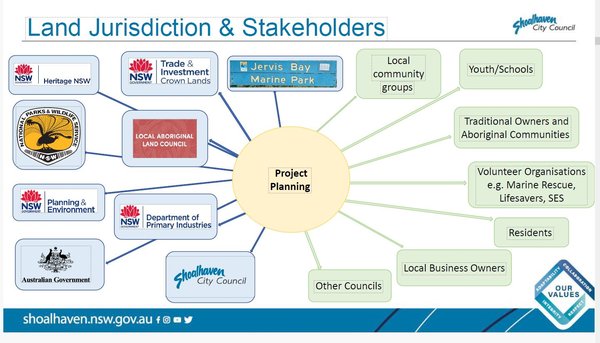
Strategic management of the range of landowners can make a project run more smoothly.
- © Shoalhaven City Councilland owners_Sholahaven
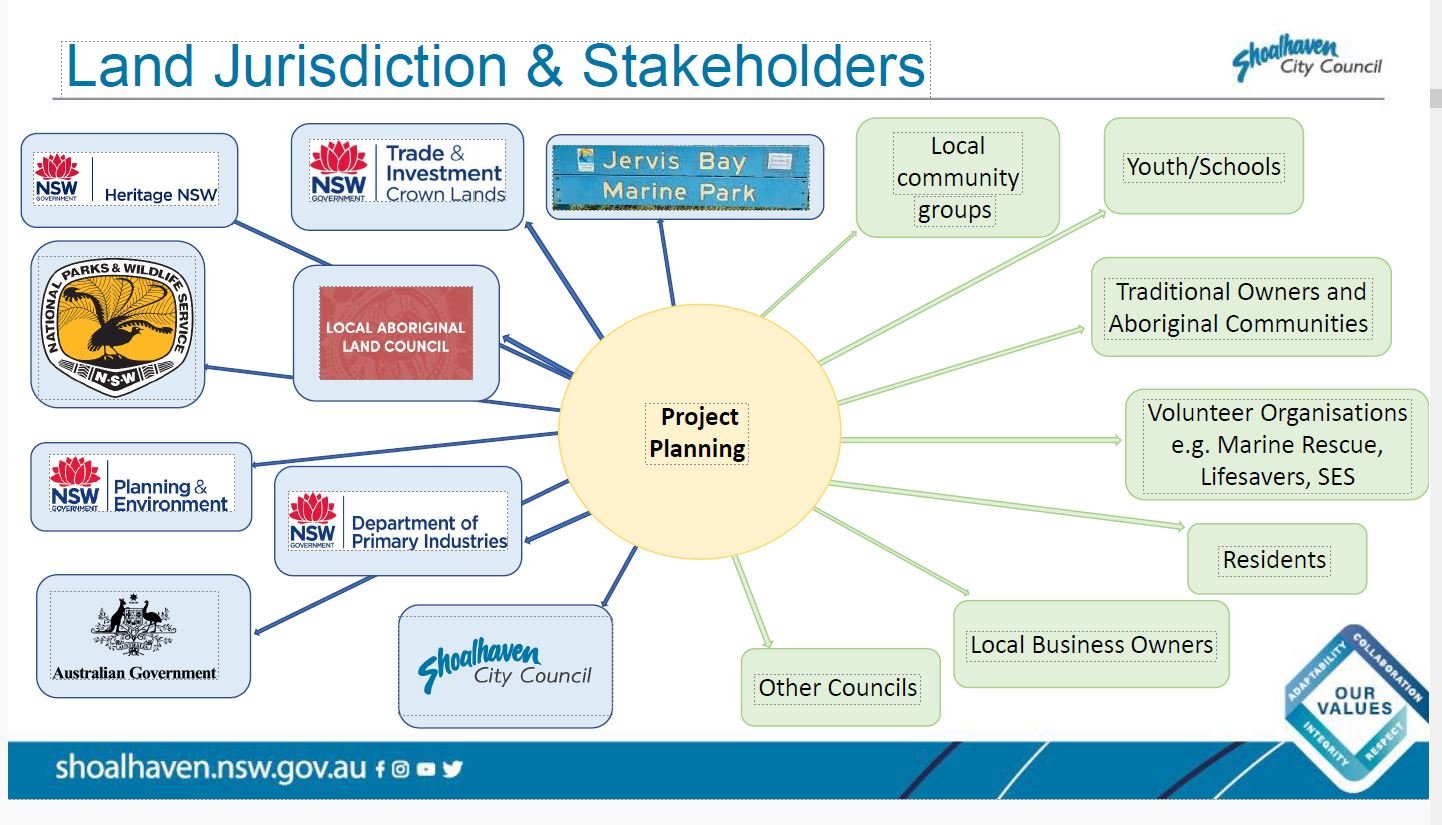
Strategic management of the range of landowners can make a project run more smoothly.
© Shoalhaven City Council
Local community engagement can be challenging, with pockets of community resistance encountered at certain beaches. Despite community consultation activities, there remains some community misunderstanding over the use of heavy machinery to aid natural beach erosion recovery, and the value of the activity. In one case, an erosive storm event followed one week after a beach scraping campaign. The beach scraping was perceived by some as a waste of council money, as the community did not appreciate the storm’s likely impact if beach scraping had not been performed. Ongoing community engagement and education efforts are required.
Gaining funding to conduct emergency reactive beach scraping after a significant storm can be difficult, because state government funding is primarily available through an annual funding round. In the wake of the beach erosion due to the 2016 East Coast Low, Shoalhaven Council set aside emergency funding that could be accessed for rapid response beach restoration works, until the next round of state funding becomes available.
Funding is also a key constraint on the level of proactive beach scraping Shoalhaven Council can undertake. Therefor works would be prioritised based on considerations such as community expectations, past scraping campaigns and assessment of highest risk beaches to future erosion. Proactive beach scraping of at-risk beaches might be undertaken to get on the front foot if the climate cycle is trending toward La Niña, which tends to generate the East Coast Lows that can produce significant beach erosion.
Lessons learned
Key lessons were learned from understanding the nuanced differences from each beach scraping campaign. Council staff also noted the need to be adaptable and prepared for the unexpected. In one campaign at Shoalhaven heads, for example, the team profiled the scraped beach to match the height of the dune, but subsequently lowered the height to counter wind-blown sand accumulation landward of the beach.
Monitoring and evaluating of each beach scraping campaign, to modify the methodology for each subsequent campaign, was considered the best way to work with nature and gain the most cost-effective outcomes from work undertaken.
Having conducted a number of beach scraping campaigns, the Shoalhaven Council team recently engaged an external consultant to independently assess the work. The assessment will provide recommendations and further guide works for future campaigns.
To cite:
This case study was prepared by Nigel Smith, Shoalhaven City Council. Please cite as: Smith, N, 2024, Early beach scraping helps out Shoalhaven beaches. Case study for CoastAdapt, National Climate Change Adaptation Research Facility, Griffith University, Gold Coast.