


At a glance
- Changes in sandy shorelines change affected by novel underwater structures can be predicted by calculating the dynamic flow of water around the structure, transformation of waves over the structure, and the movement of sediment from flows, leading to beach sections that widen or erode.
- However, it can be costly to calculate the entirety of the physical process in such a dynamic system can be costly.
- Using machine learning models can reduce the number of simulations by creating a database of the relevant coastal and structural parameters, their subsequent shoreline change, and mapping the relation between the antecedent parameters and shoreline change outcomes.
Planning artificial reefs can reduce erosion and promote surf breaks
Artificial reefs are increasingly being considered for use as a means of coastal protection – in addition to other existing uses for environmental and tourism benefits or power generation.
Once installed, artificial reefs can act as submerged breakwaters to reduce wave energy reaching the shoreline and so to help prevent erosion and promote sand deposition. As waves break over the structure this can provide recreational surf amenities.
However, such projects require careful planning and monitoring to ensure the multipurpose functions are optimised for both coastal protection and recreational purposes. Coastal dynamic modelling involves the computer simulation of physical coastal processes to calculate the motion of water and sand and their influence on each other using governing equations and engineering assumptions.
Artificial reefs are often constructed from concrete blocks, rocks or repurposed materials such as decommissioned vessels.
These engineering models are necessary to ensure the safety and predict influence of an artificial reef on the coastal system as the complex transformation of waves over the structure can lead to unintended erosion at the shoreline. However, for designers and coastal planners, the traditional use of process-based modelling can be limiting due to the time and cost required to test and optimise multiple designs.
So, rather than test a few designs in detail, a designer can test the feasibility of multiple designs to generate a dataset. Then machine learning algorithms can use this with the relevant parameters to predict shoreline change from multiple designs instantaneously via data-driven solutions that bypass the need to calculate the entire process every time a coastal planner wants to change the shape or size of the reef structure.
This enables a data-driven solution that implements machine learning predictions to find complex relations that are imperceptible (or at least difficult) to human minds or conventional methods.
Screenshot 2023-11-20 at 9.56.52?pm
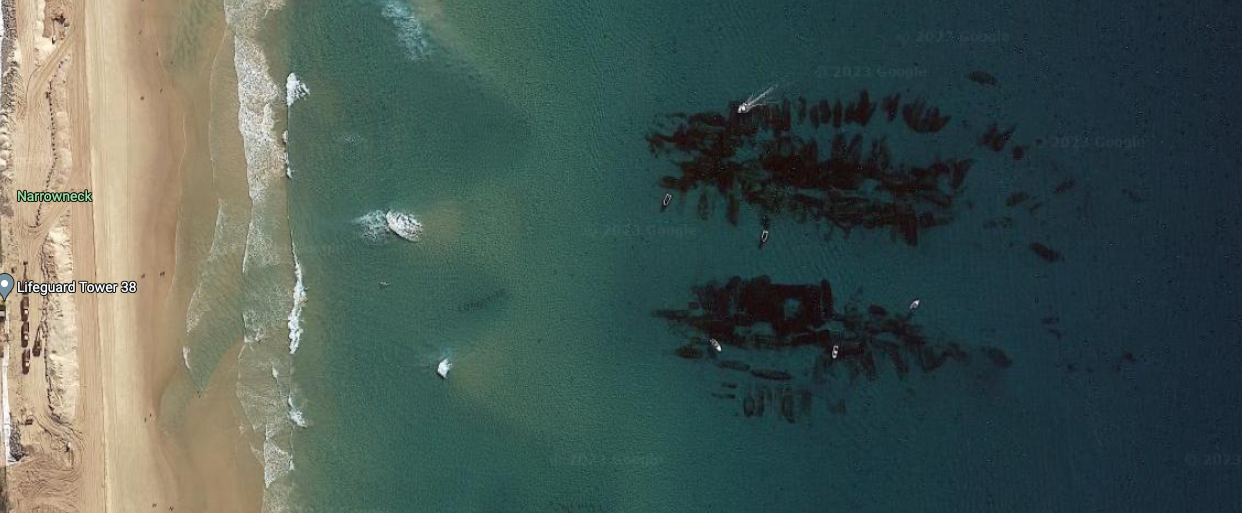
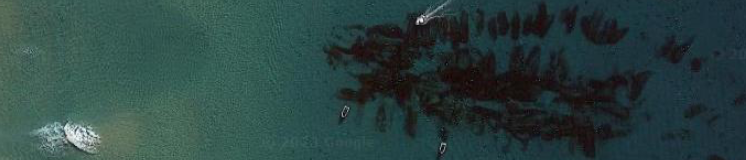
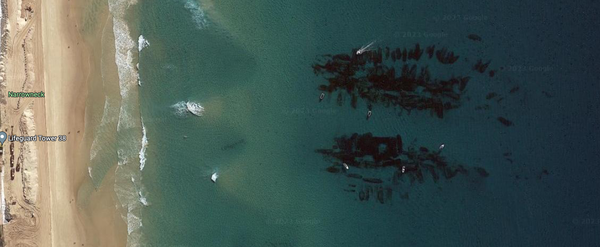
An artificial reef at Narrowneck on the Gold Coast, Queensland, was originally constructed for the purpose of stabilising the beach but had also improved the shape and frequency of waves for surfing.
© Google Earth
Machine learning can save time and money
As data-rich simulations and AI-based solutions become more accessible for both scientific and everyday use, hybrid methods will become a routine part of the decision-making process for many industries and sectors. These methods will be especially useful where the combination can enable faster predictions while offsetting the climate impact of carbon-intensive high-powered computational models (Kudiabor, 2024).
In this case, the machine learning algorithm learns from coastal and submerged structure data (inputs) and their consequent shoreline change (output) derived from coastal model simulations. This enables the machine learning model to quickly predict a shoreline change output given a combination of inputs (even if they are novel), which would normally require hours of process-based modelling to derive a solution for any single combination.
Modelling a range of options for decision-makers
The modelling framework uses DHI Group’s MIKE water modelling software to derive an unstructured 2D-horizontal triangular mesh model of the reef structure in a simplified straight shoreline sandy coast. From this it calculates the effect of wave transformations over the structure and from shoaling to determine their effect on the flow of water and sand in the simulated environment.
This information is compiled into a one-line shoreline output using engineering assumptions of the Bruun Rule (Bruun, 1954) to simplify the model output into a 1D solution space representing the shoreline with positive numbers indicating accretion and negative indicating erosion along the shoreline. The details and numerical method can be found in reference (Muroi et al., 2024).
This allows for a novel approach to simulate the effects of artificial reefs on shoreline change, whereby data can be generated while considering the important physical effects (such as circulation flows) that lead to shoreline accretion and erosion. By generating enough variations, a training dataset can be created with unique shoreline change patterns for incremental differences in design such as the shape and position of the reef.
The machine learning aspect of this work dramatically reduces the costs. It is expensive to simulate every possible combination of variables at fine increments for a higher resolution solution space that changes with attributes such as time and climate. However machine learning algorithms—at fraction of the cost of running process models — are able to predict the input-output relation of any dataset to make predictions on novel inputs.
Therefore, to test the validity of the machine learning prediction, is simply a matter of running the novel input variables in the original process-based model. This new validated information can then be used to build confidence in the machine learning model, or added to the training data that the machine learning algorithm learns from is added to the training data, then the algorithm now knows the solution to this novel combination of variables (according to the process-based model) and can use that to inform future predictions.
Future directions
By standardising the procedure, future studies can use this benchmark approach to experiment various options for particular structure placed in a controlled simulation environment. This will enable them to create the database required for a machine learning model to interpret the shoreline effects of artificial reefs at parameter ranges that are valid to localised conditions (coastal and bathymetry data). This can then generate data to better understand the impact of sea rise on the shoreline in coastal reef systems.
Note however, that despite the implied efficiency of the machine learning models, they still require process-based modelling data. The benefit is that by taking advantage of machine learning predictions, which bypass the process to form a data-driven solution, we can more efficiently use a large number of simulation data to predict points in between intervals generated in the dataset.
This allows for a continuous prediction for any combination of variables in the data-driven model. However, this also implies that making predictions outside of the range of the database: i.e., making predictions on 10m waves when the machine learning model was trained on 1m-2m waves would lead to massive uncertainties about the reliability of the prediction). Therefore, care should be taken to ensure the dataset encompasses the range of parameterised variables that are relevant and valid to localised conditions where a submerged structure (such as an artificial reef) is being planned.
This case study was prepared by Subaru Muroi, Griffith University. Please cite as: Muroi, S, 2024. Predicting the impact of an artificial reef on sandy shores using applied machine learning. Case study for CoastAdapt, National Climate Change Adaptation Research Facility, Griffith University, Gold Coast.