



At a glance
- In many areas of southern Australia, introduced grass species now dominate the coastal dune profile, often out-competing the local native species and substantially changing the shape and slope of the dune. Beach nesting birds that rely on these habitats for feeding, roosting and breeding are faced with an increasing battle to find suitable areas as these weeds change the dune and beach environments.
- Nesting sites on the Fleurieu Peninsula are some of the dune profiles under threat from several invasive grassy dune and beach weeds. These weeds reduce the availability of habitat by covering large areas of the beach and altering dune morphology and shape.
- There are fewer than 80 Hooded Plovers (Thinornis culcullatus culcullatus) in the Hills and Fleurieu and Green Adelaide landscape regions: these are listed as a vulnerable species under the EPBC Act (1999) and the SA National Parks and Wildlife Act (1972). National conservation advice identifies several grassy weeds growing and spreading in dunes as a threat to suitable breeding habitat requirements and hence population growth.
- The Our Plover Coast project was trialled at 20 Hooded Plover nesting or foraging sites from Myponga Beach to Goolwa, South Australia, to reduce introduced grasses, and revegetate the dunes with the local native spinifex vegetation association. Targeting these weedy grass species and replacing them with local native spinifex, improves existing nesting sites and makes available more areas of our coast to provide suitable habitat to support the recovering population.
- Twenty thousand spinifex and other local native coastal plants were propagated by volunteers at the Fleurieu Coast Community Nursery at Yankalilla. Volunteers from coastal community groups are partnering with the Friends of the Hooded Plover volunteers to undertake planting across the sites. Targeted rabbit control has also been undertaken to improve revegetation success and prevent erosion.
- Experience and learnings from this project are being shared with land managers across southern Australia. The team welcomes opportunities to collaborate with others on similar projects.
The Our Plover Coast project is coordinated by Landscapes Hills and Fleurieu and Green Adelaide, with support from BirdLife Australia, local councils and volunteers.

Improving habitat to help the Hoodies
In south-eastern Australia, hooded plovers live and breed almost exclusively on ocean beaches, preferring broad, flat, open sandy areas with plenty of seaweed and backed by low sand dunes. Breeding sites on the Fleurieu Peninsula are under threat from storm surges and weed incursions, particularly grassy dune and beach weeds [sea wheat (Thinopyrum junceiforme), pyp (Ehrharta villosa), marram grasses (Ammophila arenaria) and sea spurge (Euphorbia paralias)]. These invasive weeds reduce the availability of nesting, roosting and foraging habitat by covering large areas of the beach and altering dune morphology and shape.
Over time, as these introduced species have become dominant, out-competing the local native species: habitats that were previously suitable are turned into breeding areas that are nonviable. Dunes with introduced grasses become steeper and higher, due to the growth habits of the grasses, compared to those covered with local native spinifex plants. Native deep-rooted surface running grasses, such as spinifex, capture sand and stabilise dunes, creating a natural buffer to storm surges and provide critical habitat for plants and animals.
Lower, less steep dunes provide habitat for nests and allow hooded plover chicks to retreat into the dunes when under threat from predators or during high tides and storm surge. Hooded plover chicks feed themselves from the first day they hatch, foraging across all areas of the beach from the water’s edge back to the sand dunes.
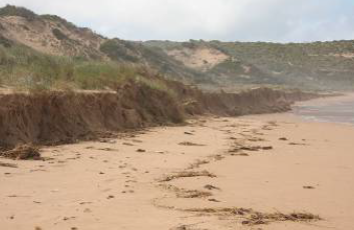
Sea wheat grass dominated dune with dense, limited diversity vegetation and tall erosion scarp.
- © T. FlahertySeawheat grass dominated dune _eroding scarp_T Flaherty
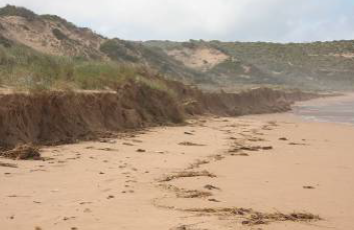
Sea wheat grass dominated dune with dense, limited diversity vegetation and tall erosion scarp.
© T. Flaherty
Removing introduced grasses that form dense vegetated areas in the Hooded Plover breeding beaches, enables the birds to utilise greater areas of the ocean beaches as suitable nesting territories.
Hooded Plover pairs occupy distinct territories and will often return to the same area to breed each year. Replacing weedy grass species them with the local native spinifex plant associations, helps to improve existing nesting sites and makes available more areas of the coast to provide suitable habitat to support the recovering population.
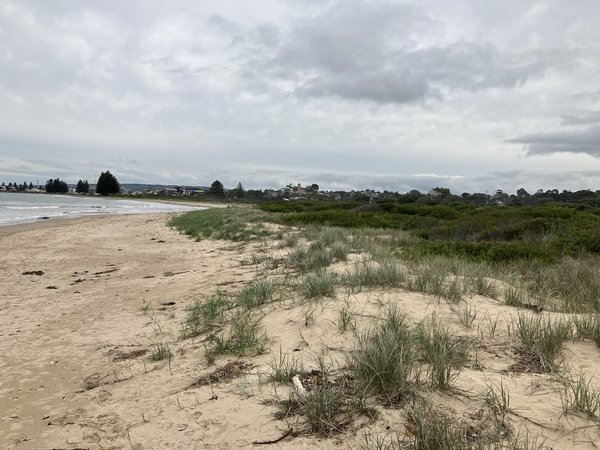
Treated (foreground) versus untreated (rear) sea wheat grass. Over 18 months, this site has had four treatments (initial + three follow up).
- © C. TaylorTreated (foreground) vs untreated_Seawheat grass_C Taylor
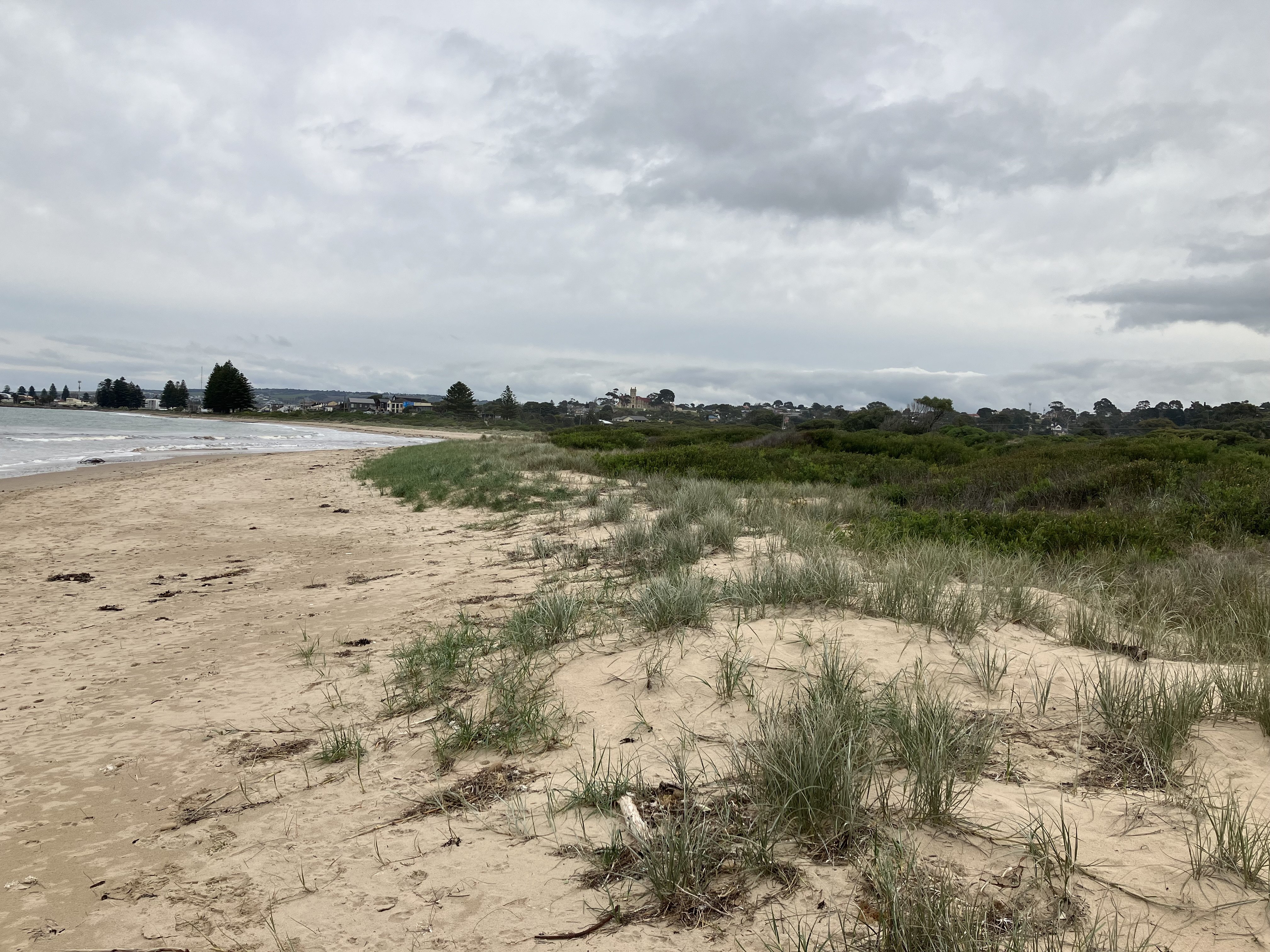
Treated (foreground) versus untreated (rear) sea wheat grass. Over 18 months, this site has had four treatments (initial + three follow up).
© C. Taylor
Project goals
The goals of the project are:
- greater understanding of weed control methods for introduced grasses growing in dunes of ocean beaches
- able to change shape and profile of a dune based on plant species association while maintaining integrity and functionality of dunes
- successfully propagating large quantities of rolling spinifex (Spinifex hirsutus) that has been a difficult species to propagate in large numbers
- increased community awareness of Hooded Plovers, the importance of suitable habitat and the role of spinifex plant associations in dunes
- greater connection of projects with coastal community volunteer groups, the Fleurieu Coast Community Nursery and Friends of the Hooded Plover volunteers
- combining expertise from local contractors, land managers, project partners and the community.
Habitat management
The different growth methods of the native grasses versus introduced grasses directly impacts the shape, height and slope of a dune and therefore its ability to provide suitable habitat for beach nesting birds.
Introduced grass species, particularly sea wheat and marram grass, are known as habitat-transforming species. The plants spread via dense, fast-growing rhizomes (roots) that spread underneath the surface of the dunes and send leaves up above the surface. This effectively traps sand within the dune and forms a strong complex root system defence against eroding forces of wave, wind and trampling.
In contrast, the native dune grass, Spinifex hirsutus grows across the surface of the dune via stolons (runners), sending roots down into the dune system from the surface. When faced with eroding forces (wind, rain, storm surge, trampling), spinifex dunes erode more slowly and slump, rather than cut, a steep dune face, while retaining long plant runners at the surface and front of the dune.
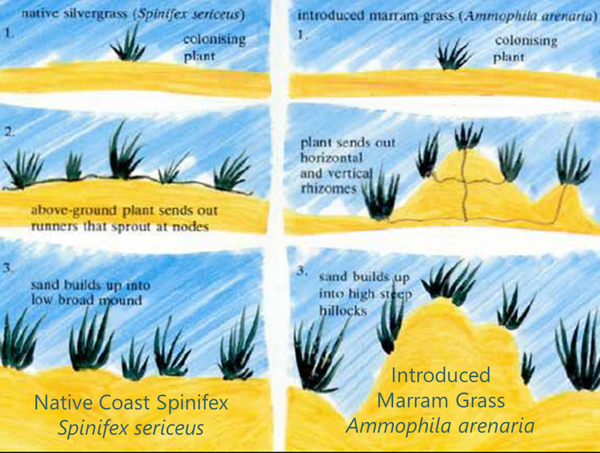
Different growth, different dunes: contrasting dunes growth results in changes in dune height, slope and shape.
- Source: Bell, A. 1988Alien dune plants reshape our beaches_A Bell
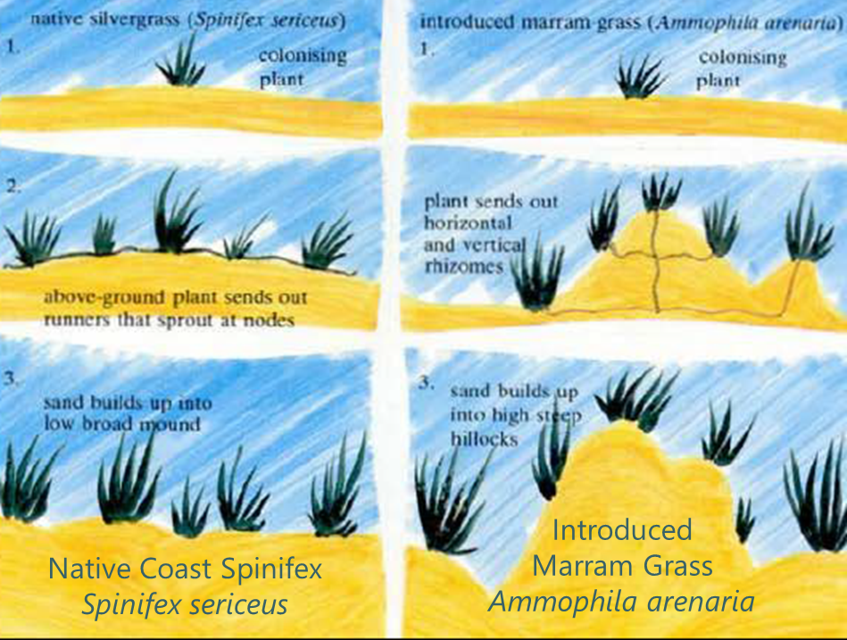
Different growth, different dunes: contrasting dunes growth results in changes in dune height, slope and shape.
Source: Bell, A. 1988
Weed control trials were undertaken at the beginning of the project to identify the best control methods for each species. Once identified, these methods were applied across multiple sites, resulting in successful control of target species. Repeat applications by local weed control contractors were required across all sites, despite control methods being undertaken in peak plant growing seasons. Following the initial treatment, re-emergent plant shoots were observed at all sites but in much lower densities than prior to treatment.
Volunteers at the Fleurieu Coast Community Nursery at Yankalilla propagated spinifex vegetation association species. Over the life of the project, 20,000 plants have been established across the 20 identified sites following weed control. Planting across the sites was undertaken by volunteers from the various coastal community groups who work to conserve and restore the dunes in partnership with the Friends of the Hooded Plover volunteers, who monitor the birds.
Careful planning and project management have ensured that the staged removal of the weed species has not had a negative effect on dune stabilisation while the native spinifex gets established. Signage was also installed at each site to increase awareness of the project and provide information for local community and beach users.
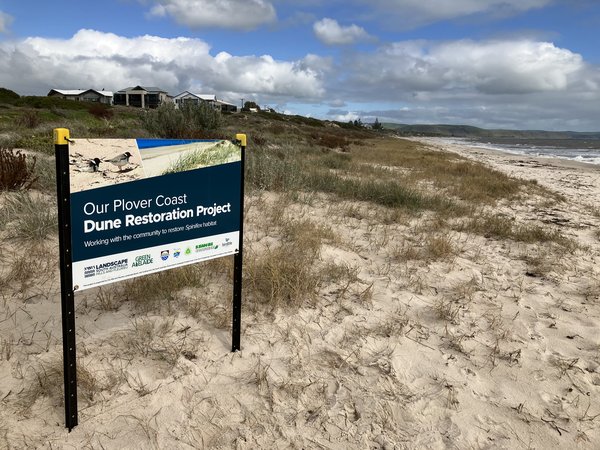
Carrickalinga beach with Our Plover Coast signage installed following weed control and community planting on site.
- © C. TaylorCarrickalinga beach with Our Plover Coast signage_C Taylor
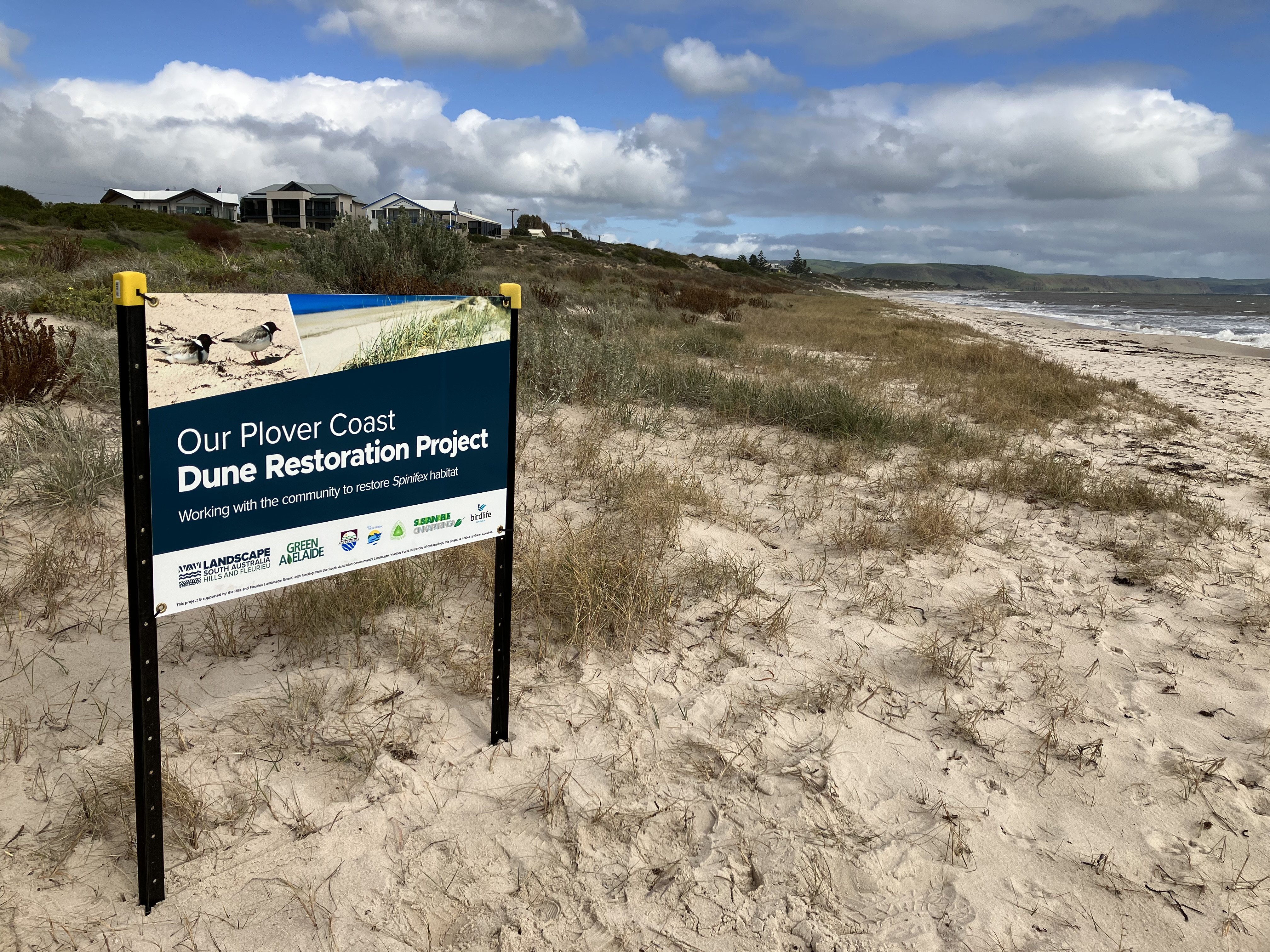
Carrickalinga beach with Our Plover Coast signage installed following weed control and community planting on site.
© C. Taylor
Challenges and successes
The project drew on the experience of various staff and community volunteers but still presented a number of challenges. First was cracking the secret to reliable propagation of rolling spinifex (Spinifex hirsutus) to produce large quantities (10,000+ plants per growing season) for restoration of the sites.
This was achieved by trialling various methods, soil mixes and types of cutting materials. The most important factor for successful propagation of this species is warm temperatures (through a poly tunnel preferably with a warming mat) directly following propagation for at least 14 days.
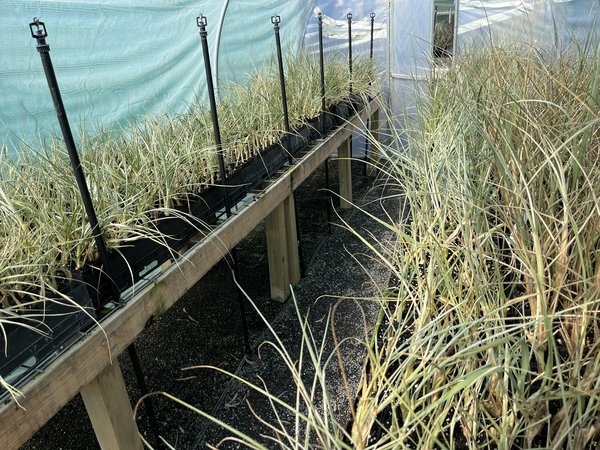
Spinifex cuttings in the polyhouse: various method of propagation were trialled.
- © C. Taylorpolyhouse spinifex cuttings_C Taylor
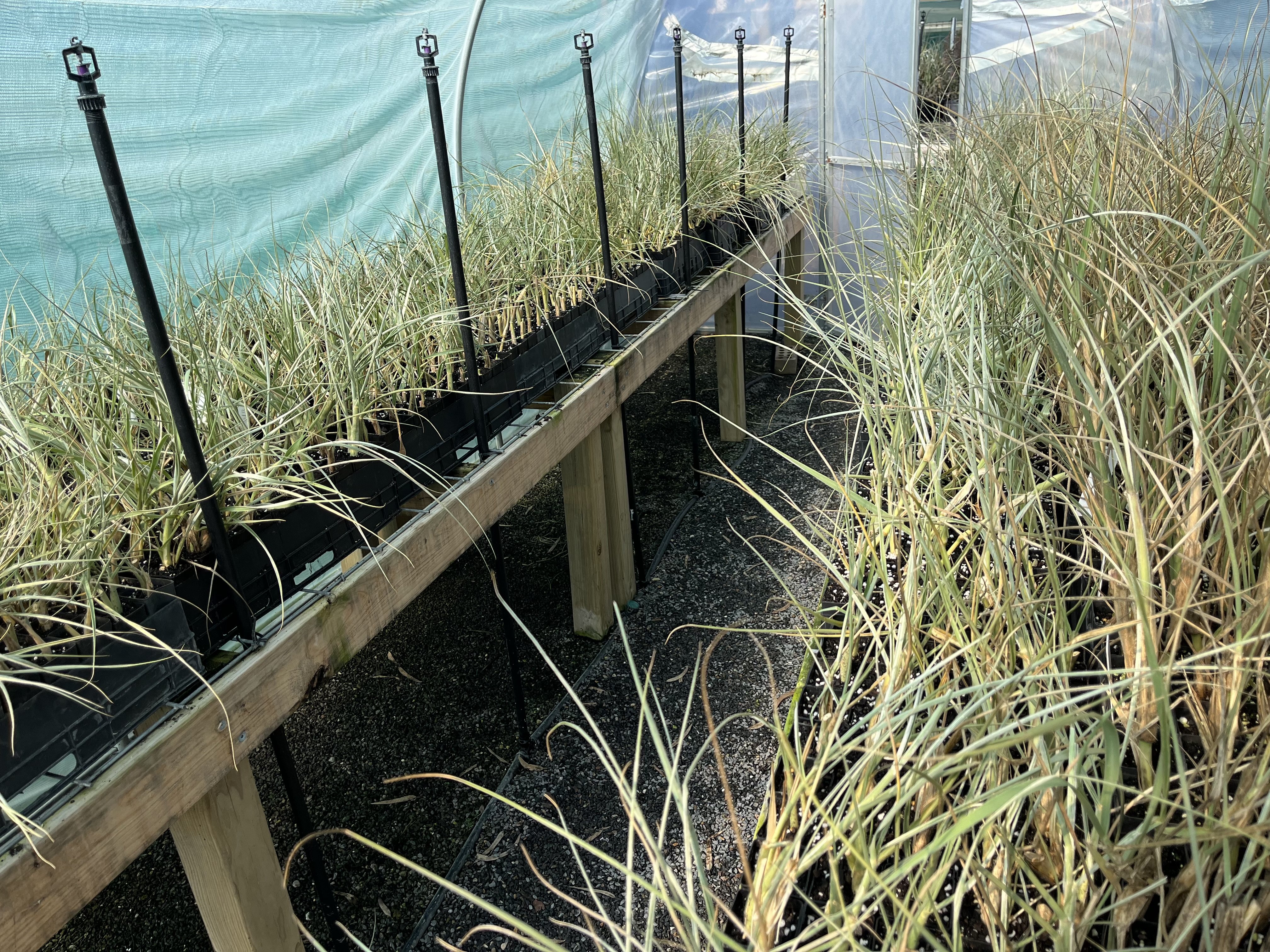
Spinifex cuttings in the polyhouse: various method of propagation were trialled.
© C. Taylor
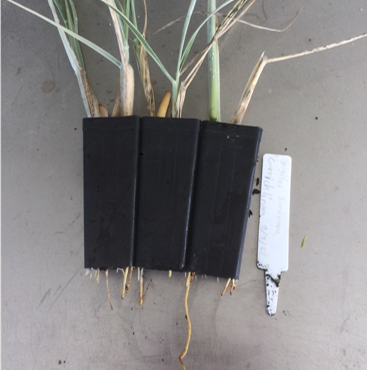
Spinifex seedling growth four weeks after propagation.
- © C. JacksonSpinifex Seedling growth 4 weeks after propagation_C Jackson
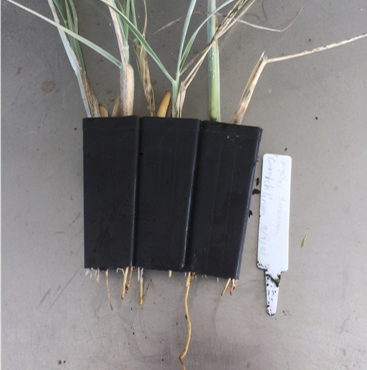
Spinifex seedling growth four weeks after propagation.
© C. Jackson
The active growing season for the weed species coincides with the hooded plover breeding season. Careful time management between project staff and weed control contractors was needed to avoid active nesting periods (between August to March) and prevent potential disturbance to the birds. Managing this across 20 nesting sites with variable weather conditions was quite challenging.
Collaboration between hooded plover volunteers monitoring the birds on the beaches and staff contractor management was critical to ensure weed control was completed without affecting the birds.
After there had been effective control of the weed species, the second goal was to observe if weed removal would translate to a change in dune shape, slope and height.
Following two years of weed control and two planting seasons, we have observed a distinct change in dune profile at many sites. Following control of the more densely vegetated areas, the dunes showed distinct slumping of sand on the seaward face. This reduced dune height and provided a mobile sand source at the front toe of the dune. At sites where spinifex had been previously established (or planted the previous year) spinifex runners spread down the face of the dune, allowing the mobile sand to be trapped at the base.
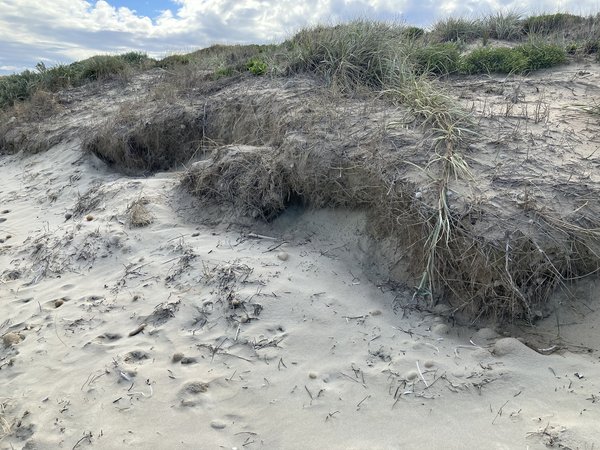
Dune profile reshaping following weed control. Note spinifex runners coming from top of dune to trap mobile sand released from control of sea wheat grass.
- © C. TaylorDune profile reshaping post weed control_C Taylor
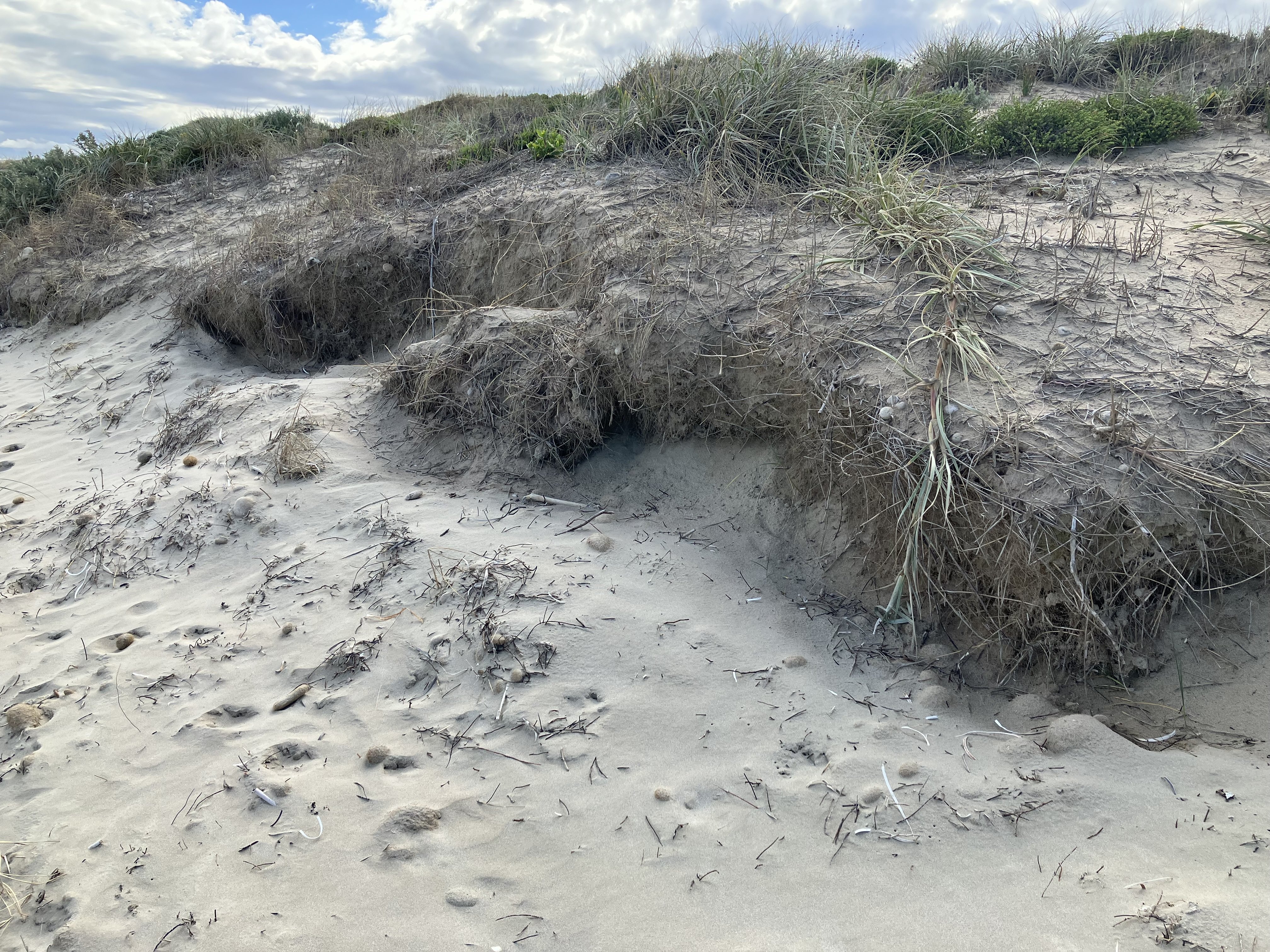
Dune profile reshaping following weed control. Note spinifex runners coming from top of dune to trap mobile sand released from control of sea wheat grass.
© C. Taylor
Shifting the balance, not weed eradication
With such a widespread suite of weeds to manage, this project set clear objectives about expectations for weed control. Sites were chosen that were known breeding sites for hooded plovers and a targeted dune length (between 50–200 m) was managed.
Sites with high value assets or infrastructure were of lower priority to manage due to potential dune erosion between control of weeds and re-establishment of spinifex. The desired outcome was a substantial reduction in the growth and below-sand biomass of the root systems of the weed species.
By achieving this, the project enabled the native spinifex to establish and re-establish roots from the surface runners within the dune. The period of time between weed control and root system decay allowed the sand captured within the dune to redistribute within the dune or return to the beach. This often appeared as minor foredune slumping following high tide or storm conditions.
Treated (foreground) versus untreated (rear) sea wheat grass. Over 18 months, this site has had four treatments (initial + three follow up).
- © C. TaylorTreated (foreground) vs untreated_Seawheat grass_C Taylor
Treated (foreground) versus untreated (rear) sea wheat grass. Over 18 months, this site has had four treatments (initial + three follow up).
© C. Taylor
Sites required multiple weed control treatments. Sites with very dense and large areas of weeds required multiple follow up applications to reduce the biomass that re-emerged after treatment. Sites with low density weed cover required fewer applications, and longer times between control, to maintain suitable conditions for spinifex to re-establish.
Local rainfall conditions had a dramatic effect on active growth times of the weed species. The most effective control was achieved when weed species were actively growing, which allowed the greatest translocation of herbicide throughout the plant. This is particularly important when considering the limited and narrow leaf structure and relative biomass of above ground leaf to below root mass. Within the 20 sites, control timing varied by several weeks between sites demonstrating the high variability of local conditions.
Despite the continued and targeted efforts, low quantities of sea wheat grass continued to emerge across some sites. This may have been from deep root systems within the dune (particularly on the edge of control areas) or from fragments redistributed via currents and wind.
Future maintenance control efforts will be needed to reduce reestablishment of weeds. Where sites have effective control, the native spinifex is showing a strong growth response of several metres and multiple runners from the central plant. This growth is actively trapping the mobile sand at the toe of the foredune which appears to be the driver for the lower dune face slope.
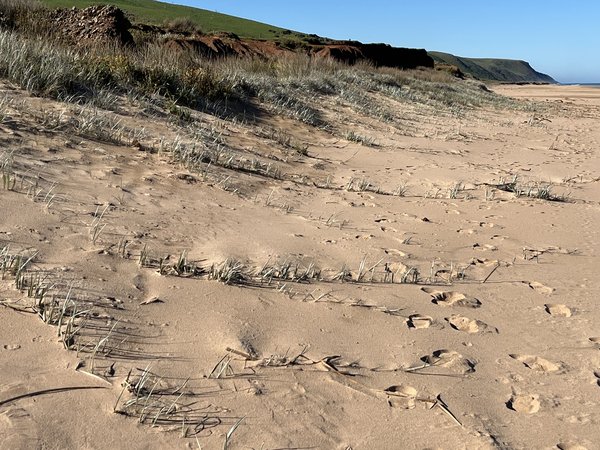
Spinifex plant runners growing across the surface of the sand from adult plants at top of dune, putting down roots to stabilise sand.
- © C. TaylorSpinifex plant runners growing across surface of dune_C Taylor

Spinifex plant runners growing across the surface of the sand from adult plants at top of dune, putting down roots to stabilise sand.
© C. Taylor
Next steps
Throughout the project, the hooded plovers have continued to nest across the sites. Future analysis of the bird monitoring data will seek to investigate if the birds will now preferentially nest in the improved habitat adjacent to the treatment areas within the wider nesting areas at each site.
Ongoing maintenance weed control will continue across the sites in an effort to keep these weed species managed within the breeding areas. Where required, there will be additional in-fill planting and changes in dune profile will be monitored over time.
The project team are keen to share learnings from this project with other land managers across southern Australia and welcome opportunities to collaborate on similar projects.
To cite:
This case study was prepared by Caroline Taylor, Landscapes Hills and Fleurieu.
Please cite as: Taylor, C., 2024: Our Plover Coast - Restoring coastal Spinifex dunes for improved beach nesting bird habitat. Case study for CoastAdapt, National Climate Change Adaptation Research Facility, Griffith University, Gold Coast.