


At a glance
- Sea level rise of up to 0.9 m by 2090 (and greater that 2 m in extreme cases) will drive shoreline erosion, alter beach morphology, and degrade surf quality at iconic breaks.
- Changing storm patterns due to fewer East Coast Lows and Tropical Cyclones but greater cyclone intensity, are likely to reduce surfable days while increasing episodic erosion and infrastructure damage.
- Health hazards from poor water quality may arise from ENSO-driven rainfall variability, storm surge, and algal blooms.
- Economic stakes are high, with marine environments contributing $69 billion annually and adaptation costs exceeding $1.7 million/km under high-emission scenarios.
- Adaptation options include restoring dunes and vegetation, nourishing beaches, and using artificial reefs to protect surf quality and reduce erosion. Policies that help safeguard surf spots and cultural values include managed retreat, advanced monitoring, and community initiatives such as surfing reserves and sustainable tourism.

Surfing is an iconic activity
Australian beaches and surf breaks are valuable cultural and economic resources, yet face growing threats from climate change. Rising sea levels could reshape beaches, while changing storm patterns: these are the two key climate impacts that may alter the swells that create surfable waves.
The Griffith University report estimates marine environments bring $69 billion per year to the Australian economy (Miller 2025).
Another study in 2024 estimates direct benefits per year from surfing is A$2.71 billion, while the estimate of indirect benefits is $4.88 billion (Manero et al., 2024). Surfers surveyed also perceive benefits for their physical health (95 %), mental health (99 %) and also for community connectedness (80 %).
the Griffith University report on surf breaks and climate change, which synthesises current risks and outlines a practical adaptation pathway for decision-makers and stakeholders.
Benefits of surfing in Australia
The Griffith University report estimates marine environments bring $69 billion per year to the Australian economy (Miller et al. 202?). Another study in 2024 estimate of direct benefits per year from surfing is A$2.71 billion, while the estimate of indirect benefits is $4.88 billion (Manero et al., 2024).
Surfers surveyed also perceive benefits for their physical health (95 %), mental health (99 %) and also for community connectedness (80 %).

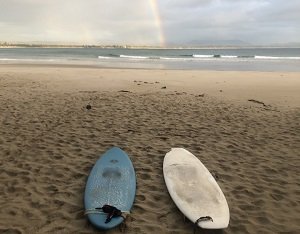
IMG_3848_2
© NCCARF
Climate changes likely to affect surf breaks
Sea-level rise
Sea-level rise (SLR) is considered to be the most significant risk to surf breaks. Projections indicating an increase of 0.6–0.9 metres by 2090 under the high-emission RCP 8.5 scenario, and exceeding 2 m under extreme conditions.
SLR affects surfing conditions by reducing the interaction between ocean swells and the sea floor, whether that is a reef or sandbar, which is the process essential for shaping swells into high-quality surfing waves.
When the water gets deeper, waves lose less energy over reefs or sand, which weakens the surf breaks and reduces the times when conditions are ideal for surfing. This impact is particularly pronounced at reef and point breaks, where depth remains relatively fixed compared to beach breaks influenced by shifting sand.
Sea-level rise is also expected to increase the tidal range, which means reefs and sandbars will be exposed for shorter periods, which will reduce the time waves can form properly. This risk is highest for reef and point breaks that rely on low tide, while beach breaks vary depending on sand movement. Overall, surf breaks across Australia are likely to be affected.
Storm patterns and other risks
Changes in storm patterns are expected to compound these risks.
Weather events such as Tropical Cyclones and East Coast Lows both generate high-quality surf, however both are projected to decline in frequency in a changing climate. By 2090, Tropical Cyclones are expected to decline by 25%, while East Coast Lows are expected to decline by up to 50%. This would reduce the number of days with good quality (large, powerful) surf waves.
At the same time, TC intensity is expected to increase by 17%, amplifying episodic erosion and causing greater damage to coastal infrastructure.
ENSO-driven rainfall variability will further heighten storm surge and flooding risks. Heavy rainfall events may also lead to more harmful algal blooms and poor water quality which may pose health hazards for ocean users.
about Tropical Cyclones and East Coast Lows, which often are a boon for surfers!
Impacts on seven iconic Australian surf spots
Seven iconic surf spots around Australia are described to illustrate the effects of climate change, as projected for 2090 – 2100. These seven spots are:
- Noosa, and Burleigh Heads in Queensland
- The Pass (Byron Bay), Lennox Head and Angourie in Northern New South Wales
- North Narrabeen in the Nothern Beaches area of Sydney
- Bells (Winki Pop, Rincon and The Bowl) in Victoria
- Main Break (Margaret River) in Western Australia.
Noosa and Lennox Head breaks are considered to be the most at risk. Margaret River's Main Break is considered to be least affected.
'Endangered' waves
about a Surfrider Foundations' initiative on Endangered Waves, which are defined as under a threat that is identifiable, imminent and within reasonable proximity to the break.
What are potential adaptation options?
Adaptation strategies in the report include restoring dunes and coastal vegetation to buffer erosion and storm surge, and implementing beach nourishment programs to maintain beach width and surf quality. Artificial reefs can be deployed to enhance wave conditions while providing physical barriers to erosion.
Managed retreat and zoning policies could help limit development in high-risk areas and protect key surf spots. Advanced monitoring and modelling tools are critical for predicting sand movement and informing timely interventions.
Community engagement initiatives such as designating surfing reserves and promoting sustainable tourism, could help preserve the that cultural and recreational values of surfing of climate affected future waves.
To cite:
This case study was prepared by NCCARF.
Please cite as: NCCARF, 2025: Waves under pressure: climate change impacts on surf breaks. Case study for CoastAdapt, National Climate Change Adaptation Research Facility, Griffith University, Gold Coast.