


At a glance
- Environmental DNA (eDNA) was used to rapidly detect fish species in two degraded northern NSW wetlands – Everlasting and Tuckean – providing a baseline for future ecological restoration efforts.
- The study identified diverse fish communities, including important commercial and recreational species, as well as alien and rare species. Limited upstream movement of estuarine species highlighted ongoing connectivity issues.
- While eDNA offers sensitive species detection, it cannot determine abundance or life stages. Follow-up using conventional sampling methods is recommended to validate results and support effective restoration planning.
The two largest wetlands in northern NSW
Everlasting swamp, in the lower Clarence River catchment, and Tuckean swamp, in the lower Richmond River catchment, are among the largest freshwater wetlands on the NSW north coast.
Both swamps have been heavily modified, including extensive networks of drains, channels, floodgates, weirs as well as altered natural waterways. This has resulted in major water quality issues.
The modified hydrology at both locations has created landscapes that frequently generate large volumes of deoxygenated water, affecting fish populations and aquatic ecosystem health.
Sample collection and analysis
Between February to April 2023, a NSW Fisheries project team collected eDNA water samples across six zones in the two wetlands. Five sites in each zone were sampled in each zone at both high and low tides over one or two days to maximise biodiversity detection and to determine any tide-related movement of fish. A minimum of 10 samples were collected from each zone and filtered onsite to reduce DNA degradation.
DNA was extracted from the samples using a Qiagen PowerSoil Kit and species were identified with VSEARCH software. While most detections could be confirmed at the species level, a few cases could only be resolved at genus or family level.
In total, the team detected 36 taxa in the Everlasting Swamp and 42 fish taxa in the Tuckean swamp and these spanned a wide range of coastal marine, estuarine and freshwater species.
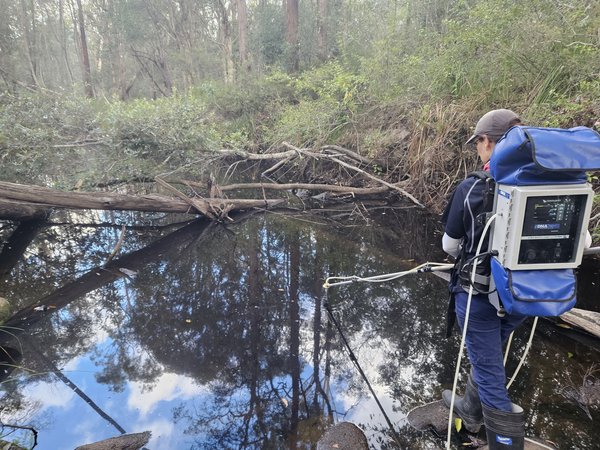
Field staff collecting eDNA water sample in the Warragai Creek zone in the Everlasting Swamp study area, April 2023.
- © Butler et al, 2024CS_eDNA_NSW1
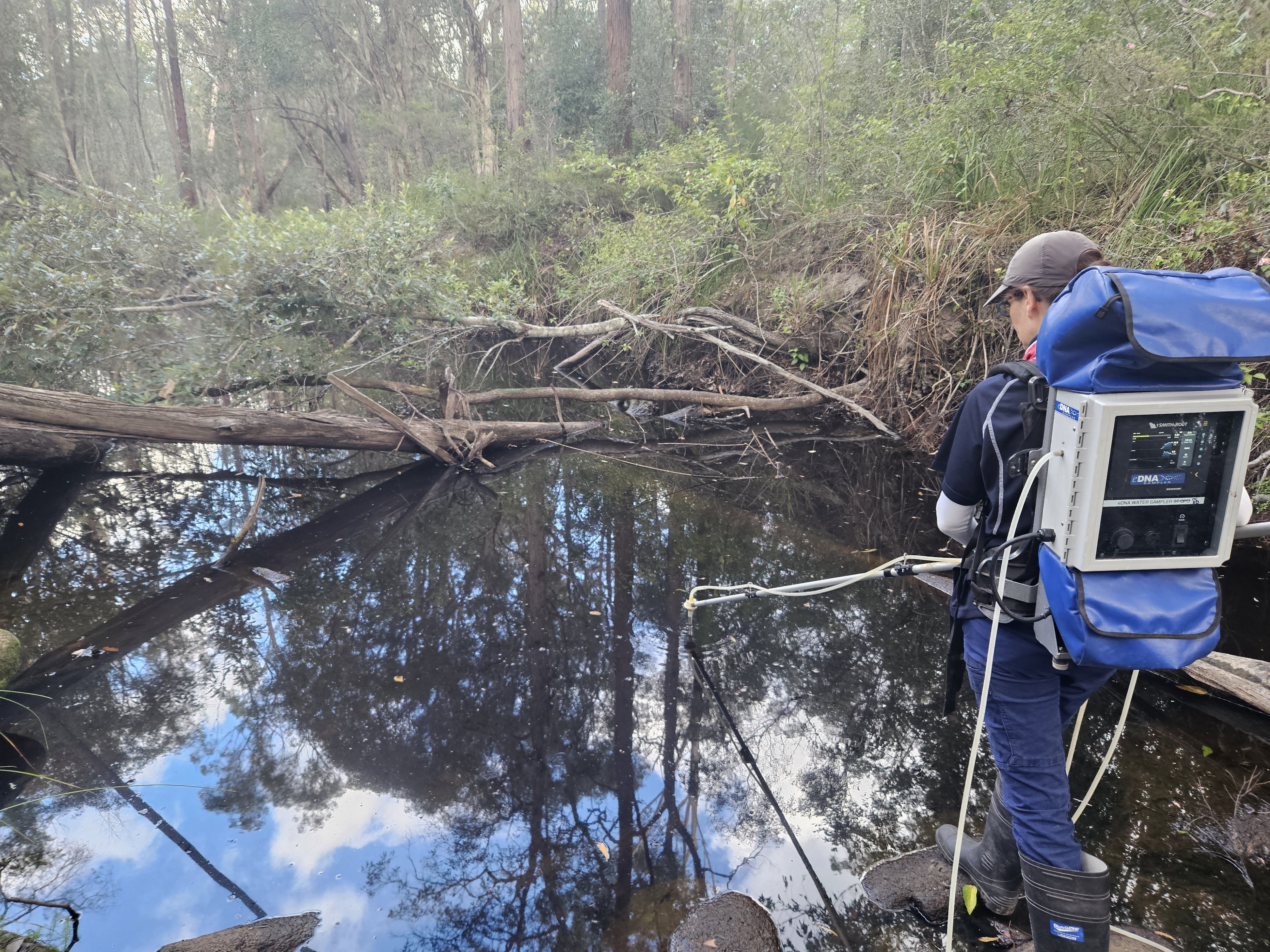
Field staff collecting eDNA water sample in the Warragai Creek zone in the Everlasting Swamp study area, April 2023.
© Butler et al, 2024
Key findings
In each swamp, there were differences in the species detected across tidal cycle. The authors note that there may be an element of chance if an animal was detected or not and this result required a deeper understanding of fish behaviour and activity to interpret with confidence tide-related patterns.
A small proportion of species were detected infrequently, which indicates that they are rare in the study areas. Sampling also detected the DNA of three alien species in each swamp.
Despite the apparent degraded state of the swamps, the results suggest several important recreational and commercial fish species continue to use both wetlands and nearby waterways.
Although an eDNA detection cannot distinguish between life-history stages, given that coastal wetlands are known to be important nursery habitats for fish, the authors believe it is likely that juveniles as well as adults of these and other important species are using both wetlands.
The eDNA results showed that while several marine and estuarine species were detected in both study areas, they appear to be mostly restricted to downstream areas – very few appear to be moving to upstream extremities of either wetland – highlighting limited connectivity that needs to be addressed.
READ: more about NSW coastal wetland rehabilitation
READ: the full project report by Butler et al. 2024
Limits to eDNA
The detection sensitivity of eDNA is one of the main reasons why it is increasingly being used to determine the presence of fish in all types of environments. The method is proving particularly useful for detecting species in low abundance or not easy to sample, such as identifying isolated populations of threatened species or detecting new incursions of exotic species.
In this study, the fish assemblage in both wetlands was dominated by relatively common and endemic species but a small number of threatened and rarer species were also detected. These isolated detections require further investigation before they are validated.
False positive or negative findings can occur due to factors such as PCR and extraction biases and the risk of sampling contamination. So, follow-up sampling using more conventional methods such as electrofishing and netting is needed to validate findings and allow future management actions to proceed with greater confidence.
Future studies
Repeating the eDNA sampling in the future will help assess if restoration efforts are effecting species richness of fish in both systems.
Key questions about life stages and size structure, as well as the abundance of different species cannot be determined using eDNA alone. For a more complete picture, future surveys should include complementary sampling techniques (e.g. netting, underwater video, electrofishing, stable isotope analysis). These will provide better insights into benefits of rehabilitation activities in terms of habitat connectivity, water quality, and ecological processes.
To cite:
This case study was prepared by NCCARF.
Please cite as: GL Butler, Cameron LM, Rourke ML, Ebner BC, Bowen C, St Vincent Welch J, Poitras N, Martins CL, Osbourne M, Dwyer P, Griffiths J, Impey R, 2024. eDNA fish monitoring informs restoration of degraded wetlands. Case study for CoastAdapt, National Climate Change Adaptation Research Facility, Griffith University, Gold Coast.