



At a glance
Researchers used long-term coastal erosion data from the Otway Ranges to estimate how long dinosaur footprints survive on shore platforms, helping inform conservation and management of these significant fossil sites.
The study found that a typical 5 mm deep mould dinosaur footprint has an average preservation age of about 20 years, although lifespan can range from as little as 4-6 years to several centuries depending on local erosion rates, rock type, elevation, and rock hardness.
Results showed that footprints located higher on shore platforms generally erode faster and have shorter lifespans, while those closer to the seaward edge tend to persist longer due to lower erosion rates.
The research highlights the need for ongoing monitoring and conservation measures, particularly for low-relief or rapidly eroding footprints, and suggests that more resistant cast (positive-relief) footprints may survive considerably longer than mould (negative-relief) tracks.
Using erosion data to help conserve prints on a rocky shore
Dinosaur footprints are commonly found on rock intertidal ledges called shore platforms. The same erosion process that exposes such footprints also destroys them. The longevity of these footprints is unknown and therefore their sensitivity to changing climates is poorly understand which limits their management.
Using the world’s longest record of platform downwearing, the researchers assessed the longevity of dinosaur footprints in the Otway Ranges made by the ‘Southern Hunter’ Australovenator wintonensis. They estimate a mean preservation age of around 20 years for the studied prints, based on a downwearing rate of 0.25 mm/yr. However, the longevity could vary from 4 – 6 years up to centuries due to the wide range of erosion rates (0.008 – 1.8 mm/yr) found in this geological setting, which is closely influenced by rock type, elevation and hardness.
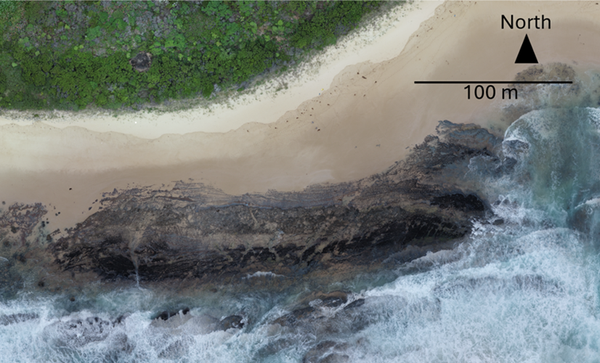
Dinosaur footprint tracks are located on the landward end of the Browns Creek shore platform along the Otway coast in Victoria.
- @ Runjie YuanDinosaur footprints_sml
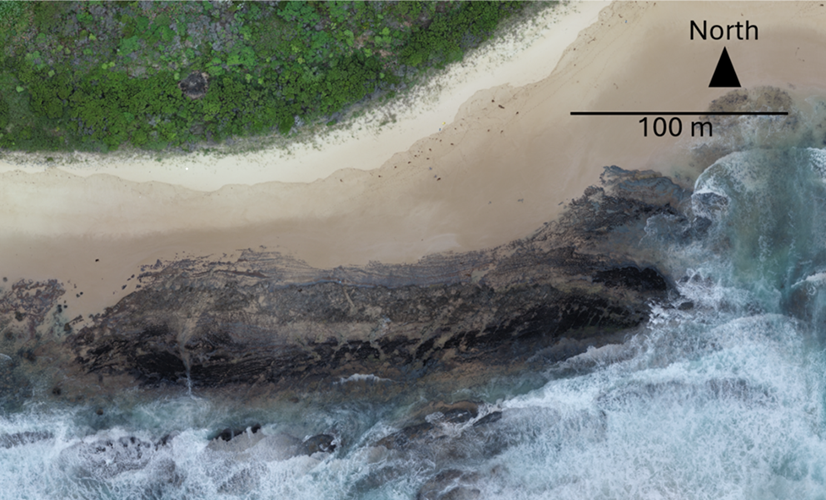
Dinosaur footprint tracks are located on the landward end of the Browns Creek shore platform along the Otway coast in Victoria.
@ Runjie Yuan
Background and context
Fossil tracks are produced by the contact between the planar surface of the feet of ancient animals and a sedimentary substate. They tend to be more abundant in fine-grained sandstones and mudstones. On the contemporary rocky coast, which are erosional landforms formed by the action of marine and subaerial processes, fossil tracks are revealed in situations where erosion is granular in scale and the intertidal surface slowly lowers in the vertical plane.
Erosion is a continual process in these geomorphic environments so a process that exposes the prints will also eventually destroy them. Degradation caused by natural weathering processes and subsequent erosion has long been recognised as one of the primary threats to these vulnerable paleontological features, yet to date little quantitative research has been conducted through measurement of actual erosion. Therefore, determining the timescale of longevity of fossil tracks on shore platform surface is critical in the conservation management of these heritage sites.
Globally, rates of downwearing on shore platforms range between <0.1 and 5 mm/yr, and on sandstones and mudstones it is 0.2 – 1.4 mm/yr. Rates of erosion peak in the intertidal zone, especially near the mean higher high water level (MHHW). The challenge for managers is that the same conditions that are ideal for exposing fossil tracks are the same for destroying them.
The aim is to understand the geomorphological context
Dinosaur footprints within the Otway Basin in south-eastern Australia are extensively found along the shore platforms of the region, which coincidentally hosts the world’s longest continual monitoring sites of platform downwearing.
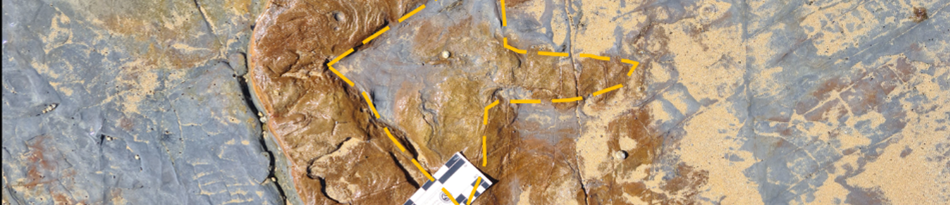
Early Cretaceous Ornithopod dinosaur footprint tracks were discovered on a shore platform at Browns Creek in 1989, nicknamed the ‘Skenes Creek tracks’ and representing the first trackways described in Victoria. At this site, two mould footprint tracks of 5 mm negative relief prints are exposed in mudstones at the landward end of a shore platform.
Using this site as a field laboratory, the researchers aim to explore the future preservation potential of the fossil tracks. The key is to understand the geomorphological context of the positioning of fossil tracks on shore platforms and their vulnerability to erosion and subsequently, the need for longer-term management and preservation.
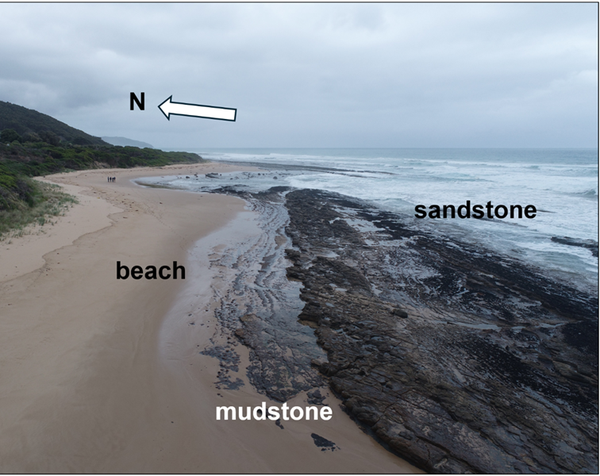
Oblique UAV aerial photos of the shore platform at Browns Creek from the west view. The mudstone layer is overlain by the sandstone layer which is located more seaward. Beach is accumulated at the rear of the platform
- © Runjie YuanUAV
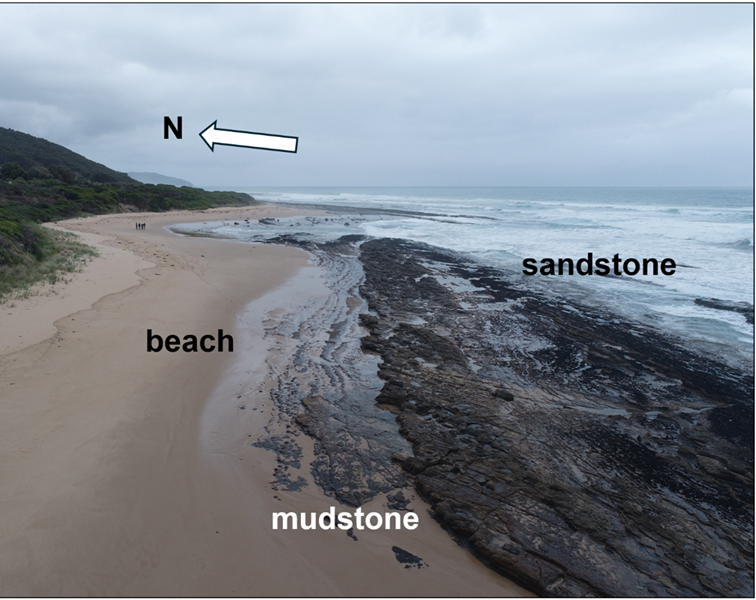
Oblique UAV aerial photos of the shore platform at Browns Creek from the west view. The mudstone layer is overlain by the sandstone layer which is located more seaward. Beach is accumulated at the rear of the platform
© Runjie Yuan
Methods used to explore the morphology
To explore the longevity of fossil tracks on the coast, the researchers used bedrock downwearing rates obtained from shore platforms along the Otway coast. These records were obtained using a micro-erosion meter (MEM) on a monitoring network installed between Lorne and Marengo.
This coastal monitoring project was initiated by researchers from CSIRO in the late 1970s and reactivated by coastal scientists from the University of Melbourne in 2010. A total of 43 MEM observation sites are still operational.
A digital elevation model (DEM) of the shore platform at Browns Creek was created from an unoccupied aerial vehicle (UAV) survey to describe the platform morphology. Rock hardness of the footprint-hosting bedrock was measured with an L-type Schmidt Hammer. Hardness is important to measure so as to ensure the use of erosion records from the most similar rock types to where the prints are found.
the journal paper by Yuan and Kennedy (open access).
Research outcomes
- By applying the MEM erosion records, a mould dinosaur footprint of 5 mm negative relief may have an average preservation age of 20 years under a mean downwearing rate of 0.25 mm/yr. However, due to the wide range of obtained erosion rates, the longevity could vary from as short as 4 – 6 years with the maximum rates of >1 mm/yr, up to centuries with minimum rates < 0.01 mm/yr.
- The downwearing rate of shore platforms is influenced by different factors such as rock type, surface elevation and rock hardness. When assessed with erosion rates obtained from similar rock type (mudstone), surface elevation (MHHW mark) or rock hardness, the dinosaur footprint at Browns Creek may have an expected longevity of 33, 10 or 20 years, respectively.
- Because of the flat and smooth surface micro-topography of the footprint-hosting bedrock, the erosion of the mudstone bedrock is primarily driven by subaerial weathering processes through granular-scale disintegration rather than the wave-induced large block removal.
- Influenced by the different efficacy of subaerial weathering in breaking down bedrock across the platform, a general spatial pattern of fossil track longevity is shown that those located at higher, inland section tend to have faster erosion and shorter longevity while located at lower, seaward section tend to have slower erosion and longer longevity. However, this general pattern may ignore the complexity in shore platform erosion in the field.
- Compared to the mould dinosaur footprint, the natural cast dinosaur footprint track, such as those found at Knowledge Creek along the Otway coast, is filled with quartz and sand grains cemented with hematite. As a result, the fossil feature itself is more weathering resistant and reasonable to expect a lifetime over decades or even longer.
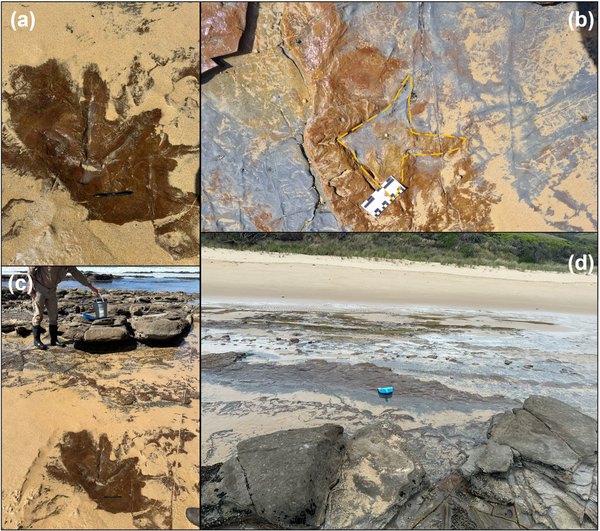
Close-up of two mould footprints in (a) track 1 and (b) track 2 exposed on mudstone and (c, d) their relative position to the overlying sandstone layer in front (seaward). A pen (0.14 m in length) near track 1 and a scale card (0.15 m) near track 2 are for scale
- © Runjie YuanFootprints mould
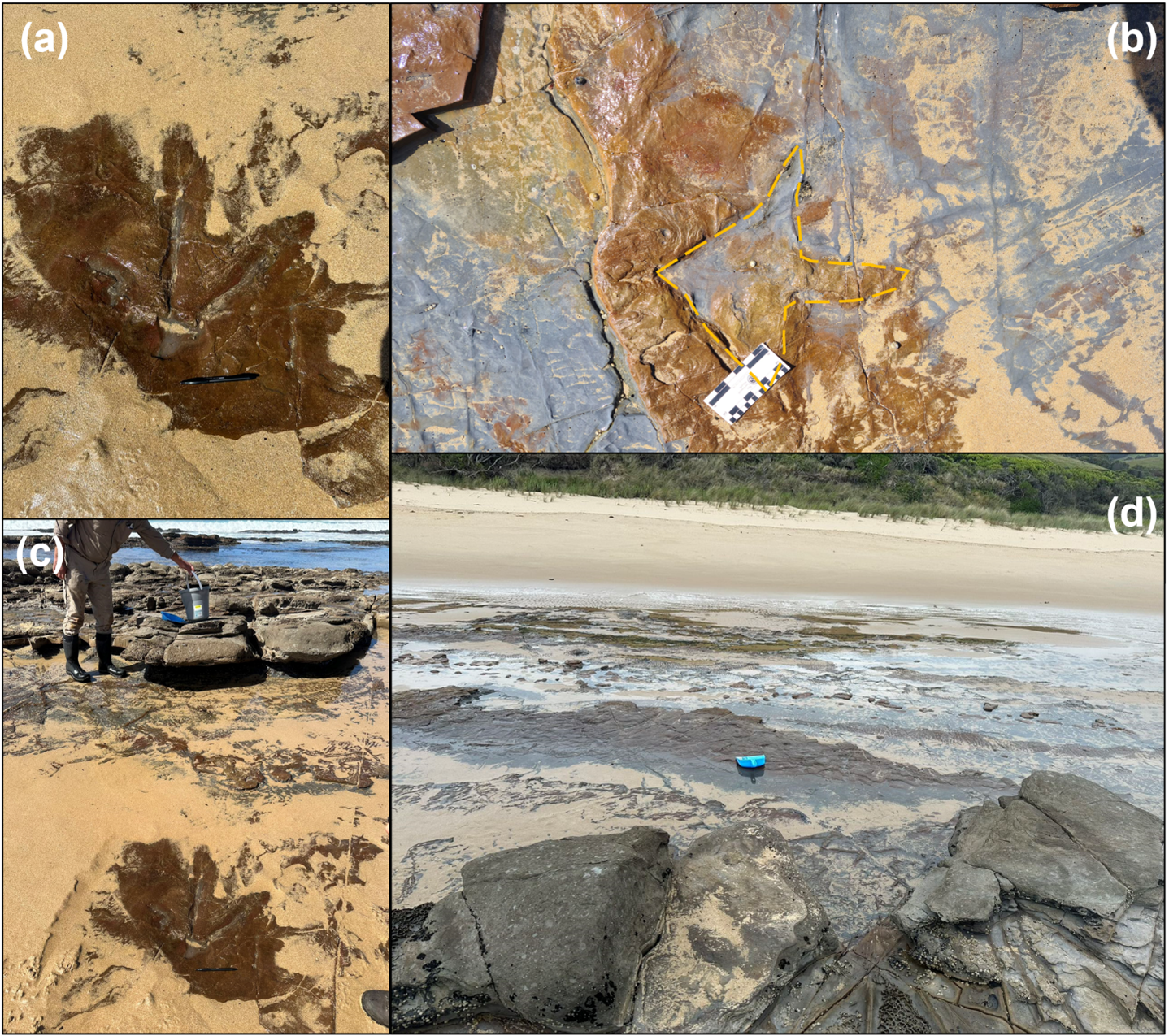
Close-up of two mould footprints in (a) track 1 and (b) track 2 exposed on mudstone and (c, d) their relative position to the overlying sandstone layer in front (seaward). A pen (0.14 m in length) near track 1 and a scale card (0.15 m) near track 2 are for scale
© Runjie Yuan
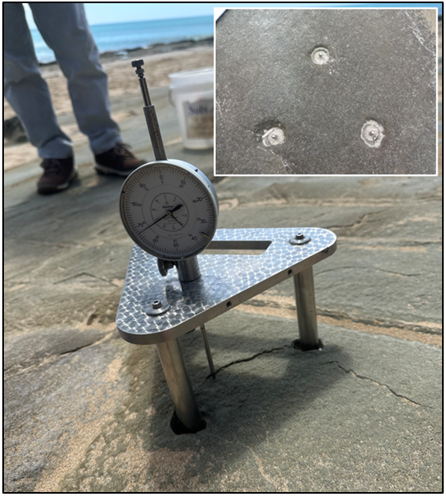
Micro-erosion meter (MEM) on a bolt site installed on the shore platform along the Otway coast, a monitoring site consisting of 3 bolts shown in the inset. The distance between two bolts is 0.15 m
- © Runjie YuanMEM

Micro-erosion meter (MEM) on a bolt site installed on the shore platform along the Otway coast, a monitoring site consisting of 3 bolts shown in the inset. The distance between two bolts is 0.15 m
© Runjie Yuan
Conclusions
- For a mould dinosaur footprint of 5 mm negative relief, its average preservation age is 20 years along the Otway coast but could range from as short as 4 – 6 years up to centuries across the shore platform due to the spatial variation in bedrock downwearing rates.
- Fossil sites located at higher, inland section tend to have faster erosion and shorter longevity while at lower, seaward section tend to have slower erosion and therefore longer longevity.
- Influenced by the depth of the footprint and its position in the intertidal zone, fossil sites of low relief (1 – 2 mm) or located in the fast-eroding zone (seaward) of the shore platform have correspondingly short longevity. Immediate conservation measures, including both in situ (cast/mould replica) and ex situ (removal) approaches, should be conducted to save the features from continual erosion.
- To better understand the evolution of fossil tracks in the erosive coastal environment, non-destructive monitoring techniques such as laser scanner and close-range SfM photogrammetry can be used to build the 3D models of the micro-topographic footprint features and calculate their erosion over long-term repeat observations.
- The cast (positive-relief) footprint tracks may have longer lifetime than the mould (negative-relief) tracks in the field.
- The role of beaches formed on the rear of the platforms was not investigated but likely is significant. Whether this influence enhances preservation through protection by burial, or enhances erosion through providing abrasives into the surf zone is unknown and requires significant further research.
To cite:
This case study was prepared by Runjie Yuan and David M Kennedy, University of Melbourne. Please cite as: Yuan R and DM Kennedy, 2025: Exposure and preservation of dinosaur footprint tracks on the coast. Case study for CoastAdapt, National Climate Change Adaptation Research Facility, Griffith University, Gold Coast.