



At a glance
- The Solomon Islands has been actively addressing the urgent challenge of climate change-induced displacement through a formal program of managed relocation.
- This case study provides an update for the 2016 CoastAdapt case study that outlined an adaptation strategy for the community of Choiseul Bay township in the Solomon Islands.
- In 2022 the Solomon Islands Government developed relocation guidelines that aim to ensure a relocation process upholds the rights, dignity, and cultural heritage of the relocating communities. The diverse and significant challenges involved in relocating communities, making progress slow and difficult.
- Also, in the Solomon Islands, the Walande community self-relocated in 2015 and is still experiencing many uncertainties.

Relocation becomes more urgent but remains just as hard
The Solomon Islands has been actively addressing the urgent challenge of climate change-induced displacement through a formal program of managed relocation.
This case study provides an update for the 2016 CoastAdapt case study, which described the approach used to prepare a climate change adaptation strategy that requires communicating complex scientific messages in a simple way, and integrating the science and technical outputs of a hazard and vulnerability assessment into meaningful and responsive planning outcomes.
the 2016 CoastAdapt case study, Choiseul Bay Township Adaptation and Relocation program, Choiseul Province, Solomon Islands
CSS3_Map
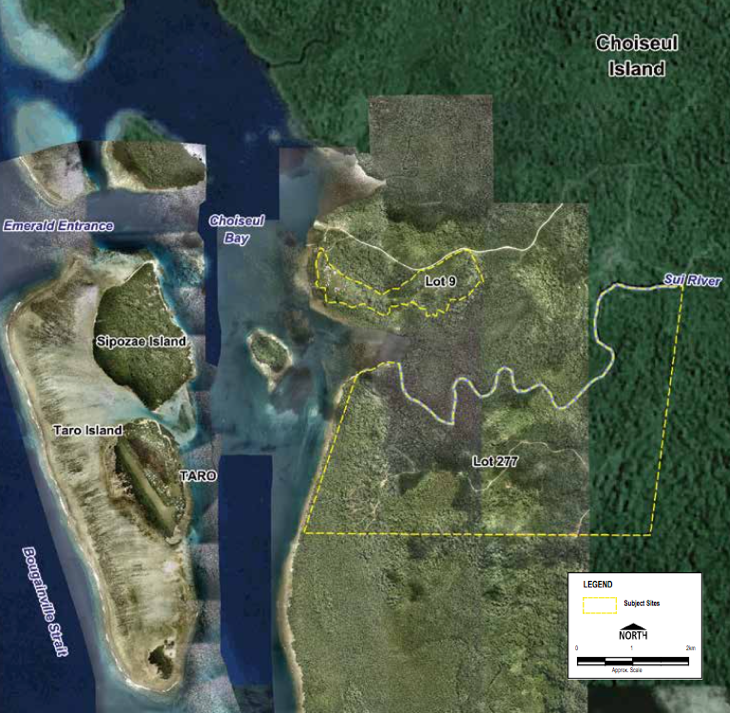
Choiseul Bay locality, showing Taro Island and adjacent mainland sites.
© Haines 2016.

Choiseul Bay locality, showing Taro Island and adjacent mainland sites.
- © Haines 2016.CSS3_Map
Choiseul Bay locality, showing Taro Island and adjacent mainland sites.
© Haines 2016.
What's happened in Choiseul Province since the 2016 case study?
While the original adaptation plan for Choiseul Bay highlighted the urgent need for relocation and outlined a comprehensive strategy, it has taken more than a decade to move beyond planning into active implementation.
In 2025, the Solomon Islands Government officially elevated the Choiseul Bay Township Project (CBTP) to a national priority, committing significant resources to accelerate development. Construction is underway, with progress on construction of roads and utilities. Funding gaps and logistical challenges remain the biggest obstacles.
to a 2021 podcast by the ABC' Pacific Prepared about the relocation, the CBTP project; The first community in the Pacific re-located amid disaster fear
Solomon Islands launches relocation guidelines in 2022
In 2022, the Solomon Islands Government, with support from the International Organization for Migration (IOM), launched the country's Planned Relocation Guidelines. These guidelines provide a structured framework outlining the institutional arrangements and detailed steps to be followed before, during, and after relocation.
These guidelines aim to ensure that any relocation process upholds the rights, dignity, and cultural heritage of affected communities while minimising social disruption and environmental impact. They promote a participatory approach that actively engages these communities in decision-making, ensuring their needs and preferences shape the relocation plans.
This approach also includes support mechanisms such as livelihood restoration, infrastructure development, and social services to help relocated communities restart their lives sustainably.
Implementation of these guidelines remains slow.
Planned relocation guidelines cover

READ: the Solomon Government's planned relocation guidelines launched in 2022.
READ: the Solomon Government's planned relocation guidelines launched in 2022.
Planned relocation guidelines cover
READ: the Solomon Government's planned relocation guidelines launched in 2022.
Snapshot of another community: 'No more land' prompts community relocation of Walande
In 2015, the 800 people of the Walande community moved from a small artificial island to mainland Malaita due to rising seas and intensifying storms.
This community-led planned relocation to a place known as 'Small Malaita' was driven by the lack of available land on the original island and the increasing threat of sea-level rise, illustrating how this climate-affected populations was driven to find new homes. By 2009, about 85% of the original island area had disappeared, leaving little space for homes or livelihoods.
The relocation, which predated the Planned Relocation Guidelines by several years, was community-inspired, -led and largely self-financed, with minimal government or international assistance.
However, moving islands and also moving more inland has not resolved this community's climate-induced challenges. They now content with land tenure disputes, uncertainties of resettlement and sustaining livelihoods, as well as still experiencing sea level rise in their new location.