


At a glance
- The study explored how different priming strategies (future‑focused, altruism‑focused, and past‑focused) influenced coastal property owners’ views on climate adaptation options.
- It shows that carefully designed priming can help shift attitudes toward more sustainable, forward‑looking coastal climate adaptation policies
- Future‑focused priming was the most effective, encouraging participants to discuss responsibilities to future generations and showing greater openness toward adaptive, nature-based coastal management strategies.
- Altruism‑focused priming also worked but was harder to implement and carried more risk, while past‑focused priming was counterproductive and reduced constructive adaptation dialogue.

'Climax thinking' on the coast
Being able to speak to affected communities about climate change and the difficult decisions ahead is critical to adaptation. A study in Canada that tested the impact of 'priming' on discussions of coastal adaption,
The research used a novel climax thinking framework to test the influence of three experimental priming treatments on perceptions of coastal adaptation among coastal residents in Nova Scotia – a vulnerable coastal area, where communities face decisions about their responses to climate change.
The study concludes that the more productive discussions are those that help to orient people towards considering the needs of future generations.
Structuring conversations about adaptation
The research investigated how to foster productive discussions with coastal residents about nature-based coastal adaptation. In 2019, through 14 online focus groups, the researchers from Dalhousie University in Canada compared the impact of three experimental priming treatments on conversations with coastal residents about nature-based coastal adaptation options. Online delivery enabled participation among a widely distributed rural population.
Climax thinking is an emerging framework for understanding undesirable resilience to public good landscape change. It is the widespread misconception that our current landscapes are ideal or even fated. Priming is a way to set the scene for a target audience to make desirable associations with messages.
Priming is a way to set the scene for a target audience to make desirable associations with messages.
The focus groups – setting the scene
In the focus groups, participants viewed interactive material, such as videos and short polls, via computer and received audio through a phone. The calls lasted 75-90 minutes and participants were paid C$75 to participate. Each group contained five to eight participants.
In enlisting participants, the researchers selected people who owned property in three different coastal areas – Atlantic, Northumberland and Bay of Fundy – anticipating that they may have different experiences and also allowing them to present adaptation options relevant to their area.
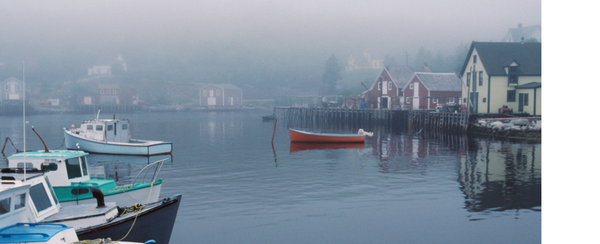
harbour in Nova Scotia

© Freeimages.com
The groups commenced with participants describing their particular coast. All the groups watched a five-minute video that introduced the impacts of climate change across the Nova Scotia coast. This was designed to develop a shared understanding about climate impacts. Following a short poll, they shared local experiences of climate change impacts.
Another video provided some vocabulary for talking about coastal protection options, including hard versus soft protection, accommodation and retreat. In this way, the researchers were able to assess the participants’ perception of the different options.
Three different priming treatments
After this general introduction, facilitators applied a specific priming treatment to each group. The three treatments were:
- Past priming sought to convey to participants that the dramatic changes needed for coastal adaptation are only the most recent in a long line of changes that people have faced on the same coast as their needs have changed.
- Future priming sought to explore the idea that adaptation would not erase people’s enjoyment of living on the coast.
- Altruism priming sought to explore the benefits of associating sacrifices in the name of climate change with other satisfactions of collective action.
Facilitators presented specific questions to each group to generate discussion. The final component for all the groups was a short video about viable ‘nature-based’ options. After each of the options was described, participants did a poll about whether they supported its use on their coast. Then they responded to a poll about their preferred solution. The subsequent discussion explored perceptions of these nature-based options, what coastal residents would need to know before using or accepting them and how to talk to coastal residents about them.
Climax thinking, explained simply, and how it was implemented in the focus groups. Source: Sherren et al. 2022.e
| Past | Future | Altruism | |
|---|---|---|---|
| Pathology- Exceptionalism | Previous land uses were just paving the way for this one. | Future generations matter less than this one. | Someone else should need to accept change before I do. |
| Pathology - Uncertainty | There were no previous land uses. | Current solutions will continue to work in future. | Local landscape decisions do not affect people elsewhere. |
| Focus group priming | This change is just one of many your coast has faced over time as needs change. | The things you love about being on the coast will persist under adaptation. | We have faced big challenges together before and can do so again. |
| Specific discussion topics | How has your coast changed for reasons other than climate change (e.g., economy) and how did the community cope? | What do you love about this coast that you hope future generations will get to experience, and what is your duty to those future residents? | How did the residents of your community face wartime mobilization and what made that possible? |
Impact on conversations about coastal adaptation
Short survey-based pre and post tests were carried out to provide a test of climax thinking and assess changes due to the focus group treatments. Most participants did not yet feel the issue was urgent but this did vary by treatment. Some past-primed participants were quite apathetic about adaptation and seemed to think that everything possible to combat coastal change was already being done. Others were concerned about the impacts of climate change and believed that changes need to be made. But they thought the next generation should be the group to champion those changes.
In the altruism-primed focus groups, participants seemed aware of the need to change and adapt and were mostly willing to make that change. There was a sense that in times of need people could be spurred into action. Participants appeared concerned about making responsible and positive changes rather than making changes just to protect what they had.
The future-primed groups featured quite urgent language around the need for change. The common reactions of future-primed participants suggest that the priming treatment was able to emphasize the time sensitivity of adapting to climate change.
The control groups, by contrast, showed very little urgency. Overall, they did not appear interested in coastal adaptation, except to protect existing coastal infrastructure and shoreline options.
While priming in communication is only a starting point, this experiment suggests that climate adaptation practitioners can reduce climax thinking by using future or altruism-focused communication strategies. The researchers recommend that future work should test these strategies among larger groups and in different jurisdictions.
To cite:
This case study was prepared by NCCARF. Please cite as: NCCARF, 2024: Communicating coastal futures in Canada. Case study for CoastAdapt, National Climate Change Adaptation Research Facility, Griffith University, Gold Coast.