


At a glance
- There are many sources of climate data and information in Australia. Some provide general information while others are sector- or region-specific and also supply the underlying data.
- A resource developed by NESP Climate Systems Hub helps users identify the most appropriate climate portal to look for historical and future climate data and information. It compares key characteristics and features for Australia’s major portals.
- The focus here is on future climate projections but some places listed also offer historical data.
- This information was collected in 2024 and there are likely to be some changes within the portals since then (such as shift from use of CIMP5 to CIMP6 data).
Climate portals for Australia
Australia has a growing number of climate data portals, each developed with a specific user in mind and offering different datasets, formats and levels of detail.
For coastal planners from various backgrounds and expertise, it can be confusing to know which portal us most appropriate to use.
The guide, developed by the National Environmental Science Program Climate Systems Hub, aims to help simplify these choices by comparing the common climate data portals.
- the full suite of portals reviewed in the 2024 report Navigating Climate Portals developed by the National Environmental Science Program Climate Systems Hub.
- the state portals are also listed in the NESP report, but also listed in the relevant CoastAdapt state page.
NESP cover 2
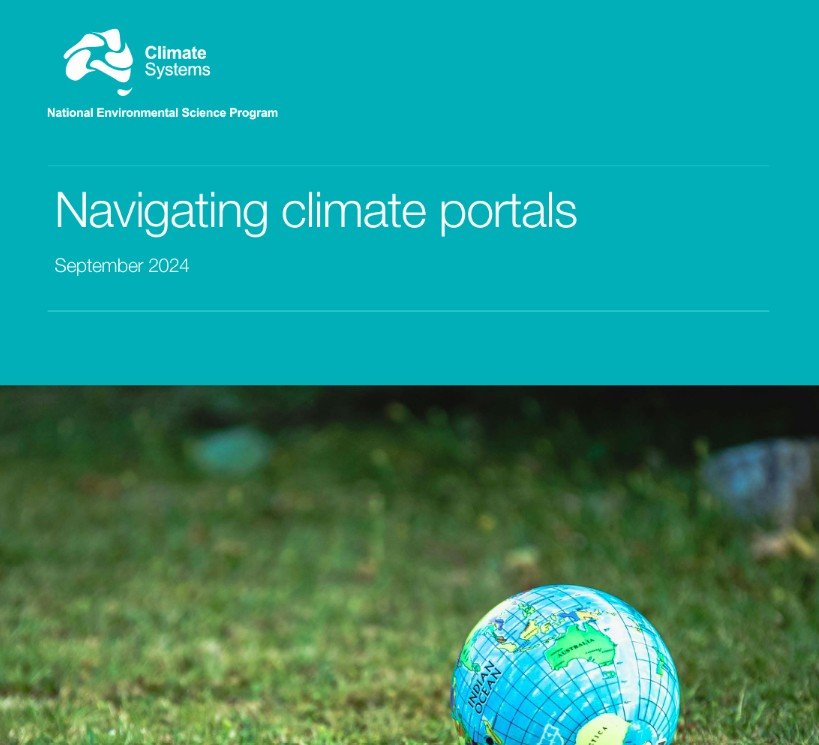
The Navigating Climate Portals guide compares the main climate data portals relevant for Australian.
NESP Climate Systems Hub 2024.
The Navigating Climate Portals guide compares the main climate data portals relevant for Australian.
- NESP Climate Systems Hub 2024.NESP cover 2
The Navigating Climate Portals guide compares the main climate data portals relevant for Australian.
NESP Climate Systems Hub 2024.
What is a climate portal?
Broadly, a climate portal is a tool that takes complex scientific information - in the form of climate modelling outputs - and translates it into more accessible and practical formats such as maps, graphs, or downloadable datasets to help decision making.
- What climate portal you use depends on your decision context and scale.
- There may not be one single climate portal or dataset - you might need to use more than one.
- Begin broad and then focus or layer in more specific datasets.
Summary of climate portals useful for coastal planning
The two tables below are a summary of the portals most likely to be useful for coastal decision makers (mostly at the 'novice' to 'intermediate' level) as assessed in the NESP report.
Not all the attributes summarised in the NESP report are included here, but there should be enough information to help you screen which portals may be most useful for your needs. You can check out the NESP report for more attributes of each portal or go to the portal itself (see link in Further Information)
Australian (national) climate portals
| Portal name (expertise required) | Sector | Region | What do you get? | Climate indices/ variables |
|---|---|---|---|---|
| Climate Change in Australia – Regional Climate Change Explorer (Novice/intermediate) | General | NRM superclusters, clusters and sub-clusters | Brief summaries | Temperature (extremes) Rainfall (extremes) Drought Coastal Fire Evapotranspiration Solar radiation Humidity |
| Climate Change in Australia - Analogues Explorer (Intermediate) | Environment Agriculture Infrastructure Services General Corporate | Point location (cities, towns) | Matches future climate at a location with a location where the current climate is like projected climate | Temperature Rainfall |
| Climate Change in Australia – Extremes Data Explorer (Intermediate) | Environment Infrastructure Services Corporate | NRM clusters and sub-clusters | Seasonal box plots | Coldest night Hottest day Wettest/1-in-20-year wettest day |
| Australian Climate Service Portal (Intermediate) | Services Infrastructure | National State Local government | Climate model output (5-10km) Maps | Rainfall (extremes) Temperature (extremes) Fire Tropical cyclones Drought |
| My Climate View (Novice - intermediate) | Agriculture Environment | Point location | Snapshot table (pdf) and charts (csv, png) for any location Choice of commodity | Rainfall Temperature Evapotranspiration Soil moisture Extremes |
| CoastAdapt (Novice) | Land Coastal Sea-level rise General adaptation guidance | National Local government Coast/ shoreline | Infographics Case studies Charts Maps | Coastal Temperature Rainfall |
| Coastal Risk Australia (Expert) | Services Infrastructure Environment | National | Map with inundation overlap | Coastal |
| Canute3 (Expert) | Coastal planning Environment Infrastructure | National coast/ shoreline Point location | Maps, charts and tables (csv) | Coastal (tides, waves, SLR) |
International climate portals relevant to Australia
| Portal name (expertise required) | Sector | Region | What do you get? | Climate indices/ variable |
|---|---|---|---|---|
| IPCC Interactive Atlas (Intermediate - expert | Corporate Environment General | Worldwide AR6 WGI reference regions Major basins Point location | Online map viewer Time series | Temperature and rainfall (extremes) Wind Evapotranspiration Rel. humidity Coastal |
| Copernicus Climate Change Atlas | Corporate Environment General | Worldwide European Countries/ regions AR6 WGI reference regions User defined | Online map viewer Time series Climate stripes | Temperature and rainfall (extremes) Wind Evapotranspiration Rel. humidity Coastal Radiation |