

What is Sea Country?
Sea Country is how Aboriginal and Torres Strait Islander peoples describe the coastal, estuarine, and marine areas that form part of their traditional Country.
Sea Country, also known as saltwater country, is not an add-on to land-based Country, rather it is part of integrated land-sea domain. It extends beyond the coastline and water to include the animals, plants, tides, currents, reefs, seabed, islands, stories, and cultural practices, rites and responsibilities connected to these places.
A key message about Aboriginal culture is respect for country and by respecting country we ensure that the landscape is managed sustainably for the future.
DPI (no date)
Through their own words: descriptions from mob
a video that explains Sea Country in words and images of local mob in Lutruwita, (Tasmania) (15 mins)
"Our island home is shaped by the coastline,
yet our connection to Country extends beyond these shores"
Produced by the Great Southern Reef and supported by the Centre for Marine Socioecology (UTas).
a video about Yuin mob's battle for Indigenous fishing rights in southern NSW. Long time campaigner, Uncle Wally Stewart, talks about the history of their connection with Sea Country and the importance of cultural access (2 min).
“It was a rich place to grow up.
We are coastal people, we’re called Katungal, which means seafood”
more about First Nation's adaptation responses and Sea Country through CoastAdapt's case studies on Caring for Sea Country.
What about climate change?
During the more than 60,000 years that Indigenous people have occupied this land, there have been many changes. One significant change is that sea levels have risen dramatically by more than 100 metres.
Researchers have collated stories from 21 locations around Australia that describe events associated with post-glacial sea-level rise more than 7,000 years ago, before sea level reached its present position.
These stories by Nunn and Reid (2016) provide evidence of long-term environmental knowledge, demonstrating how Indigenous knowledge systems can preserve observations of coastal change across thousands of years and offer valuable insights into past climate and shoreline transformations.
A case of coastal change in South Australia
Indigenous narratives from South Australia preserve detailed memories of coastal transformation, including the flooding of former land connections and the creation of islands as sea levels rose.
These stories show how Indigenous knowledge systems have recorded and transmitted observations of coastal change for thousands of years, offering valuable insights into past and future responses to sea-level rise. Read more about the "example of Ngurunderi in South Australia" in Nunn et al 2025.
Learning from Indigenous weather knowledge
Today, Indigenous groups living on Country are observing many changes due to a shifting climate.
Indigenous seasonal calendars are built on millennia of close observation of plants, animals, weather patterns, and ecological cues.
These calendars offer rich insights into weather, climate, and environmental patterns passed down through countless generations. For Aboriginal and Torres Strait Islander peoples, these observations guide life on Country and reflect a deep, enduring connection to the land, waters, and skies.
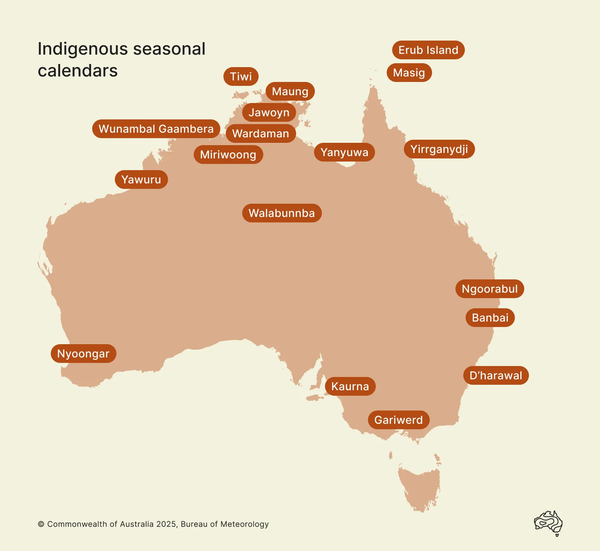
The Bureau of Meteorology hosts several Indigenous seasonal calendars, acknowledging their significance and the custodians who maintain them.
Indigenous seasonal calendars:
- some co-produced by Indigenous groups with CSIRO, as well as some resources for, and lessons learned from, the process of developing these resources.
- some hosted by the Bureau of Meteorology, which acknowledges their significance and the custodians who maintain them.
indigenous-weather-knowledge-calendars-map.png
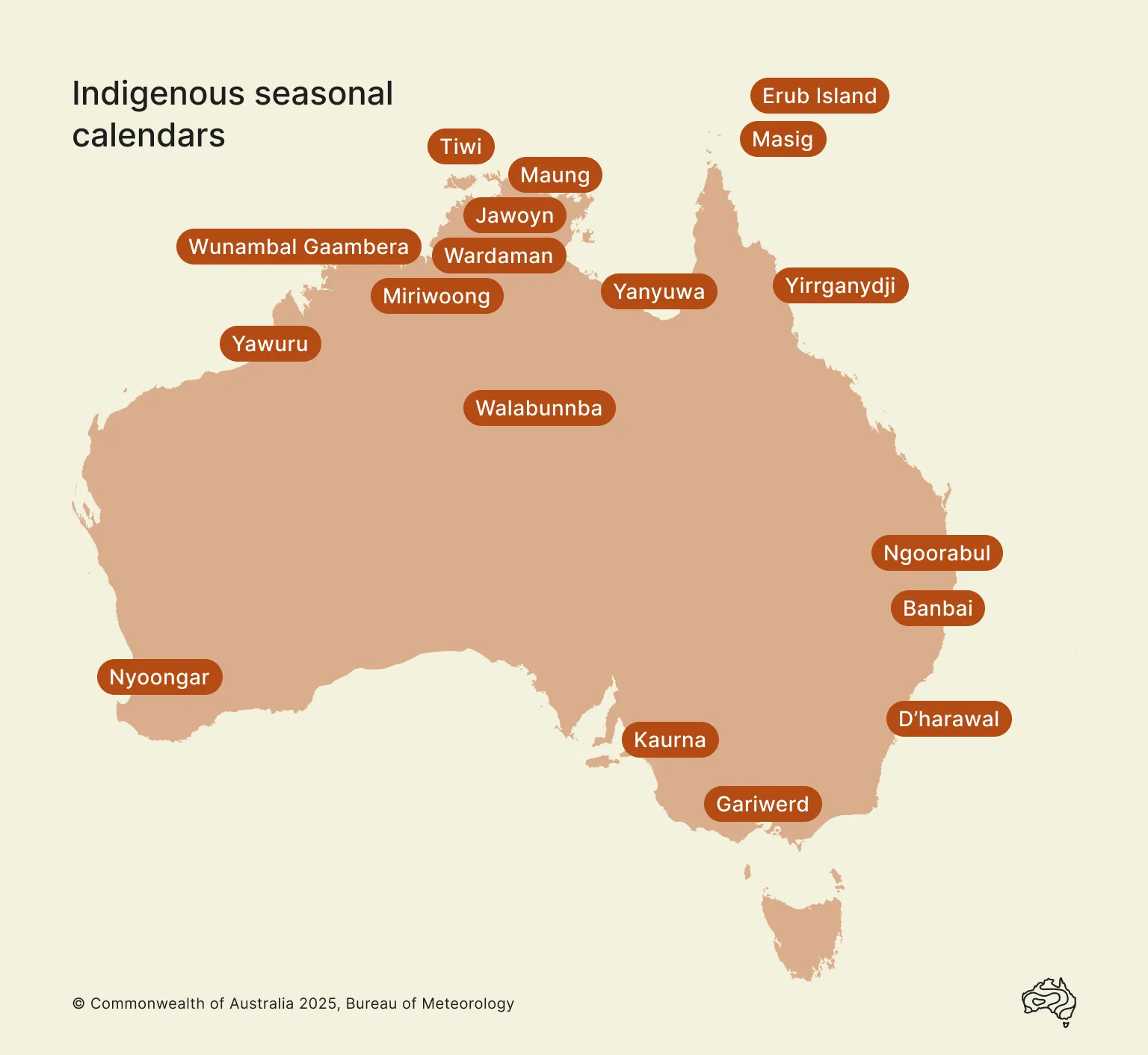
The Bureau of Meteorology hosts number of seasonal calendars on their website
@ Commonwealth of Australia 2025.
CSIRO suggests that the importance and significance of these calendars are:
- strengthening and sharing knowledge within language groups, including between Elders and younger generations.
- providing an educational tool for learning in local schools and within the wider community.
- increasing awareness of the richness and diversity of Indigenous seasonal knowledge and connection to Country, especially through classroom use.
- serving as a boundary object (or prompt for discussion) that supports knowledge‑sharing with partners for joint management of natural areas, informing water planning, and guiding Indigenous‑led land and sea management.
your understanding of Free Prior Informed Consent (FRIC) when engaging with First Nations groups.