


At a glance
- The climate system can undergo abrupt, irreversible shifts known as tipping points, triggered when critical thresholds are crossed and reinforced by self‑amplifying feedbacks.
- Several major tipping points – including Greenland and West Antarctic ice sheet collapse and low‑latitude coral reef die‑off – may be triggered around 1.5°C of global warming, posing severe long‑term risks such as rapid sea‑level rise.
- Tipping points are low‑probability but high‑impact, yet they carry systemic risks for ecosystems, economies, and societies, and require precautionary, long‑term planning, especially for critical, long‑lived infrastructure.
- Preventing Earth system tipping points requires emission cuts, limiting and shortening any temperature overshoot above 1.5°C, and addressing non‑climate drivers like deforestation and pollution.
Risk of abrupt climate change
Current climate projections, and most guidance (including that by CoastAdapt), relies on steady, IPCC-projected increases in temperature, sea level, and extreme events such as storms, floods, and bushfires. However, the Earth’s climate system also has the potential for abrupt change. Some abrupt changes are also known as climate tipping points.
A tipping point is defined by the IPCC as a critical threshold beyond which a system reorganises, often abruptly and/or irreversibly.
IPCC (AR6)
A climate tipping point is a critical threshold: beyond this the Earth’s climate system can shift abruptly from incremental warming into a new state that leads to cascading changes with severe impacts.
Crossing this threshold typically triggers self-reinforcing changes driven by internal feedbacks, with profound consequences for climate, ecosystems, and society. Tipping point risks are often interconnected, meaning that crossing one tipping point can increase the likelihood of crossing others.
From a risk perspective, tipping points are low probability but high consequence events, which means they can likely to be disruptive and devastating. Their effects can propagate through ecosystems, food systems, geopolitics, and financial stability, posing systemic risks and potentially triggering social tipping points in vulnerable regions.
There is strong scientific consensus on the importance of tipping points, but their timing and speed remain uncertain due to the complexity and interconnectedness of the climate system. Applying the precautionary principle calls for proactive action despite these uncertainties.
The precautionary principle suggests that uncertainty is not an excuse for inaction. Even if the timing or magnitude of tipping points is not precisely known, these risks must be considered in long-term decision-making.
One of the most significant risks involves ice sheet collapse. If the Greenland or West Antarctic ice sheets reach their tipping points – which is potentially triggered at current or slightly higher global warming levels – then sea levels could rise more than 1.5m above current projections within the next century.
Such an increase would dramatically reshape Australia’s coastline and pose severe challenges for coastal ecosystems, communities and infrastructure.
In the climate change literature, the term ‘tipping point’ was coined for climate tipping points. More recently, it is also applied to social changes and positive shifts, like rapid adoption of renewable energy or shifts in public opinion that gather momentum for widespread change.
Some academics find this a useful discussion: the term has rhetorical power and helps link messages of urgency with the power of societal transformation.
However, others consider this use of the term stretches the original scientific meaning of abrupt, irreversible changes in Earth systems and makes the concept confusing.
Note: here we discuss tipping points as climate related. We refer to social tipping points as transitions or transformations.
about positive social tipping points in CoastAdapt in Transformations: deeper shifts in adaptation
Key climate tipping points
Climate tipping points include the collapse of major ice sheets, changes in sea ice, shutdowns of ocean circulations, and impacts on the carbon cycle and biosphere.
Identified tipping points are grouped into four categories: ice sheets, sea ice, ocean circulation and biosphere/carbon cycle (see Figure 1). (Table 2 below also has more details)
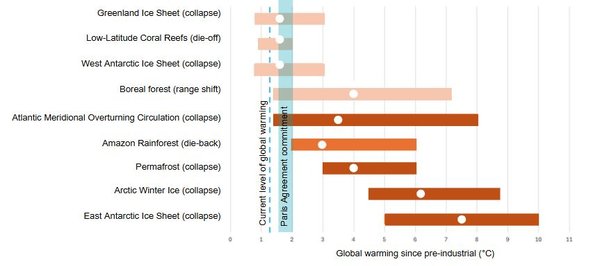
Figure 1: Horizontal bars show the global warming ranges at which eight global and one regional tipping elements relevant to Australia may be triggered.
The white circle on each bar marks the estimated tipping point. The blue dashed line shows the current level of global warming, and the solid blue bar represents the Paris Agreement target.
Bar colors indicate threshold categories:
- light orange indicates below 2 °C (within the Paris Agreement range)
- orange indicates between 2 °C and 4 °C (possible under current policies)
- brown indicates 4 °C and above.
No data were available for Antarctic sea ice or Antarctic overturning circulation slowdown/collapse (see Table 1).
- © Boulter, 2025. Figure adapted from CSIRO Workshop Report (2024) using Armstrong McKay et al. (2022).Tipping points
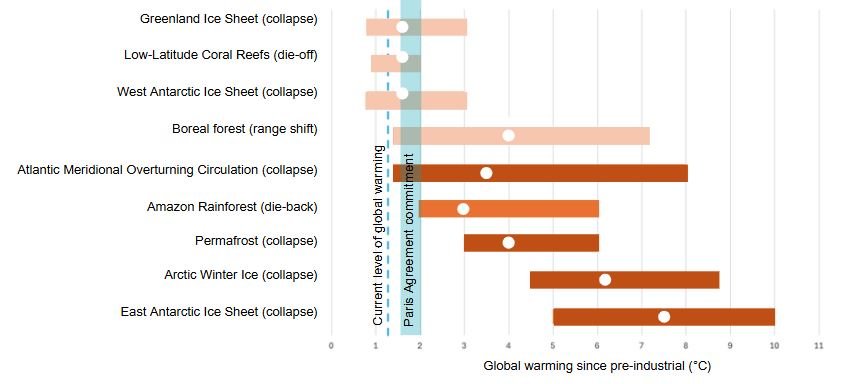
Figure 1: Horizontal bars show the global warming ranges at which eight global and one regional tipping elements relevant to Australia may be triggered.
The white circle on each bar marks the estimated tipping point. The blue dashed line shows the current level of global warming, and the solid blue bar represents the Paris Agreement target.
Bar colors indicate threshold categories:
- light orange indicates below 2 °C (within the Paris Agreement range)
- orange indicates between 2 °C and 4 °C (possible under current policies)
- brown indicates 4 °C and above.
No data were available for Antarctic sea ice or Antarctic overturning circulation slowdown/collapse (see Table 1).
© Boulter, 2025. Figure adapted from CSIRO Workshop Report (2024) using Armstrong McKay et al. (2022).
a 2024 article in The Conversation by CSIRO about dangerous climate tipping points.
Drivers of tipping points help their management
Tipping points can also be grouped into ones with mostly climate drivers or those with a mix of climate and non-climate drivers. This then determines how they can be managed.
For example, Table 1 shows that tipping points are either nearly entirely climate-driven and are not sensitive to anything but mitigation as a prevention strategy (e.g. AMOC collapse), versus those with a mix of climate- and non-climate-related drivers (e.g. coral reef die-off, or Amazon die-back).
| Tipping points predominantly driven by climate | Tipping points driven by a mix of climate and non-climate drivers |
|---|---|
| Glacier retreat (although one driver [black carbon] is regionally generated) | Boreal forests |
| Ice Sheets (Greenland and East & West Antarctica) | Coral reefs |
| Ocean circulation (AMOC, SPG and Southern Ocean) | Dryland degradation |
| Permafrost thaw (except for a small contribution from vegetation change) | Lake browning |
| Sea ice loss (although one driver [black carbon] is regionally generated) | Mangroves |
| Marine regime shifts (fisheries etc) Monsoon Savannah degradation Temperate forests Tropical forests |
In more detail, ocean circulation tipping points AMOC and SPG (Figure 2a) are considered to have only climate-related drivers. Thus, mitigation – reducing greenhouse gas emissions – becomes the key tool and is critical for delaying the tipping point for these ocean systems.
However, coral reefs (Figure 2b) have primary and secondary drivers that are both a mix of climate (ocean warming, marine heatwaves) and non-climate (water pollution, overharvesting). Thus, there are more tools that can be used to slow a trigger.
Mitigation is still the key tool, but there are also adaptation strategies that may support coral health in a specific locality.
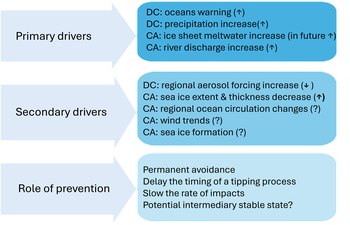
Figure 2a: AMOC/ SPG.
Ocean circulation tipping points have only climate-related drivers.
Pic_AMOS2
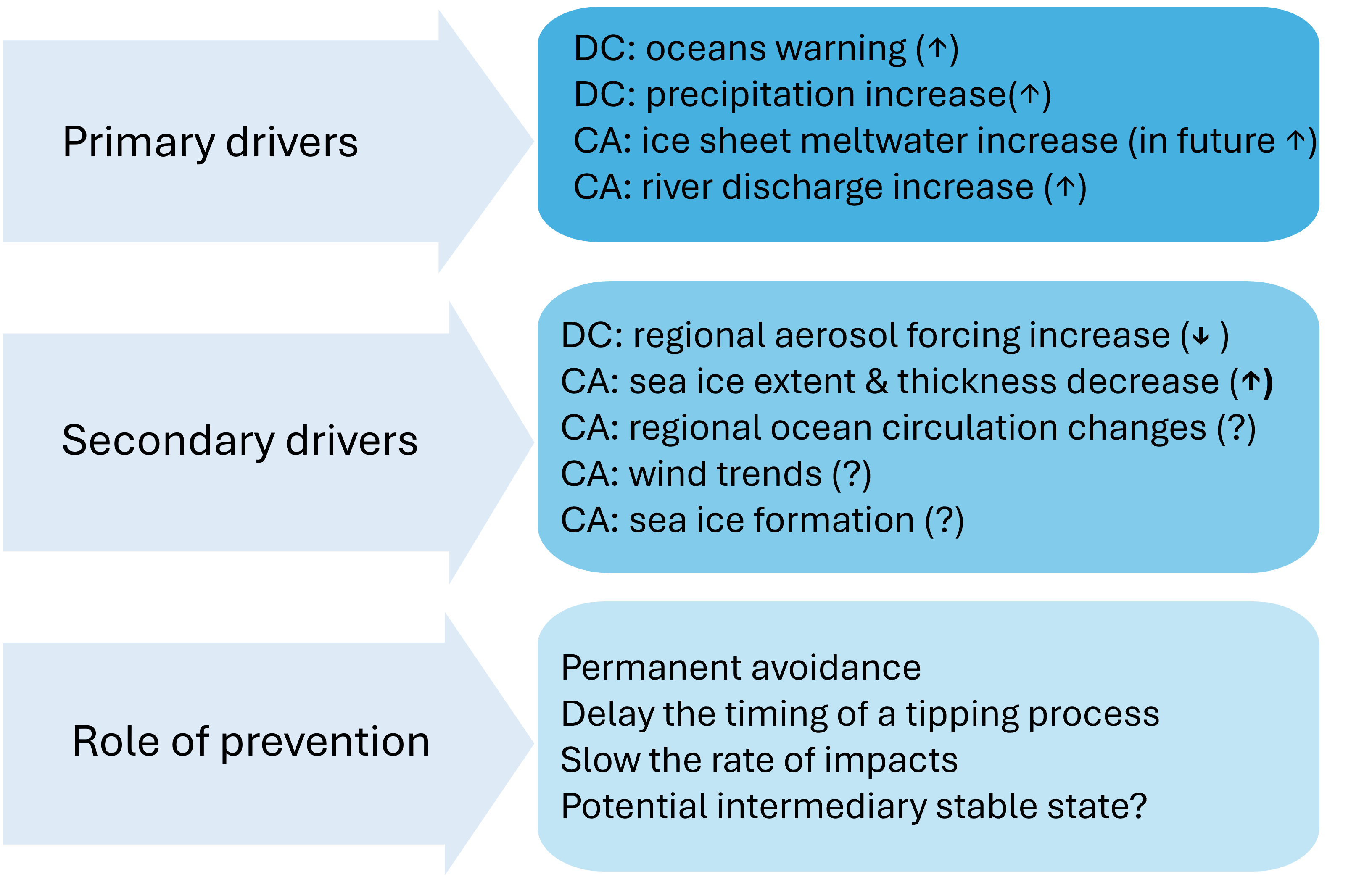
Figure 2a: AMOC/ SPG.
Ocean circulation tipping points have only climate-related drivers.

Figure 2b: Coral reef die off.
Coral reels have a mix of climate and non-climate drivers.
- © Global Tipping Point Report, 2025.Pic_coral die off
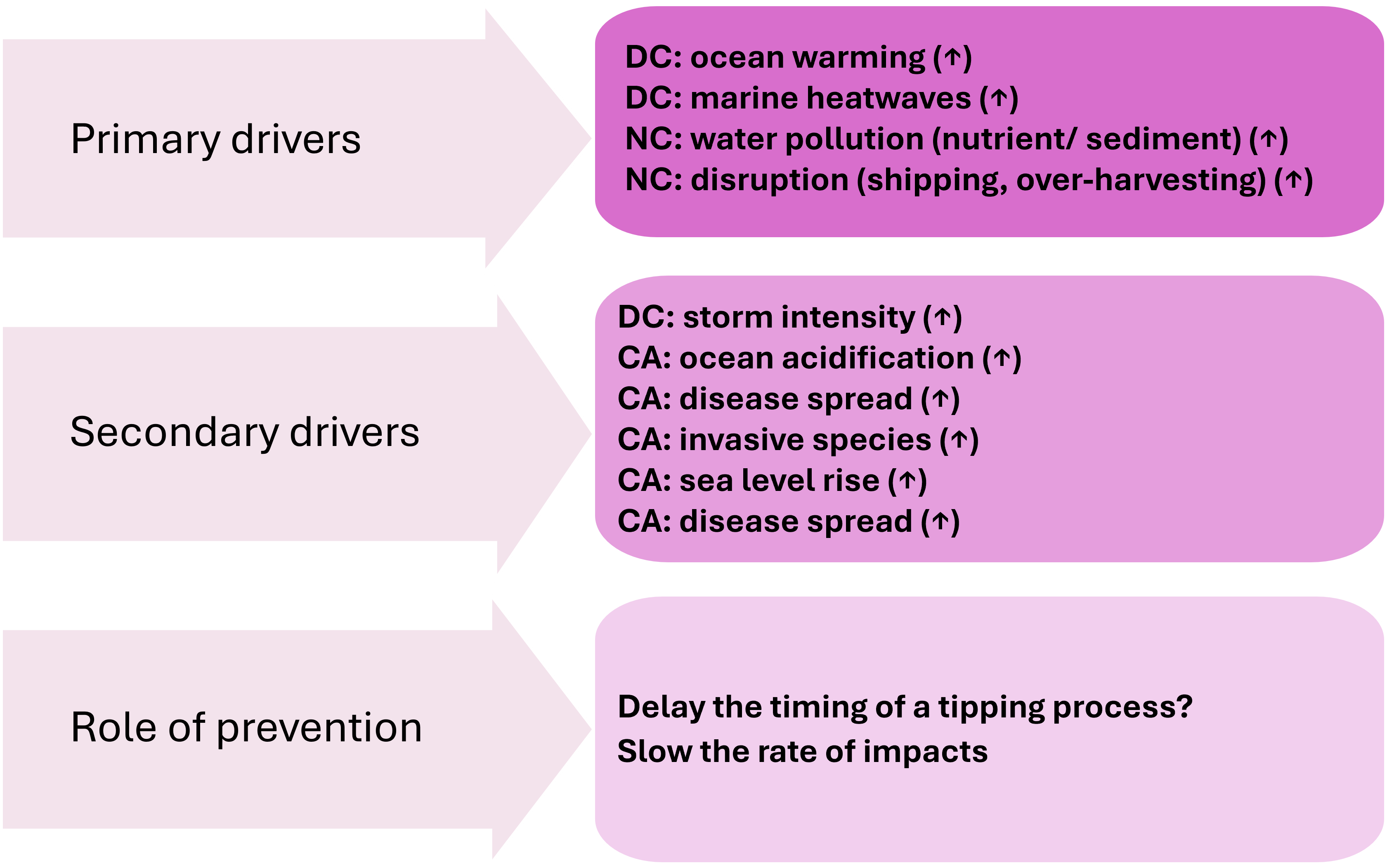
Figure 2b: Coral reef die off.
Coral reels have a mix of climate and non-climate drivers.
© Global Tipping Point Report, 2025.
| Tipping element | Description | Long term impact and timescale | Extra global warming* | Scientific confidence that element is a tipping system |
|---|---|---|---|---|
| Ice sheets and sea level rise | ||||
| Greenland ice sheet collapse | Irreversible retreat/ collapse of the ice sheet to a lower ice state caused by an extended period of warmer temperatures | Sea-level rise - up to 7m taking 1,000 –15,000 years (central estimate 10,000 years) | 0.13 (0.5 – 3) °C | High confidence |
| West Antarctic ice sheet collapse | Irreversible retreat/ collapse of the ice sheet triggered by reaching a threshold of climate warming | Sea-level rise - up to 3.3m taking 500 to 13,000 years (central estimate 2,000 years) | 0.05 (up to 1) °C | High confidence |
| East Antarctic ice sheet collapse | Irreversible retreat/ collapse of the ice sheet caused by reaching a threshold high level of global warming | Major sea-level rise (58m if all melted) under higher global warming scenarios only taking over 10,000 years | 0.6 (up to 2) °C | Medium confidence |
| Sea Ice | ||||
| Arctic winter sea ice collapse | Reduced winter sea ice cover | Additional global warming through ice albedo feedback over 10 - 100 years (est. 20 years) | 0.6 (0.6 – 1.2) °C | Medium confidence it’s not a tipping point but simply a change of state |
| Antarctic sea ice | Change of state to a lower ice area | Unknown, but could include increased warming and changes to rainfall and storms, changes over decades | unknown | Unclear if true climate tipping element, but important implications for Australia |
| Ocean circulation | ||||
| Atlantic Meridional Overturning Circulation (AMOC) slowdown/ collapse | Shutdown or collapse of the AMOC caused by an increased influx of freshwater into the North Atlantic | Dramatic changes to regional climate mainly in the northern hemisphere Unclear impact to Australia Timeframe 15 – 300 years (est. 50 years) | -0.5 °C (-4 to –10) °C regionally in northern hemisphere) | Medium confidence |
| Antarctic Overturning Circulation slowdown/ collapse | Slowdown or collapse in the overturning of dense shelf water (DSW) around Antarctica, linked to the overall global ocean circulation (including AMOC). | Altered southern hemisphere weather e.g. likely drier southern Australia Possible impacts on nutrient upwelling across decades to multi-decades | Model experiments suggest delayed warming of approximately a decade | Medium confidence is a tipping system Important climate feature for Australia |
| Biosphere and carbon cycle | ||||
| Permafrost collapse | Abrupt increase in emissions of carbon dioxide and methane through the thawing of frozen carbon-rich soils | Extra warming across decades to centuries | High confidence it is a regional tipping system Medium confidence it is not a global tipping system | |
| Low-latitude coral reef die-off (regional) | Rising temperatures pushing warmwater corals beyond tolerable levels of thermal stress into an alternative state dominated by macroalgae | Climate, ecosystem and carbon cycle changes in relevant regions across decades | High confidence is a tipping system | |
| Boreal forest range shift | A shift in boreal forests, seeing expansion into tundra to the north and dieback to the south | Unclear what the long-term impacts are, but would occur within 50-100years of collapse (but low confidence) | 0.2 – 0.4°C | Low confidence is a tipping system |
| Amazon dieback | Deforestation and hotter, drier conditions causing dieback of the rainforest and a shift towards savannah | Unclear what the long-term impacts are, but would occur within 50 –200 years (est. 100) and could contain abrupt changes | Depends on partial loss (~0.1 °C) or total loss (~0.2 °C), more regionally | Yes, tipping system High confidence in local impacts, low confidence in full dieback |
The top three tipping points - are we there yet?
Three tipping points are likely to be reached at a global climate threshold of 1.5°C: the collapse of the ice sheets of Greenland and West Antarctic and die-off of coral reefs at low latitudes.
The two ice sheets: Greenland and West Antarctic
The Greenland and West Antarctic ice sheets are shrinking at an accelerating rate and may already be passing tipping points. If this triggering occurs, sea level could rise by more than 1.5m on top of current rates of projected within the next 100 years and dramatically impact Australia’s coastline.
Low latitude corals
Warm‑water coral reefs are experiencing unprecedented die‑offs due to repeated mass bleaching driven by global warming and other human‑caused stressors. Already exceeded are their central thermal tipping point – about 1.2°C above pre‑industrial levels – and their upper limit of 1.5°C may be reached within a decade.
Even in the most optimistic scenario where warming stabilises at 1.5°C with no overshoot, the collapse of coral reefs is still virtually certain (>99%). Therefore, the Paris Agreement targets (1.5–2°C) are insufficient to prevent irreversible tipping.
What do decision makers need to consider?
For most coastal planning decisions in Australia, climate tipping points do not need to be the primary consideration. Current scientific evidence suggests that tipping points are unlikely to significantly alter climate projections before 2100. Therefore, existing climate projections remain the most reliable basis for planning.
However, the level of consideration depends on the timeframe and criticality of the decision.
- Short term decisions:
- Coastal managers can continue to rely on current climate projections for decisions with shorter planning horizons.
- Critical, long-lived infrastructure:
- For assets with long design lives and low tolerance for failure - such as ports, hospitals, airports, desalination plants, or major greenfield developments - tipping points should be included in a broader risk assessment.
- These projects are considered to have long design lives and low tolerance for failure. These are likely to require expert modeling of multiple scenarios, including those that consider tipping points risks.
Broader societal issues to consider
Current climate policies assume slow, predictable change, which mean most climate governance tends to overlook the risks of tipping points and the need for coordinated cross-border action.
Managing these risks requires new way of governance through systemic approaches, global cooperation, and policies designed for the complexity of Earth’s systems.
to environmentalist, George Monbiot about the need for systemic change.
Preventing the crossing of ESTPs is unlikely with existing measures for climate change mitigation. It requires the following.
- Keeping the peak global temperature as close to 1.5°C as possible, i.e. minimising the height of temperature overshoot. Every additional 0.1°C increases the risk of transgressing ESTPs.
- Keeping the duration of temperature overshoot above 1.5°C as short as possible (every year counts) and returning global average temperatures to below 1.5°C.
- Minimising temperature overshoot requires:
- frontloaded mitigation pathways with the heaviest cuts this and next decade
- immediate development and scaling of sustainable carbon removal capacities.
- Addressing non-climate drivers of tipping, such as deforestation (e.g. Amazon rainforest) and pollution (e.g. warm-water coral reefs).
Source: Lenton et al. 2025