


At a glance
- Sea-level rise is already happening: global sea levels have risen over 22 cm since 1900, with faster increases since 1970, particularly in northern and southeastern Australia. Reducing emissions can slow future rise, but it will not stop the upward trend, making long-term adaptation essential.
- With most Australians living within 50 km of the coast, rising sea levels pose immediate risks. Regional variations add complexity, requiring localised planning and adaptation strategies.
- Everyday sea levels (i.e. before sea level rise is considered) are influenced by natural factors that occur across days, months and years such as weather, tides, and climate drivers including El Niño.
- Increasing atmospheric and ocean temperatures are causing sea levels to rise around the world. The main climate factors that will continue to drive sea-level rise are ocean warming, which causes water expansion, and melting polar ice, which adds mass to oceans.
- In the future, melting polar ice will play an increasing role in sea-level rise, while glacier melt’s role will decrease over time, highlighting the need for adaptive strategies based on evolving contributions.
- Secondary drivers of sea-level rise include groundwater extraction which (as the extracted water returns to the sea) increases sea levels, while dam construction (which has largely halted) will have less effect in slightly reducing future sea level rise.
- Rising seas and warming are not uniform. Regional variability comes from factors like ocean currents, atmospheric pressure, and land subsidence. Coastal planning must reflect these local realities.
Sea level rise is already happening
Sea level rise is already happening and is certain to continue. Global mean sea level has risen by over 22 cm since 1900, with half of this rise occurring since 1970. Across the Australian region, rates of sea level rise vary with the largest increases to the north and south-east of the Australian continent.
Even if greenhouse gas emissions reduce, global sea level will continue to rise for centuries. Reducing our emissions is important as it will help to slow the rate of sea-level rise, but it will not reverse the rising trend.
Rising sea levels are a major adaptation challenge for Australia as most of our population live in towns and cities within 50 km of the coast. Although we know sea levels will be higher, sea level does not rise uniformly around the coast: it varies regionally, which adds complexity for planners and decision makers who need to understand their local context.
Understanding sea-level rise is essential to predict and manage its impacts on the coastal environment. As sea levels continue to rise, there will also be a rise in the hazards associated with extreme sea levels, such as storm surges and waves. Monitoring and adapting to these changes will be crucial for mitigating the impacts on coastal communities.
What is ‘sea level’ before it is ‘sea level rise’?
Understanding what influences the height of the sea before accounting for climate change is important for understanding how the phenomenon of sea-level rise works.
On a normal day, the height of the sea is affected by several natural processes. These processes, while influenced by climate change, operate independently from the direct drivers of long-term sea-level rise.
They include local weather such as wind and waves; factors such as astronomical tides; seasonal effects with ocean water expanding in warmer months and contracting in cooler ones; and change from year to year due to climate drivers like El Niño.
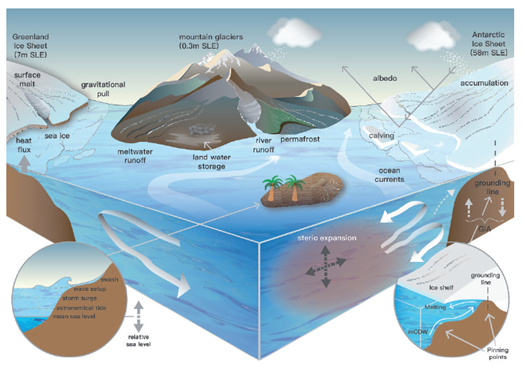
Figure 1. Climate-sensitive processes and components that can influence global and regional sea level
- Source: Fox-Kemper et al., 2021#301_slr graphic
Figure 1. Climate-sensitive processes and components that can influence global and regional sea level
Source: Fox-Kemper et al., 2021
What climate factors contribute to sea level rise?
Expanding water and melting ice
Increasing atmospheric and ocean temperatures are causing sea levels to rise around the world. There are two main mechanisms through which climate change accelerates sea-level rise:
- expanding water: as the oceans warm due to increased atmospheric temperatures, the sea water warms and expands, raising sea levels – a process known as thermal expansion.
- melting ice: ice stored in glaciers and polar ice sheets (particularly in Greenland and Antarctica) melts and so adds mass to the oceans.
- These two factors are responsible for most of the observed rise in sea levels in recent history. Between 1901 and 2018, melting glaciers contributed 41%, thermal expansion (38%) and the melting of ice sheets in Greenland (25%).
Other factors that affect sea-level rise include land water storage, which includes dams and underground aquifers.
- Dams impound water and so reduce the amount of water flowing to the sea and so reduce sea levels by a small amount. Globally, dam building has now largely stopped.
- Groundwater is pumped from underground aquifers for domestic, agricultural and industrial applications that then drains back to the ocean and so contributes positively to sea-level rise.
- In the absence of dam construction, it is increased use of groundwater that now leads to a small positive contribution to sea level rise.
Proportions will change
These proportions will change in the future as melting ice sheets increase their contribution, disappearing glaciers contribute less, and land storage water changes from reducing sea level rise to increasing it.
about these factors and other factors that contribute to sea level rise in the CSIRO 2024 report Sea-level Projections for Australia.
Warming and rising seas are not the same everywhere
Water warming is faster in some areas.
Not all parts of the ocean warm uniformly. Some regions around Australia, have seen faster rates of ocean heat uptake, contributing to regional variations in sea-level rise.
Sea level rise is faster in some areas
Sea level rise is not uniformly distributed across the globe.
Several factors, including atmospheric pressure, ocean currents, and gravitational pull, lead to regional differences in sea-level rise. For example, changes in atmospheric pressure can cause sea levels to rise by 1 cm for every hectopascal drop in pressure. Ocean currents, such as the East Australian Current, also play a role by redistributing water and influencing sea heights.
Changes in the land – known as vertical land movements – can help or hinder the relative rise of the water through subsidence or uplift of land. If the land is sinking, relative sea-level rise will be greater, and vice versa. The land can also subside – due to activities such as groundwater extraction, urban development, and tectonic activity – to increase the impact of rising seas.
What are the impacts of sea level rise in the coastal zone?
Sea-level rise affects coastal areas through inundation and coastal erosion. Inundation occurs when high sea levels cause sea water to move across the land. This can lead to permanent inundation of land and assets or, if as a consequence of extreme sea levels and storm surges, periodic flooding.
Coastal erosion leads to the recession of shorelines and destabilisation of dune systems. It generally occurs when ‘soft’ shorelines, typically made from sand or mud, erode landwards. For sandy beaches, the Bruun Rule is often used to provide a general indication as to the extent of shoreline recession that occurs for every unit increase in sea level (Box 2).
The extent of coastal erosion that will occur in the coming century due to rising sea levels will depend on a range of factors such as:
- the erodibility of different coastal landforms like rocky cliffs, estuaries and rocky beaches
- regional differences in the processes driving erosion
- local factors such as topography and sediment budgets (Department of Climate Change 2009).
about the direct consequences of sea-level rise on coastal sediments and beaches in CoastAdapt
What sea-level rise means for your situation
To cite:
Please cite as: McInnes, K., Zhang, X., Bloustein, H., & Dalla Pozza, R., 2025: Explaining sea level rise: CoastAdapt, National Climate Change Adaptation Research Facility, Griffith University, Gold Coast.
This information was prepared by McInnes, K., Zhang, X., Bloustein, H., & Dalla Pozza, R., from the National Environmental Science Program Climate Systems Hub. National Environmental Science Program’s Climate Systems Hub Oceans and Coasts project.
Visit www.nesp2climate.com.au or contact info@nesp2climate.com.au