


At a glance
- Australia’s climate is changing, which means that long-term averages of climate no longer provide a reliable guide to the future.
- Planning and decision-making for the coast needs to consider recent trends in climate, as well as projected future changes, particularly where there are concerns about community assets or safety.
- Identifying climate trends requires larger regional or national scales, and longer time periods, as climate variability can mask trends in local areas and over short timeframes.
- There is up-to-date climate trend information available for a wide range of climate variables. This information can be readily downloaded and used for risk assessments.

Climate trend information offers a relatively simple way to see change
Australia’s climate is changing, meaning long-term historical averages are no longer a reliable guide to future conditions. Understanding recent trends helps to show how the climate is changing and to support planning, especially where there are risks to communities, infrastructure, and environments.
Climate trend information provides a relatively simple way to detect change over time. For example, examining decades of temperature records can reveal gradual warming, while tracking rainfall patterns over time can highlight shifts in drought frequency or intensity.
Trend analysis is a valuable tool for understanding change over time in climate variables such as temperature, rainfall. This knowledge supports informed decision-making in climate-sensitive sectors such as agriculture, water management, and infrastructure planning, to help effective planning and management of emerging and existing risks. It helps identify long-term patterns that inform operational decisions, such as adjusting crop calendars, planning water allocations, or designing infrastructure for current conditions.
However, trend analysis only reflects the past and present; it does not predict future changes. For investments with long lifespans or high exposure to climate risk, such as roads, dams, or energy systems, you should complement trend analysis with future climate projections to ensure resilience under changing conditions
Understanding climate variability versus climate trends
The climate is naturally variable. Australia spans diverse climate zones, ranging from tropical in the north to temperate in the south, and each region experiences significant variability over time.
For instance, a single wet year in an otherwise dry decade does not indicate a long-term trend. This natural variability needs to be considered when analysing trends to avoid misleading conclusions.
How to analyse climate trends
To do this:
- Consider spatial variation.
- Look beyond local data to broader regional patterns to detect climate trends. Local variability in climate – especially in rainfall – can mask underlying long-term changes.
- Consider temporal variation:
- Examine climate datasets over long time spans, typically several decades or more.
- Check your focus: relying on short-term data alone can lead to decisions that are poorly matched with future climate conditions.
See the example in the box below.
This figure of a time series illustrates how it can be misleading to rely just on a short time frame.
A fire danger dataset may show no trend over a short period (e.g. 1980–1997), but if you consider the complete dataset, there is a clear upward trend around 2000 that indicates a 'jump up' (or regime shift) increase in risk of fire over time.
FIGURE~1
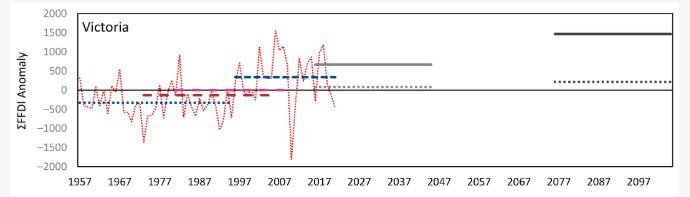
Time series of the annual cumulative Forest Fire Danger Index (FFDI), which is the main measure used in Australia to estimate fire risk. Depending on where you look can determine whether you find a change in the pattern.
© Jones and Rickets 2024. Reproduced under a Creative Common CC BY license

Time series of the annual cumulative Forest Fire Danger Index (FFDI), which is the main measure used in Australia to estimate fire risk. Depending on where you look can determine whether you find a change in the pattern.
- © Jones and Rickets 2024. Reproduced under a Creative Common CC BY licenseFIGURE~1
Time series of the annual cumulative Forest Fire Danger Index (FFDI), which is the main measure used in Australia to estimate fire risk. Depending on where you look can determine whether you find a change in the pattern.
© Jones and Rickets 2024. Reproduced under a Creative Common CC BY license
Trends in climate can settle or spark debate about climate change
Climate change has been a contentious topic, despite the strong scientific consensus around it. Trend analysis is one of the main tools used to support or challenge claims of its existence.
To assess whether the trend has been analysed correctly (whether intentionally or unintentionally) consider the following:
- Check the time period: How long is the data set?
- If only a few years, that should set off alarm bells.
- Check spatial coverage: How broad is the data presented?
- If there is just one station presented, you should question the results
- Has there been a broad regional/global analysis, averaging across a number of stations at each time point?
Misinterpretation or selective use of data can lead to incorrect conclusions. Credible studies use multiple datasets and statistical methods
- Benestad's detailed example of how climate data can be manipulated to support a particular point of view.
- about climate denial, misinformation and disinformation, where trends data can be misunderstood or deliberately misused to argue against the need for action on climate change.
Data for trend information
There is a wide range of information available on recent trends in key climate variables from the:
- Bureau of Meteorology website
- State of the Climate reports. This report is a synthesis of the science that underpins our understanding of Australia’s climate and is produced every two years by CSIRO and the BoM
- Climate Change in Australia website, which is managed by CSIRO and the BoM.
- your relevant state government website.
Climate trend information can be presented in a many ways. This section summarises the most common ways of presenting trends in climate information.
Time series graphics
Time series graphs generally show the climate variable on the y (vertical) axis with time on the x (horizontal) axis.
- For trends in graphs, it is important that data is considered over a reasonably long time period, preferably several decades or longer, as short-term fluctuations - common in daily or monthly observational data - can obscure long-term patterns.
- Averaging the data helps reveal clearer trends.
- These graphs often show anomalies relative to a fixed baseline, which ensures consistency when combining data from multiple stations.
An example of a time series graph from the State of the Climate 2024.
Time series eg_Bom SoE2024
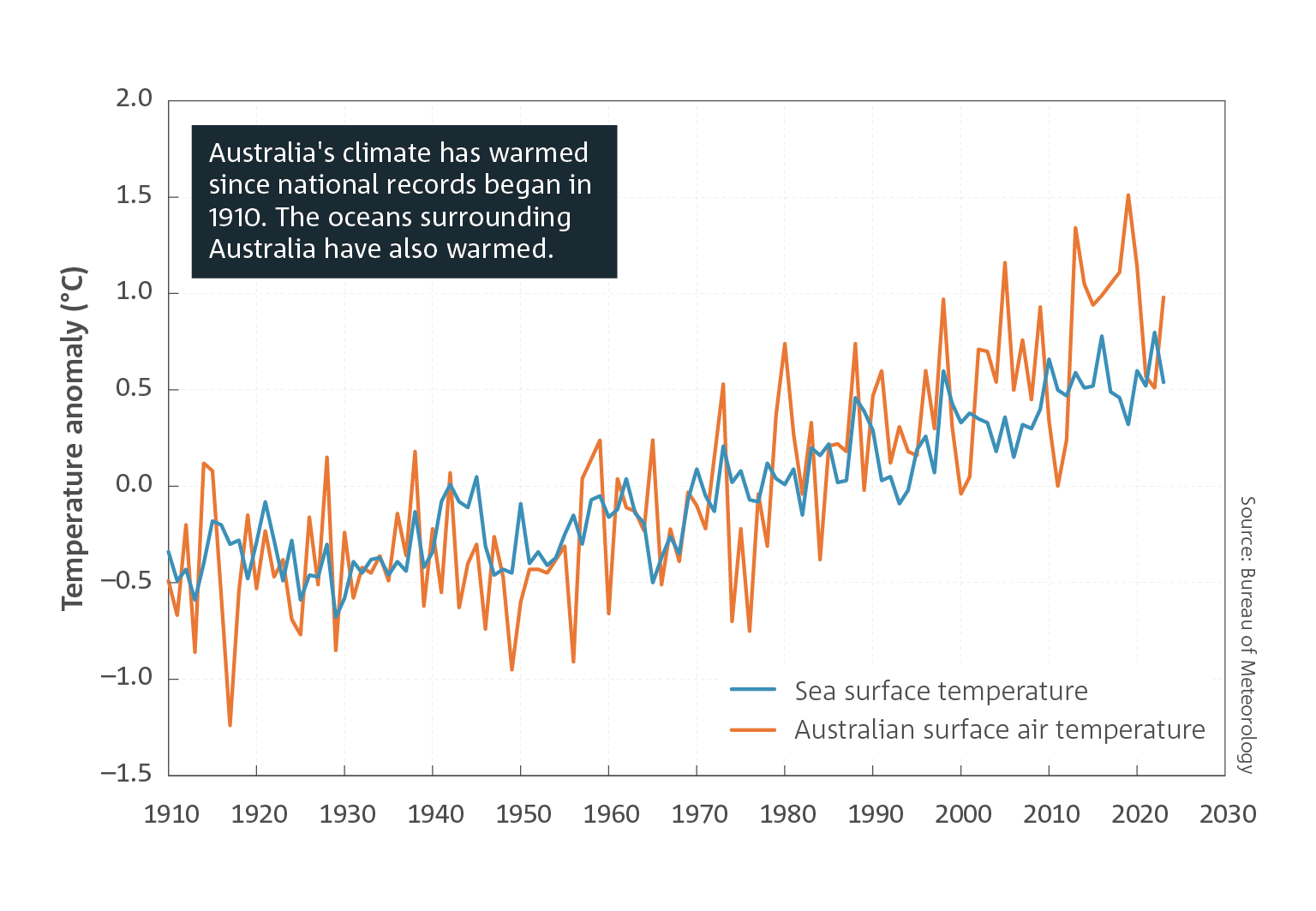
Anomalies (departures from the mean for the 1961–1990 standard averaging period) in annual mean sea surface temperature, and temperature over land, in the Australian region.
Source: BoM and CSIRO 2024: State of the Climate. Published by CSIRO and BoM.
Anomalies (departures from the mean for the 1961–1990 standard averaging period) in annual mean sea surface temperature, and temperature over land, in the Australian region.
- Source: BoM and CSIRO 2024: State of the Climate. Published by CSIRO and BoM.Time series eg_Bom SoE2024
Anomalies (departures from the mean for the 1961–1990 standard averaging period) in annual mean sea surface temperature, and temperature over land, in the Australian region.
Source: BoM and CSIRO 2024: State of the Climate. Published by CSIRO and BoM.
Bar charts
Bar charts are similar to graphs in that they often present the climate variable on the y (vertical) axis with time on the x (horizontal) axis.
- A bar chart is useful to show trends in the number of occurrences of a particular climate or weather event over time.
- The longer or taller the bar the more frequent the occurrence of the climate event.
- Each bar represents one time period, typically one year.
An example of a bar chart showing increase in hot days from the State of the Climate 2024.
Bar graph example
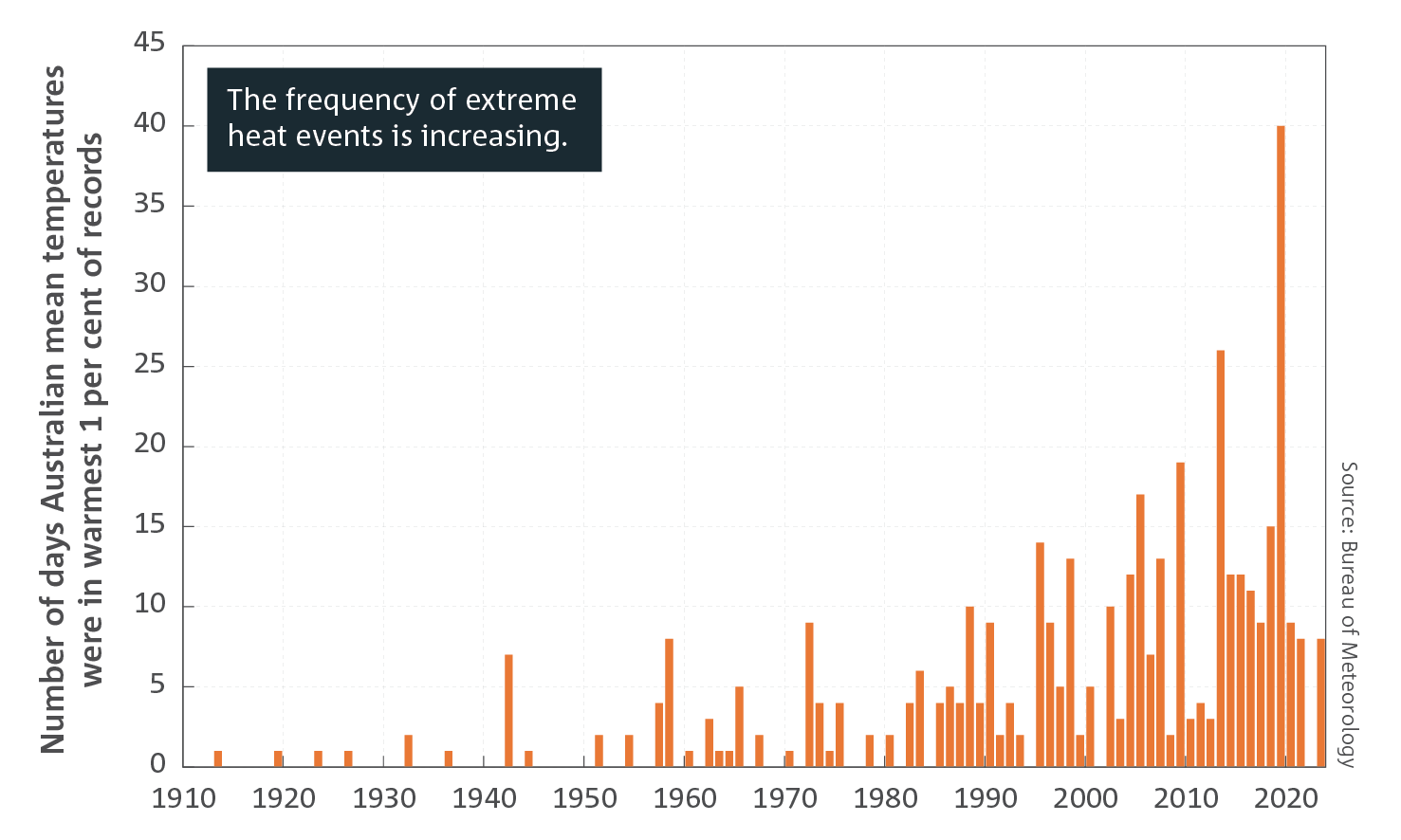
Number of days each year where the Australian area-averaged daily mean temperature for each month is extreme. Extreme days are defined as those where daily mean temperatures are the warmest 1% of days for each month, calculated for the period 1910–2023.
Source: BoM and CSIRO 2024: State of the Climate. Published by CSIRO and BoM.

Number of days each year where the Australian area-averaged daily mean temperature for each month is extreme. Extreme days are defined as those where daily mean temperatures are the warmest 1% of days for each month, calculated for the period 1910–2023.
- Source: BoM and CSIRO 2024: State of the Climate. Published by CSIRO and BoM.Bar graph example
Number of days each year where the Australian area-averaged daily mean temperature for each month is extreme. Extreme days are defined as those where daily mean temperatures are the warmest 1% of days for each month, calculated for the period 1910–2023.
Source: BoM and CSIRO 2024: State of the Climate. Published by CSIRO and BoM.
Maps of trends over time.
A climate trend map and a decile map (below) both help visualize climate data, but they serve different purposes and are interpreted differently.
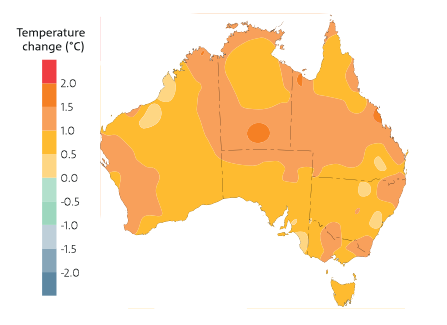
Maps of trends over time show the extent of change in a climate variable from a historic to a more recent point in time.
- A trend map is useful when you are interested in a specific climate variable and its regional variability.
- It displays the extent of change a specific climate variable (like temperature or rainfall) over a long period, typically decades.
- It illustrates the direction (increase or decrease) and magnitude (how much) of change.
An example of a map of temperature trends over time State of the Climate 2014.
Trend map

Map of annual average temperature change since 1910. Source: BoM, State of the Climate 2014, published by CSIRO and BoM.
Source: BoM, State of the Climate 2014, published by CSIRO and BoM.
Map of annual average temperature change since 1910. Source: BoM, State of the Climate 2014, published by CSIRO and BoM.
- Source: BoM, State of the Climate 2014, published by CSIRO and BoM.Trend map
Map of annual average temperature change since 1910. Source: BoM, State of the Climate 2014, published by CSIRO and BoM.
Source: BoM, State of the Climate 2014, published by CSIRO and BoM.
Decile maps
Decile maps show the amount of difference in a region or location from average levels.
- A decile is one tenth of the values in a record. A decile map ranks a climate variable (usually rainfall or temperature) within the historical record, often over a standard period (e.g. 1981–2010).
- A decile map is useful as is allows comparison of one place with another when there is a lot of variation from place to place, as there is with rainfall in Australia.
- It shows how unusual a specific period (like a month, season, or year) was, compared to past years. For example:
- How wet is the most recent decade compared to the full record?
- Is it in the highest decile (very wet), the lowest decile (very dry) or somewhere in between?
- Or described in another way, Decile 1–2: Among the driest or coldest 10–20% of years; Decile 9–10: Among the wettest or hottest 10–20% of years.
An example of a decile map
SotC24_R-01_v01

Map showing April to October rainfall deciles for the 30 years from 1994 to 2023. A decile map shows where rainfall is above average, average, or below average for this period compared to all years from 1900 (when reliable national rainfall records began) to 1993. Areas across northern and central Australia that receive less than 40% of their annual rainfall from April to October are faded.
Source: BoM and CSIRO 2024: State of the Climate. Published by CSIRO and BoM.

Map showing April to October rainfall deciles for the 30 years from 1994 to 2023. A decile map shows where rainfall is above average, average, or below average for this period compared to all years from 1900 (when reliable national rainfall records began) to 1993. Areas across northern and central Australia that receive less than 40% of their annual rainfall from April to October are faded.
- Source: BoM and CSIRO 2024: State of the Climate. Published by CSIRO and BoM.SotC24_R-01_v01
Map showing April to October rainfall deciles for the 30 years from 1994 to 2023. A decile map shows where rainfall is above average, average, or below average for this period compared to all years from 1900 (when reliable national rainfall records began) to 1993. Areas across northern and central Australia that receive less than 40% of their annual rainfall from April to October are faded.
Source: BoM and CSIRO 2024: State of the Climate. Published by CSIRO and BoM.
| Feature | Climate trend map | Decile map |
|---|---|---|
| Purpose | Show long-term change over decades | Show how a period ranks vs. historical record |
| Timeframe | usually multi-decadal (e.g. 50–100 years) | Short-term (e.g., month, season, year) |
| Focus | Direction and magnitude of change | Extremeness of conditions vs. history |
| Use case | Planning, policy, infrastructure | Monitoring current conditions, droughts |
| Reference period | Continuous trend over time | Historical baseline (e.g. 1981–2010) |
Combined approaches
Combined approaches may include maps that show trends at specific locations through symbol size.
Combined approaches are useful where understanding regional variability is important and there is also incomplete information. The map must be evaluated as a whole, and not on the basis of a single record.
Good questions to ask are:
- What proportion of stations show an increase/decrease?
- Are they clustered in a particular region?
An example of a combined approach.
T1M1_Figure 6
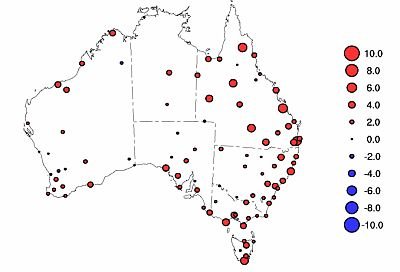
Map of trends in days above 35°C showing trend (increase) and location (clusters).
Source: © Commonwealth of Australia 2015, Bureau of Meteorology.
Map of trends in days above 35°C showing trend (increase) and location (clusters).
- Source: © Commonwealth of Australia 2015, Bureau of Meteorology.T1M1_Figure 6
Map of trends in days above 35°C showing trend (increase) and location (clusters).
Source: © Commonwealth of Australia 2015, Bureau of Meteorology.
What trend information is available for Australia
For many climate variables, there is clear and up-to-date information on recent trends available from the Bureau of Meteorology website.
CSIRO and the Bureau of Meteorology produce a biannual report that captures trends in the key variables. For example, the State of the Climate 2024 summaries the trends for Australia.
State of the Climate 2024: Key trends for Australia
- Australia’s climate has warmed by an average of 1.51 ±0.23 °C since national records began in 1910.
- Sea surface temperatures have increased by an average of 1.08 °C since 1900.
- The warming has led to an increase in the frequency of extreme heat events over land and in the oceans.
- In the south-west of Australia there has been a decrease of around 16% in April to October rainfall since 1970. Across the same region, May to July rainfall has seen the largest reduction, by around 20% since 1970.
- In the south-east of Australia, there has been a decrease of around 9% in April to October rainfall since 1994.
- Heavy short-term rainfall events are becoming more intense.
- There has been a decrease in streamflow at most gauges across Australia since 1970.
- There has been an increase in rainfall and streamflow across parts of northern Australia since the 1970s.
- There has been an increase in extreme fire weather, and a longer fire season, across large parts of the country since the 1950s.
- There has been a decrease in the number of tropical cyclones observed in the Australian region since at least 1982.
- Snow depth, snow cover and number of snow days have decreased in alpine regions since the late 1950s.
- Oceans around Australia are becoming more acidic, with changes happening faster in recent decades.
- Sea levels are rising around Australia, including more frequent extreme high levels that increase the risk of inundation and damage to coastal infrastructure and communities.
Using maps and graphs to understand local climate trends
To understand local climate trends using maps and graphics, use the following steps:
- Define the area or location of interest.
- Keep in mind that climate patterns can be quite large – and extend beyond local boundaries – so broader regional trend information can provide important context for local-scale changes.
- Identify the relevant climate variables.
- Determine which variables – such as temperature, rainfall, or sea level – are most important for your needs.
- Explore up-to-date maps and visual tools from trusted sources like the Bureau of Meteorology and Climate Change in Australia for data and graphics.
- Consider whether expert guidance is needed.
- Interpretation of some climate records – especially highly variable ones like rainfall and wind patterns – may require expert input to ensure any trends are accurately understood and applied correctly.
- Consider relevance for local decision-making.
- Identify whether observed trends in your area of interest are likely to affect local planning, community risk or other decision-making, and incorporate the information in risk assessment if required.