


At a glance
- Climate adaptation on the coast is complex and faces both barriers (can be overcome with effort) and limits (where adaptation is no longer feasible).
- Barriers include lack of knowledge, financial constraints, regulatory uncertainty, and strong cultural attachments to place.
- Limits arise when adaptation options (e.g. relocation, insurance, protective works) become impractical, unaffordable, or ineffective.
- Broadly, some of the different groups that face distinct challenges include:
- individuals – beliefs, emotions, cost, unclear guidance
- businesses – finance, insurance, market viability, brand identity
- governments – governance conflicts, political pressures, legal risks.
- Broader structural systems (e.g. markets, governance, colonial legacies) shape and intensify these challenges, requiring both local action and systemic change.

Barrier and limits to adaptation at the coast
For effective climate adaptation, it is important to understand barriers and limits to adaptation. Adaptation decisions are made within complex social, economic, environmental, and political systems, often under conditions of uncertainty, competing priorities, limited resources, and diverse stakeholder interests.
These conditions give rise to persistent barriers, such as institutional constraints, uncertainty, and conflicting values, that can delay or constrain action. Over time, these barriers may contribute to the emergence of limits to adaptation, where responses become increasingly constrained or no longer feasible.
Identifying barriers and limits helps to identify where targeted interventions may enable adaptation, and where more fundamental or transformative responses may be required.
Barriers and limits: Key concepts
Barriers are any type of challenge or constraint that can slow or halt progress on adaptation but can be overcome with effort.
Limits are the point beyond which it is no longer possible or practical for human or natural systems to adjust to climate change impacts in a way that avoids serious harm or loss.
CoastAdapt resources on enablers of adaptation - these are not the flip side of barriers or limits to adaptation. Instead, they highlight ways to build on available resources and capacities to address constraints.
Understanding adaptation barriers
Early approaches to climate adaptation largely focused on identifying individual barriers that delayed or prevented action, such as gaps in information, funding, or policy. In Australia, one of the earliest comprehensive assessments was the Productivity Commission’s 2011 inquiry (Box 1).
Many of the barriers identified in the Productivity Commission inquiry still persist, including fragmented governance, unclear responsibilities, limited funding and local capacity, and challenges in communicating climate risks, continuing to hinder adaptation in Australia and globally.
Box 1. The 2011 Productivity Commission inquiry into barriers to effective adaptation
The Productivity Commission’s 2011 inquiry identified governance, policy, information, resource, and psychosocial constraints based on broad stakeholder input. Waters et al. (2014) grouped these into 50 barriers across five categories (Table 1).
This work provided an important foundation for understanding how different types of barriers can shape adaptation outcomes.
| Types of barriers | Summary of attributes of these types of barriers |
|---|---|
| Governance | Unclear roles across governments and sectors Weak leadership; poor coordination; conflicting priorities Misaligned timeframes with political cycles Inconsistent policies across jurisdictions Challenges in balancing policy trade-offs. |
| Policy | Uncertainty around liability and compensation Weak or inconsistent planning and building regulations Unclear insurance frameworks Overemphasis on mitigation and disaster recovery Lack of equity considerations Regulatory misalignment with technology. |
| Information | Uncertainty in climate impacts and projections Lack of local-scale data; limited implementation knowledge; Insufficient research; reliance on historical data Poor communication and targeting of information Lack of standards for data interpretation. |
| Resouces | Limited skills and staffing (especially in local government) Funding constraints; high costs of adaptation; restricted revenue-raising capacity; limited investment incentives Inadequate support for vulnerable groups Rising business costs. |
| Psychosocial | Low perceived efficacy Public skepticism and contestation of climate science; Apathy and denial. Short-term thinking; limited risk awareness; cultural resistance; political conflict Preference for high-risk living. |
From isolated barriers to more systemic thinking
Adaptation research into barriers has advanced significantly since the 2011 inquiry. Contemporary adaptation thinking recognises that barriers and limits do not occur in isolation. Instead, they emerge from broader social, economic, political, and institutional systems that shape both vulnerability and the capacity to respond to climate risks.
Adaptation, therefore, is not just a about addressing the availability of resources or knowledge. It is also a governance and development challenge that involves managing competing interests, addressing inequalities, and navigating long-term social and environmental change
Many of these challenges have deep historical roots. They are shaped by broader systemic factors that influence what adaptation options are feasible in practice, such as the following.
- Uneven risk and capacity
- Climate risks and adaptation opportunities are unevenly distributed, shaped by differences in exposure, resources, and ability to respond.
- Inequality and power
- Social and economic inequalities, along with governance and power dynamics, influence whose risks are prioritised and who benefits from adaptation.
- Structural constraints
- Past decisions create path dependency and institutional lock-in, limiting current options for change.
- Cross-scale dynamics
- Decisions at different levels interact, with policies and funding at one scale enabling or constraining action at another.
- Interconnected impacts
- Climate risks and responses can produce cascading effects, including unintended consequences and risk shifting, where actions to reduce risk can unintentionally increase risks elsewhere
- Competing priorities
- Adaptation must be balanced against other goals, often involving difficult trade-offs.
- Values and perceptions
- Differing beliefs about risk and acceptable outcomes shape support for adaptation.
- Equity and justice
- Adaptation decisions distribute costs, benefits, and responsibilities unevenly, making fairness central to effective responses.
For coastal decision-makers, these insights highlight the need to move beyond considering only technical or information gaps. Effective adaptation needs also to consider who benefits, who remains exposed to residual risk as well as how costs, responsibilities and decision-making are distributed across communities.
narrow-shore-middle_sml
© WIRESTOCK
Understanding hard and soft limits
Limits tend to be described as hard or soft, which reflects the extent to which they constrain adaptation
- A soft limit has no currently available adaptation options, but options could be available in the future. New technology, better funding, or different policies could open up options in the future.
- For example, there might not be affordable ways to protect a coastal area today, but a future innovation could make it possible.
- A hard limit occurs when adaptation can no longer prevent unacceptable losses or maintain valued functions despite available measures.
- For example, an inundated coastal area may be permanently underwater.
Barriers and limits experienced by individuals
For Individuals living in the coastal zone, their capacity to adapt is shaped by a range of (overlapping) personal, financial, social and institutional barriers.
For groups and sectors that are more vulnerable to climate change impacts, these factors are likely to be compounded and restricted by structural conditions that require more systemic change.
Key barriers for individuals
Key barriers for individuals include the following.
- Knowledge and information
- Awareness alone is insufficient. People are more likely to act when they trust institutions, feel supported, and believe their actions will be effective.
- Access to clear, locally relevant information is often limited, uncertain, or difficult to interpret, leaving residents unsure how risks apply to their property or what actions are available.
- Psychological and social
- Decision-making is shaped by emotions, risk perceptions, cultural identity, and social norms rather than purely rational processes.
- Attachment to place, denial, anxiety, or feelings of helplessness can delay action, while individuals often look to peers or authorities for cues.
- Where adaptation is not visible or widely accepted, uptake may be slow.
- Social and cultural
- Cultural values, community identity, social networks, and inclusion shape which adaptation options are acceptable.
- Strong attachments to place or established ways of life may conflict with some adaptation measures.
- Financial
- High costs of measures such as retrofitting, property protection, or relocation can be prohibitive, particularly for low-income households, renters, and older residents.
- Rising insurance costs, reduced coverage, and concerns about declining property values further constrain options.
- Institutional and regulatory
- Unclear rules, inconsistent planning frameworks, and limited local government capacity create uncertainty about what actions are permitted.
- Perceived unfairness or poor communication of policies (e.g. rezoning or planned retreat) can erode trust and reduce cooperation.
Limits to adaptation for individuals
Individuals may reach limits to adaptation when climate risks exceed their capacity to respond, due to financial, social, physical, or institutional constraints.
- Soft limits
- Adaptation is possible but constrained by affordability, access to information, social acceptance, or policy settings.
- For example, households may not be able to afford retrofitting or relocation, face rising or unavailable insurance, or lack clear guidance on what actions are permitted.
- Strong attachment to place or social norms may also limit willingness to pursue options such as retreat.
- Hard limits
- Adaptation is no longer possible. For example, if homes are repeatedly damaged or permanently lost to erosion or flooding, or where risks to safety and wellbeing become unacceptable.
- Loss of insurability or essential services can also make continued habitation unviable.
- more CoastAdapt resources about insurance at the coast.
What individuals can do to address barriers
Addressing individual barriers requires coordinated approaches that build trust, reduce inequities, and align institutional settings with community needs. Broadly, strategies to overcome these individual-level barriers should focus on the following.
- Strengthen inclusive governance
- Support participatory and community-led approaches that build trust, improve legitimacy, and address underlying drivers of vulnerability.
- Enhance communication and decision support
- Provide clear, locally relevant, and accessible information (e.g. property-scale risk mapping), alongside trusted advisory services to help translate knowledge into action.
- Address financial constraints
- Expand targeted funding, subsidies, and insurance reforms to improve affordability of adaptation, particularly for low-income and at-risk groups.
- Improve institutional clarity and consistency
- Establish clear, consistent planning frameworks, legal guidance, and support services to reduce uncertainty and enable timely decision-making.
- Harness social dynamics
- Leverage peer networks, community leadership, and visible examples to normalise adaptation and overcome behavioural barriers.
a case study written by a local government decision maker on his perspective on overcoming barriers.
Barriers and limits to adaptation for an Indigenous coastal community
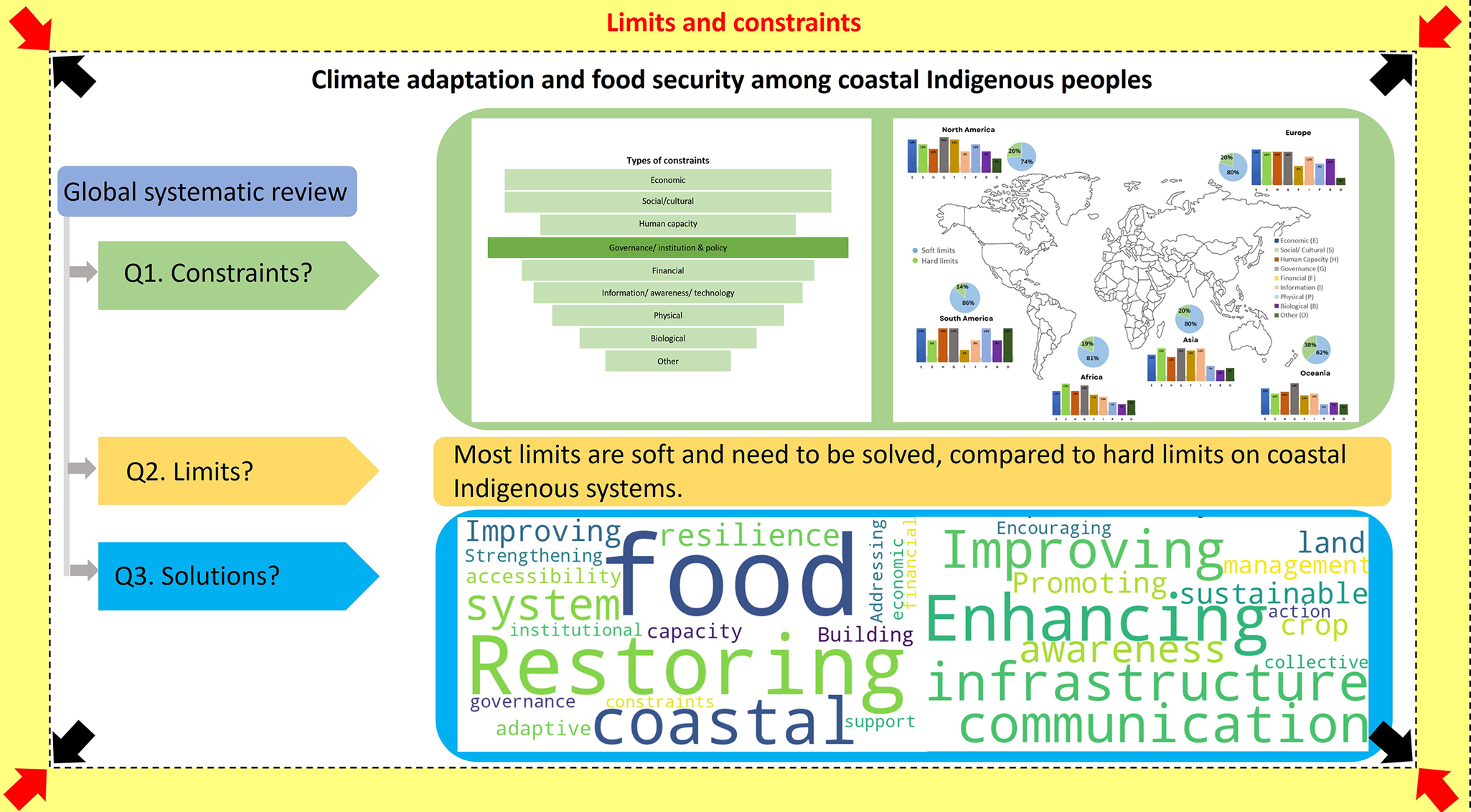
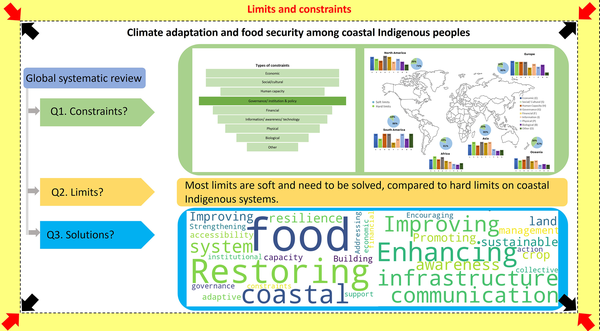
Indigenous coastal communities are among the most affected by climate change impacts on food systems. Globally, these communities rely on aquatic resources up to 15 times more than non-Indigenous populations, making them highly exposed to disruptions.
Historical and ongoing colonial practices have created deep-rooted barriers by dismantling traditional food systems through land dispossession, environmental degradation, and restricted access to healthy ecosystems. These legacies have compounded nutritional challenges and increased exposure to pollutants, leaving communities with fewer options to adapt.
Climate-driven biological changes – including rising sea temperatures, ocean acidification, altered salinity, and more frequent storms – further threaten fisheries and aquaculture. While major algal blooms have not yet caused major disruption, the risk is growing.
Adaptation constraints for these communities are mostly soft limits, shaped by social, cultural, and economic factors, such as limited financial resources and infrastructure, cultural ties to marine resources that restrict relocation or major changes, lack of policy frameworks that recognize Indigenous rights and priorities. Currently, few national or regional policies directly address these barriers.
Potential solutions include: improving infrastructure and communication, building local capacity and diversifying crops and aquaculture, strengthening governance to integrate Indigenous knowledge and cultural values into adaptation planning.
Ultimately, there is a need for transformative governance that respects Indigenous rights and cultural connections to marine ecosystems while ensuring ecological resilience and food security.
Galappaththi et al., 2025.
Barriers for Indigenous fishing
© Galappaththi et al., 2025. Published by Cambridge University Press
Barriers for Indigenous fishing
© Galappaththi et al., 2025. Published by Cambridge University Press
Barriers and limits experienced by businesses and industries
Coastal small businesses face a wide range of climate risks beyond direct hazards, affecting ecosystems, infrastructure, supply chains, and demand. For small businesses, many barriers overlap with those faced by individuals, businesses also contend with investment, market, and regulatory challenges.
Key barriers and limits include the following.
- Knowledge and capacity
- Limited resources, expertise, and time constrain risk assessment and adaptation planning, compounded by uncertainty about future impacts.
- Small and medium enterprises often lack the staff, expertise, and capital to undertake long-term investments in adaptation.
- Financial and investment
- High adaptation costs, rising insurance, and reduced access to finance can restrict investment and create a cycle of declining capacity.
- Infrastructure and supply chains
- Disruptions to transport, utilities, and networks can affect operations even if assets are undamaged, requiring a systems-level approach.
- Regulatory and governance
- Policy uncertainty, inconsistent planning, and unclear government responses can discourage long-term investment.
- Social and cultural
- Strong ties to place and business identity can limit willingness or ability to relocate or change models.
Limits to adaptation
Small businesses may reach limits to adaptation when climate risks exceed their ability to respond, due to economic, environmental, or institutional constraints. These can be soft limits (options exist but are not feasible) or hard limits (no viable options remain).
- Soft limits
- Adaptation is possible but constrained by cost, insurance access, market conditions, or policy settings.
- For example, tourism businesses in northern Queensland report they have struggled to remain viable after repeated cyclone and flooding events.
- Fisheries may be able to relocate some of their operations, but higher costs can make this unviable,
- For a tourism location that relies on a reputation of wide sandy beaches, if beach nourishment became no longer viable and visitation dropped, then this would have implications for most local businesses.
- Hard limits
- Adaptation is no longer possible, which could occur where repeated damage, land loss, environmental degradation, or loss of insurability fundamentally undermines business viability.
Barriers and limits experienced by governments and institutions
Governments at local, state, and federal levels play a central role in coastal adaptation, but they face interconnected institutional, financial, political, and capacity-related barriers that shape their ability to plan, coordinate, and implement adaptation responses across scales.
Key barriers include the following.
- Knowledge and information
- Uncertainty in climate projections, limited local-scale data, and challenges translating evidence into policy-relevant guidance can constrain decision-making and prioritisation.
- Institutional and governance
- Fragmented responsibilities across levels of government, unclear roles, and inconsistent policies can hinder coordination and delay action, especially transformative change.
- Short political cycles may also conflict with the long-term nature of adaptation.
- Governments balance adaptation objectives against competing policy priorities, including housing affordability, economic development, infrastructure investment, environmental protection, and disaster recovery: these compete for resources and political attention available for proactive adaptation planning
- Financial and resource capacity
- Limited funding, competing budget priorities, and uneven capacity - particularly at the local level – can restrict implementation of adaptation measures and long-term planning.
- Political
- Adaptation decisions may be politically sensitive, particularly where they involve trade-offs such as land-use restrictions, managed retreat, or redistribution of costs.
- Public resistance or low trust can further constrain action. planning processes may stall or stop when communities become polarised around specific options, especially difficult transitional or transformation options like rezoning, property buybacks or managed retreat.
- Regulatory and legal
- Uncertainty around liability, compensation, and planning controls can limit willingness to take proactive decisions or implement transformative measures.
Governments may encounter limits to adaptation where climate risks exceed institutional, financial, or political capacity to respond effectively. These can be soft limits, where options exist but are constrained, or hard limits, where no feasible policy or management response remains.
- Soft limits: Adaptation is possible but restricted by governance, funding, or social acceptance. For example, governments may have technical options available (e.g. coastal protection or relocation programs) but face constraints due to insufficient funding, legal barriers, or community opposition. These limits may shift with policy reform, investment, or institutional change.
- Hard limits: Adaptation is no longer feasible within existing governance or physical conditions. This may occur where risks are too great to manage, such as irreversible land loss, escalating disaster costs beyond fiscal capacity, or situations where protecting communities is no longer viable.
Beyond these thresholds, governments may be required to pursue transformational responses, such as large-scale retreat, fundamental land-use change, or withdrawal of services and infrastructure from high-risk areas.
more in CoastAdapt about regulatory and institutional frameworks
- Reducing legal risk
- Information manual: Planning
- Generating organisational momentum
- Engaging the community