


At a glance
- This guidance focuses on the communication of climate change science as part of effective coastal adaptation. It sits alongside broader community engagement and participatory processes.
- Communicate risk, not predictions: Frame climate change as increasing and evolving risk. Use ranges, likelihoods and scenarios rather than single outcomes.
- Be explicit about uncertainty: Clearly distinguish what is well established, what varies locally, and what remains deeply uncertain. Also explain why.
- Link science to decisions: Connect impacts and uncertainty to adaptation pathways, decision thresholds or triggers, and staged choices rather than fixed solutions.
- Build trust through transparency: Use clear, neutral language, explain assumptions and limits; and be upfront about how advice may change as knowledge evolves.

Communicating climate change for coastal adaptation
Effective coastal adaptation depends on clear and credible climate communication. Climate change creates long‑term and interacting risks that affect coastal environments, communities and economies. Communicating these risks well is essential to informed planning and decision‑making.
Effective communication supports adaptation by:
- explaining climate change and its coastal impacts
- supporting discussion of options, trade‑offs and limits
- maintaining trust as knowledge, conditions and responses evolve over time.
Because climate science underpins all stages of adaptation, practitioners need guidance on how to communicate risk and uncertainty, particularly where impacts are contested or decisions are politically and socially sensitive.
This guidance focuses on communicating climate change science to support coastal adaptation decisions, including how to explain what is known, what is uncertain, and why this matters. It does not provide detailed guidance on community engagement or participatory processes, but complementary resources are listed below.
Also, this guidance focuses on the communication of climate change science for coastal adaptation. It does not address the wider social or political drivers of stalled climate action, except where they directly affect how scientific information is understood and used.
a range of CoastAdapt resources support community engagement alongside climate communication, including:
- Engaging the community
- an Information manual: Community engagement
- case studies in Working with the community
- resources in Explainers, templates and 'how to' pages
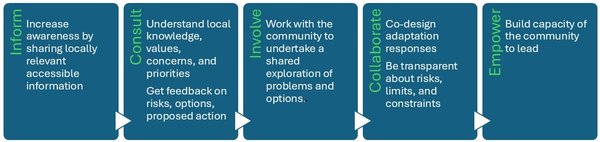
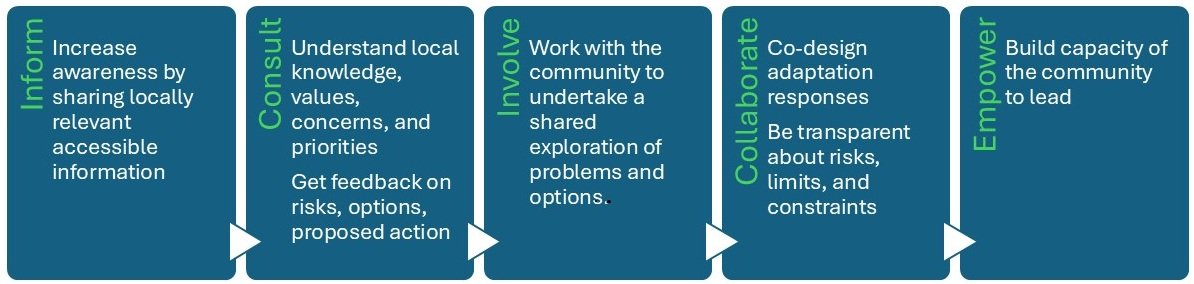
- Explainer: IAP2 approach and community participation.
Communication about climate change typically includes these reasons.
why comunicate
Communication about climate change typically includes these reasons.
Climate change communication has often been ineffective
Despite growing scientific confidence, climate change communication has frequently struggled to support effective climate adaptation responses.
Common challenges in communicating climate change science include the following.
- Unclear purpose
Communication has often not been tailored to its specific aim (e.g. explaining risk versus supporting a decision), or to the needs of a specific audience, leading to inappropriate or unfocussed messaging. - Overly technical, abstract, or moralistic language
Heavy use of scientific jargon or normative framing can reduce understanding and alienate audiences from the issue and reduce understanding, particularly when it fails to connect with their lived experience. - Global or distant framing
Emphasis on global averages, remote impacts or distant symbols (such as polar regions) makes climate change feel abstract and irrelevant to local communities. - Fear‑based or crisis‑only messaging
Communication that focuses solely on overwhelming threats, without explaining options or agency, can lead to disengagement, fatalism, or denial. - Polarising narratives
Partisan or ideological framing has contributed to conflict, resistance, and declining trust in science. - Failure to recognise climate change as a wicked problem
Linear, one‑off communication approaches have struggled to address complex, long‑term and value‑laden decisions. - Capacity and confidence constraints
Practitioners may feel ill-prepared to lead difficult conversations, particularly where property values, cultural identity, or iconic places are affected. Elected officials may also lack understanding, support, or willingness to engage with politically sensitive issues. - Inadequate preparation for misinformation and disinformation
Organisations have often been reactive rather than proactive, allowing misleading or false claims to erode trust and to shape the agenda.
These challenges underline the need for more deliberate, evidence‑based approaches to communicating climate science.
more CoastAdapt resources on misinformation and disinformation and what steps you can take to be better prepared.
Communicating more effectively
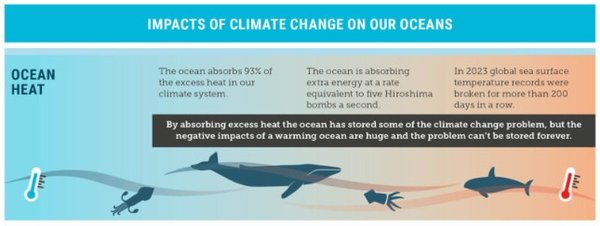
There is now a strong body of evidence‑based guidance on climate change communication. The sections below synthesise key findings relevant to communicating climate science, risk and uncertainty for coastal adaptation.
Effective communication requires:
- explaining what is changing and why
- communicating risk, probability and uncertainty
- linking science to adaptation choices over time.
Box 1 is a synthesis of broad findings from the international guides that explicitly coastal climate science listed in Table 1.
Framing tips
- Place comes first
Coastal communication is most effective when it begins with familiar places and processes - such as beaches, tides, flooding and homes - rather than not global averages and or abstract indicators (like the gool ole 'hockey stick graph'!). - Dialogue beats delivery
Participatory and community‑led approaches outperform 'educate and persuade' models. Two‑way dialogue and creative methods help surface values, knowledge and concerns. - Openness about limitation and tradeoffs
Transparency about the limits of protection and adaptation helps build trust. In some locations, more transformative responses, including managed retreat, may eventually be necessary.
Communicating science, risk and uncertainty
- Communicate science as a system, not a series of facts
Coastal climate impacts arise from interacting processes (sea‑level rise, storms, tides, erosion, subsidence). Presenting these as disconnected facts can lead to misunderstanding.
Consider compounding risks, especially as it is likely that a coastal community has experienced these in recent times! - Frame climate impacts as risks not predictions
Risk framing improves usability for planners and reduces misinterpretation of uncertainty.
Use risk language (likelihood × consequence), not deterministic outcomes that appear to be forecasts.
Compare future risks to current planning standards (e.g. “events that were rare are becoming frequent”). Emphasise that risks increase over time, even if exact timing is uncertain. - Be explicit and structured about uncertainty
Uncertainty is intrinsic to climate science, particularly for long‑term coastal change. Explain the sources of uncertainty. Downplaying uncertainty can erode trust; overstating it can paralyse action. - Focus on local progression, not distant end points
Coastal adaptation decisions hinge on near‑ to mid‑term change and cumulative impacts
Use progressive narratives (for example, 2030 - 2050) rather than distant endpoints such as 2100. - Link impacts with adaptation pathways
Introduce adaptation pathways (protect, avoid, accommodate, retreat) as options that change over time. Explain trade‑offs, residual risk and limits, as well as benefits. Link science to decision triggers (e.g. flood frequency thresholds). - Balance neutrality with empathy
Credibility depends on clarity, transparency and consistency, supported by a neutral and authoritative tone. At the same time, it is important to acknowledge that adaptation decisions affect future coasts and thus people's homes, livelihoods, cultural identity and other important coastal values.
| Guide | Core audience | Key communication messages | Specific coastal emphasis |
|---|---|---|---|
| PCC (AR6 IPCC Comms Handbook) | Policymakers, planners, practitioners | Communicate risk and uncertainty clearly Pair impacts with response options Integrate local and Indigenous knowledge | Strong guidance on communicating uncertain but escalating coastal risks over long timeframes |
| UNFCCC Technical Guide on Sea‑Level Rise | Governments, practitioners | Communicate loss, damage and adaptation with dignity Emphasise choices and justice | Strong on framing relocation, protection and accommodation pathways |
| Climate Outreach – Principles for Effective Communication | Scientists, policymakers, communicators | Start with values not facts; avoid deficit model Tailor to audience worldviews Be honest about uncertainty without it being overwhelming | Useful for framing sea‑level rise and erosion without triggering denial or paralysis |
| NOAA Digital Coast – Coastal Adaptation Planning Guide | Coastal managers, councils | Begin engagement early Use visual tools Explain pathways not end‑states Revisit messages over time | Makes sea‑level rise and inundation tangible through mapping and scenarios |
| Compendium of Best Practice for Managing Coastal Change | Coastal practitioners, local authorities | Be transparent about limits Manage expectations Prioritise trust Communicate change as ongoing | Explicitly addresses difficult conversations about retreat and loss |
| “Sailing Through Change” – Current Conservation | NGOs, trainers, community practitioners | Start from lived experience; Link local observations to climate drivers Pprioritise dialogue | Emphasises fisheries, erosion, storms as entry points to climate discussion |