

At a glance
- For effective engagement, goals need to include building trust with stakeholders through being open and transparent and having a genuine commitment to the relationship.
- Coastal institutions – state and local government agencies, community groups, small to medium enterprises such as tourism businesses – already have ways to engage with their stakeholders.
- There are a range of manuals, guides and tools available to help plan engaging with the community, including CoastAdapt's Information Manual: Community Engagement and state and territory regulations and guidance.

Engaging with coastal stakeholders
Effective adaptation to climate change at the coast relies on strong, inclusive, and ongoing engagement with the people who live, work and invest along the coast.
Stakeholders bring essential local knowledge about how coastal systems function, how impacts affect daily life, and which solutions are practical and culturally appropriate in their communities. Attention needs to be given to engaging with First Nations stakeholders (rights holders and Aboriginal/Indigenous groups and networks) to ensure culturally appropriate engagement.
Meaningful engagement with stakeholders across coastal communities builds trust, strengthens decision‑making, and helps ensure that adaptation actions are locally appropriate, understood, accepted and sustained over time.
Why coastal stakeholder engagement matters
Coastal adaptation involves navigating complex trade‑offs, including protecting built assets, preserving ecosystems, supporting local industries, and maintaining cultural values.
Early engagement is essential: it helps identify what communities value, uncover potential conflicts, and co‑design solutions that are both socially acceptable and technically robust. Research consistently shows that adaptation plans are more durable and legitimate when communities are genuinely involved throughout the process, rather than consulted only after key decisions have been made.
Engagement with Indigenous communities is important and needs to recognise and respect traditional knowledge and enduring cultural connections to Sea Country. Co‑design approaches that are grounded in long‑term relationships and culturally appropriate processes can strengthen both adaptation outcomes and partnerships.
It is also crucial to ensure equitable engagement with groups that may be disproportionately affected by coastal hazards. Renters, low‑income households, people with limited mobility, older residents, young people, and culturally and linguistically diverse communities may face greater exposure or have fewer resources to adapt.
Barriers such as limited access to information, lower decision‑making power, or reduced capacity to participate can prevent these groups from influencing decisions that directly affect their lives.
While tailored, accessible engagement approaches help ensure that their perspectives are heard and that adaptation measures support fair and inclusive outcomes.
a number of diverse ways of engaging stakeholders in CoastAdapt's case studies on Working with the community.
Existing pathways for engagement
Coastal organisations – state and local government agencies, community groups, ‘small to medium enterprises’ (SMEs) such as tourism businesses – already have pathways for engagement with their stakeholders.
Across all these contexts, engagement is typically used to gather input, gain support, and build consensus. Equally important, however, is the overarching goals of building trust, understanding and a social license.
Local governments already engage with the community over many small and large issues, from individual building development applications to broad scale city planning. For local government, community engagement is often mandated by state legislation, but councils generally retain discretion about how it is undertaken.
This flexibility for local councils allows approaches to be tailored to local contexts and enables learning as different councils test alternative methods: but it can also lead to inconsistency across a region, which may confuse or frustrate stakeholders.
Frameworks for community engagement
There are a range of approaches, tools and frameworks for community engagement that have been developed by professional associations, state governments and consultancies.
The advantage of using a readily available framework is that it can help an organisation to think through its goals and strategies. Also, some frameworks have detailed information on tools and resources, or even events and training, that can help build the capacity and confidence of staff and managers.
IAP2 is a commonly used framework
more about IAP2 and how to use it.
- CoastAdapt's Explainer: IAP2 and community participation
- CoastAdapt's Information Manual: Community Engagement describes the IAP2 spectrum in more detail
IAP2 is built around three core pillars
- Core Values, which set expectations for ethical and effective engagement
- Code of Ethics, which promotes integrity and accountability
- Public Participation Spectrum, which outlines five levels of engagement (Inform, Consult, Involve, Collaborate, Empower) to clarify the public’s role and the degree of influence they can expect in a process.
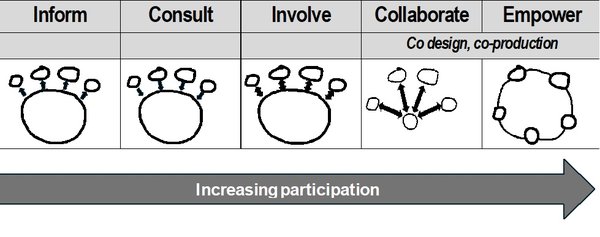
Figure 1: The five phases of the IAP2 spectrum are slightly modified here to include codesign and coproduction, terms used more often than 'empower'.
- © IAP2IAP2 spectrum
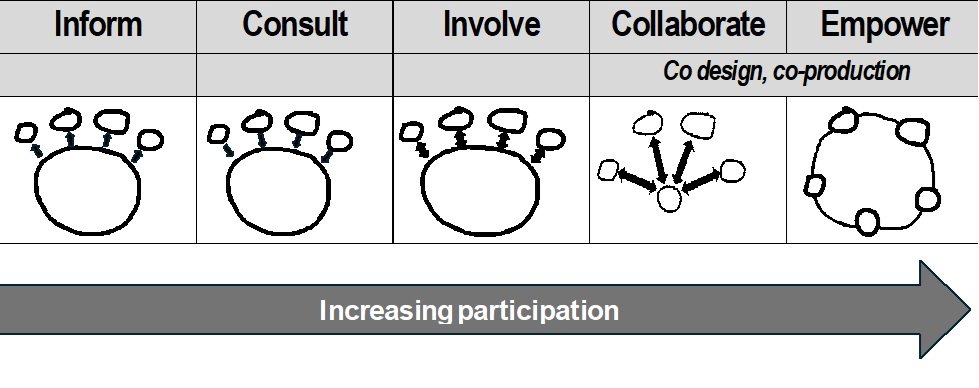
Figure 1: The five phases of the IAP2 spectrum are slightly modified here to include codesign and coproduction, terms used more often than 'empower'.
© IAP2
Three types of engagement used in coastal adaptation
Coastal adaptation generally requires three broad types of activities. These align with the IAP2 spectrum.
- Informing the community through one-way communication about programs, activities, decisions, actions and recommendations (IAP2 'Inform').
- Consulting the community to request feedback on strategy, proposals, or gathering local knowledge, values etc (IAP2 'Consult' or can overlap with 'Involve').
- Involving the community at a deeper level through two-way, iterative discussions or activities with the community to encourage knowledge sharing, education and decision making. (IAP2 'Involve' or can overlap with codesign or coproduction termed 'Empower').
Arnstein's ladder of citizen power
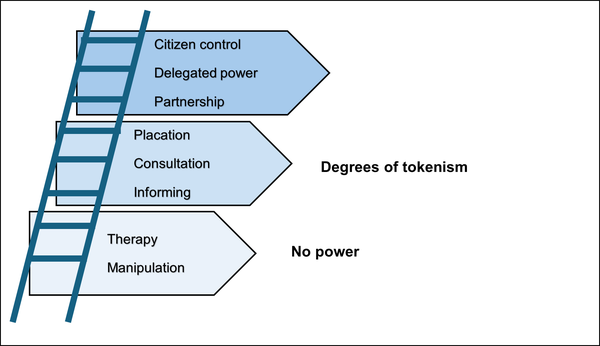
Figure 1: The IAP2 Spectrum draws on Sherry Arnstein’s 1969 Ladder of Citizen Participation, which categorises participation from non‑participation to full citizen control.
- © Arnstein 1969IAP2_PIC
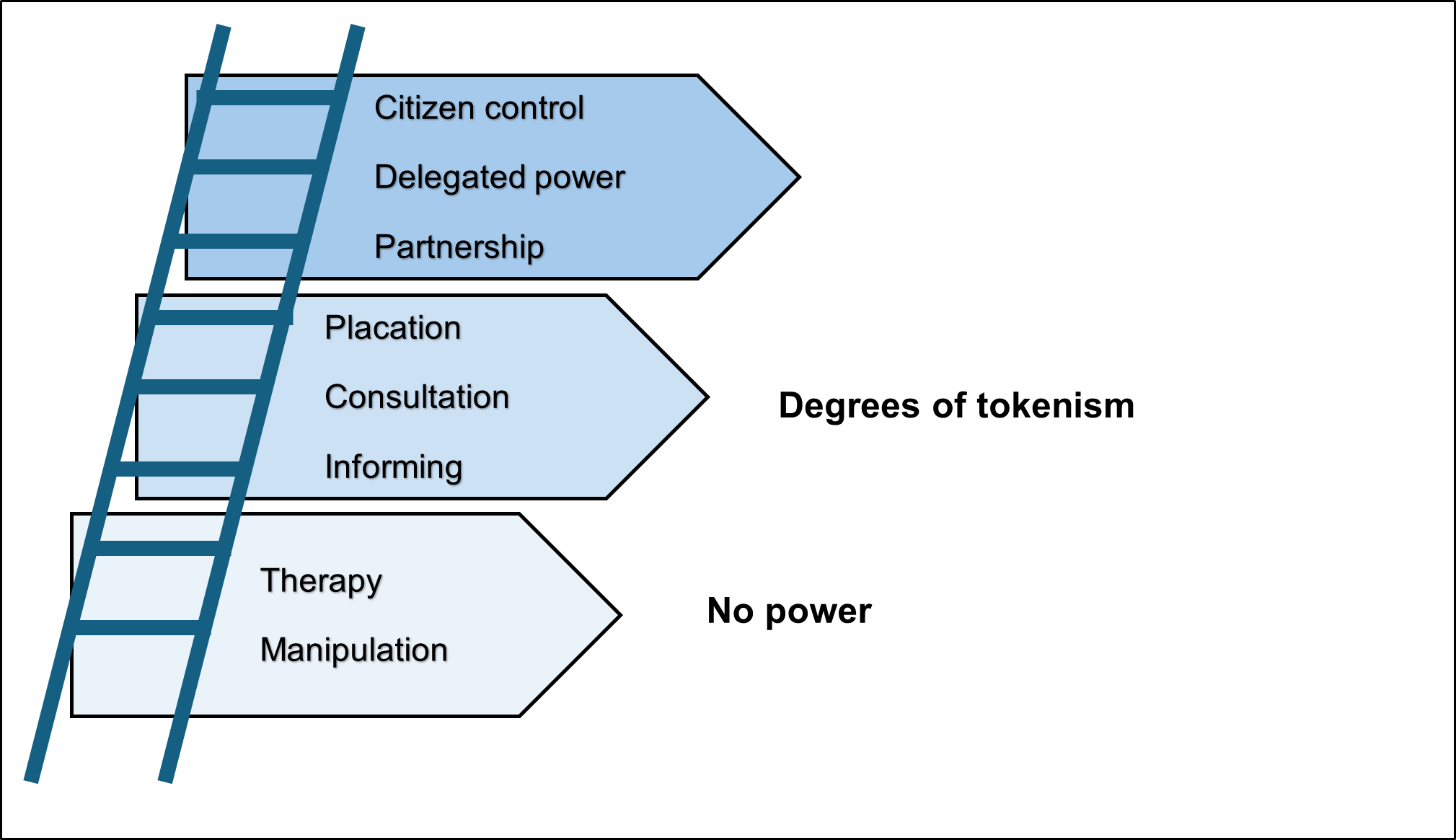
Figure 1: The IAP2 Spectrum draws on Sherry Arnstein’s 1969 Ladder of Citizen Participation, which categorises participation from non‑participation to full citizen control.
© Arnstein 1969
State government guidance for local government engagement in coastal hazards/ adaptation
State and territory governments and agencies also provide guidance to support local governments planning and implementing coastal adaptation, often through broader coastal hazard programs.
While primarily developed for councils, the tools and approaches are generally applicable to many organisations and include guidance on planning engagement, selecting appropriate methods and evaluating outcomes.
Note: there are also state legislation and guidelines broader community engagement undertaken by local governments. These are addressed in the coastal hazard engagement guidance so not addressed here.
States vary widely in how they guide local governments to engage communities on coastal hazards.
Queensland took an early lead through providing community engagement guidance (but not detailed tools) through QCoast2100 program's coastal hazard planning program in 2016. As it enters its second phase, the coastal hazard guidance is under review, including that for community engagement.
Leading practice is currently provided by New South Wales, Victoria, South Australia and Western Australia, These three states offer the most developed frameworks: NSW embeds engagement throughout its Coastal Management Program via a continually updated toolkit that includes guidance for stakeholder involvement and culturally safe engagement with First Nations people. Victoria provides clear expectations through its Resilient Coast framework, supplemented by region‑specific initiatives such as Adapt West (2026), which introduce new factsheets and collaborative governance structures to support community participation in adaptation planning.
South Australia and Western Australia stand out for their highly detailed, operational engagement tools. SA’s 2025 Coastal Hazard Adaptation Planning Guidelines set minimum standards, provide stage‑specific engagement requirements and include First Nations engagement processes. WA similarly strengthens engagement through its 2025 fact sheet, offering hazard‑literacy frameworks, scenario‑based engagement tools and values‑mapping techniques to guide councils through CHRMAP processes.
Queensland took an early lead through providing community engagement guidance (but not detailed tools) through QCoast2100 program's coastal hazard planning program in 2016. As it enters its second phase, the coastal hazard guidance is under review, including that for community engagement.
Tasmania and the Northern Territory provide more general guidance: Tasmania’s ReCFIT modules emphasise community involvement without offering modern engagement resources, and the NT’s coastal strategy articulates high‑level principles rather than operational guidance for councils.
New South Wales
- NSW Coastal Management Toolkit includes Community and stakeholder engagement guidelines and updated culturally safe engagement with First Nations people guidance.
Northern Territory
- Coastal and Marine Management Strategy 2019–2029 is a high level document that includes collaborative engagement principles within long‑term coastal and marine management.
- In this strategy produced in 2019, Objective 1: Work together describes the partnership approach to be taken. No detailed guidance is given.
Queensland
- QCoast2100 program (2016) resources have engagement guidance embedded within CHAS minimum standards and planning phases.
- Now in its second phase, the coastal hazard program is reveiwing its guidance.
South Australia
- South Australia's Climate Ready Coasts program has one of the newest and most comprehensive community engagement guidance, as a component in Coastal Hazard Adaptation Planning Guidelines, which include:
- full engagement framework upgrade, including minimum standards
- First Nations engagement tools
- engagement planning templates
- integration of engagement with governance.
Tasmania
ReCFIT – Local Government Adaptation Planning includes:
- Community‑based coastal adaptation modules that incorporate community involvement and risk pathway engagement.
- in Community-Module 1: Getting Started, there is a template for a communication plan (Inform - Consult).
Victoria
- Victoria’s Resilient Coast – Adapting for 2100+ is the state framework for coastal hazard engagement.
- Community engagement resources include regional‑scale engagement tools (factsheets, community updates, CHARP communication materials) via a project Adapt West under the Regional & Strategic Partnership model.
- An additional tool for Victoria is Engage Victoria, the state's online consultation platform.
Western Australia
- Coastal Hazard Risk Management & Adaptation Planning Guidelines (CHRMAP, 2019) include broad guidance on community engagement.
- Recent updates as a component of the regular online training models includes new,more detailed guidance on hazard literacy, scenario communication, values mapping, and lifecycle engagement.
Examples of regional community engagement plans
Great Ocean Road Coast and Parks Authority Community Engagement Strategy
- This plan outlines legislative environment and also promotes the important of engagement with Traditional Owners.
Hunter Joint Organisation (central coast NSW) Coastal and Estuary Communications Support Package
This package outlines a coordinated communication approach to support member councils to engage communities on coastal and estuary management, including climate change impacts, coastal hazards, and adaptation responses.
Developed in 2024, the package provides guidance, key messages, and practical communication resources to help councils explain risks, management options, and trade‑offs in a clear, consistent, and accessible way across the Hunter and Central Coast region.
Examples of international community engagement plans
A UK example: Working together to adapt to a changing climate - flood and coastal risk (FCREM, 2023)
- This project explored how authorities work with communities on future planning and decision-making to help reduce flood and coastal erosion risk.
- It includes several reports such as an initial evidence review and then a project learning report. It also includes some engagement tools.
- Interesting is the ‘readiness assessment resources” that uses several metrics to assess how ready is a community for climate adaptation,
- Developed by the Environment Agency, Flood and Coastal Erosion Risk Management Research and Development Programme.
a webinar from the UK Environment Agency on the project Working together to adapt to a changing climate (published Feb 2023)