


Using C-CADS
Track progress: Learn what is included in each step by expanding each C-CADS section (see right). Track your progress by clicking on the √ buttons.
Guidance: Read how C-CADS provides detailed guidance, information and opportunities (i.e. scan, follow the steps, or delve deeper into priority areas). Click on the links in the figure above to access more information on each step.
Keeping Records: Note that adaptation planning and implementation can take time, and record keeping is essential. Use the C-CADS template to record what has been done, when and by whom, and to attach copies of information and reports.
Using C-CADS: Read this section for more detail about the use and application of C-CADS.

At a glance
- C-CADS is a flexible, iterative decision-support process designed to guide users through climate change adaptation planning and implementation. It helps users move from identifying climate-related challenges and impacts to developing, implementing, and refining adaptation solutions through monitoring and evaluation.
- The process supports users in overcoming common barriers to adaptation—such as securing organisational support, engaging stakeholders, and exploring financing options. C-CADS is tailored to help users create context-specific adaptation plans and actions. Its flexible structure allows users to navigate between steps based on their planning stage and experience, building both individual and organisational capacity along the way.
- To get started, review all six steps to gain an overview. Then, work through each step in detail to develop and implement your adaptation plan. For high-risk or priority areas, explore the steps more deeply to support targeted action.
- CoastAdapt complements C-CADS by offering detailed guidance documents and case studies, especially for complex issues like planning under uncertainty.
- Importantly, C-CADS aligns with risk-based coastal zone management and adaptation approaches used both in Australia and internationally.

Coastal Climate Adaptation Decision Support (C-CADS)
C-CADS is a risk-based framework that is consistent with global leading practice and the Australian Standard of Risk Management (AS/NZS ISO31000:2009). More importantly, it is consistent with current guidance on coastal zone management in Australian states and territories.
As an iterative framework, C-CADS is designed to lead users from understanding their risk and vulnerability to climate change to taking effective action to address those risks. Because of its adaptive nature, C-CADS enables users to learn as they go, try novel approaches, and deal with the challenges of uncertainty and constant change.
C-CADS focuses on adaptation rather than mitigation.
Adaptation and mitigation are both essential in addressing climate change, they serve different purposes:
- Adaptation aims to adjust to actual or expected changes in climate change to reduce or avoid climate impacts or take advantage of potential opportunities.
- Mitigation aims to reduce the causes of climate change by reducing greenhouse gas emissions.
C-CADS is designed specifically to guide adaptation. Nevertheless, it is important to consider carbon emissions associated with assessing and addressing physical impacts including those related to implementing adaptation options.
The following are some examples of Australian Government resources for climate change mitigation.
Why use C-CADS?
C-CADS is an iterative, flexible framework designed to support adaptation decision-making under uncertainty. It helps users stay adaptable, reduce unnecessary expenditure, and reduce the risk of being locked-in to suboptimal options to what is such a long-term challenge.
Recognising that effective adaptation often involves a mix of options, C-CADS promotes a staged approach – implementing actions sequentially in response to observed or projected climate impacts. It also provides guidance on identifying thresholds and setting up monitoring to trigger timely action.
C-CADS is suitable for users at all experience levels. Beginners can start from step one, while experienced planners can jump to relevant sections or use it to refine existing plans. It’s also useful for developing consultant briefs or reviewing consultant work.
Additionally, C-CADS can be used to evaluate past efforts, identify gaps, and assess whether existing plans adequately address climate risks.
C-CADS fit in the broader jurisdictional landscape of coastal adaptation
| Jurisdiction | Coastal adaptation guidelines |
|---|---|
| New South Wales | The Guide to Climate Change Risk Assessment for NSW Local Government aims to help councils understand and assess the risks of climate change. Prioritising Coastal Adaptation Development Options for Local Government: A Guide to Monitoring and Evaluating Coastal Adaptation (2014) provides a framework for evaluating adaptation practices in local government, focussing on best practice planning, adaptive capacity, and monitoring outcomes. |
| Queensland | QCoast2100 provides the funding, tools, and technical support to enable Queensland coastal local governments to prepare plans and strategies to address climate change-related coastal hazard risks over the long-term. |
| South Australia | The SA Climate Ready Coasts program aims to improve the approach to coastal management and accelerate coastal hazard adaptation planning in South Australia. The Coastal Adaptation Guidelines (2020) support councils to assess and quantify likely impacts of coastal inundation and erosion (under review). |
| Tasmania | The Tasmanian Government offers a range of coastal adaptation resources and programs, including modules and resources for Corporate Adaptation or (for local government) Community-Based Coastal Adaptation. |
| Victoria | Victoria’s Resilient Coast – Adapting for 2100+ provides a framework, guidelines and support for place-based, best practice and long-term coastal hazard risk management and adaptation. |
| Western Australia | The Coastal Hazard Risk Management and Adaption Planning (CHRMAP) guidelines for decision-makers provides guidance on developing and implementing effective coastal hazard risk management and adaptation plans. |
C-CADS components
The six steps in C-CADS provide links to information within CoastAdapt on guidance, technical details about important aspects of adaptation and the coast, tools, worked examples, and case studies that illustrate adaptation in practice (see Figure 1).
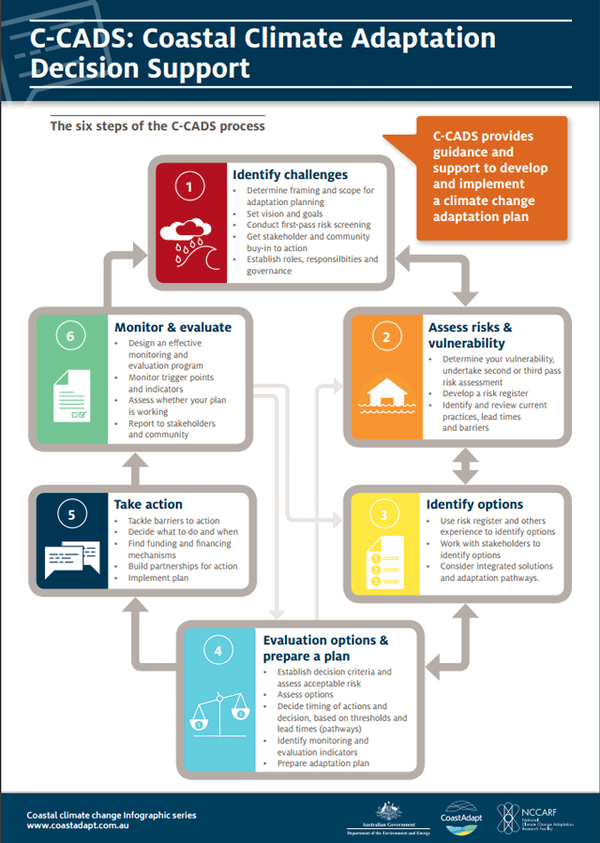
Figure 1: The six steps of the C-CADS process and some of the key components within each step. Each box represents a step in the framework, and arrows show the relationships and navigation between each step. Continuous monitoring and evaluation are integral to the cycle, allowing users to adjust plans based on performance or trigger points for action.
- © NCCARFCCADS-IG-640.original
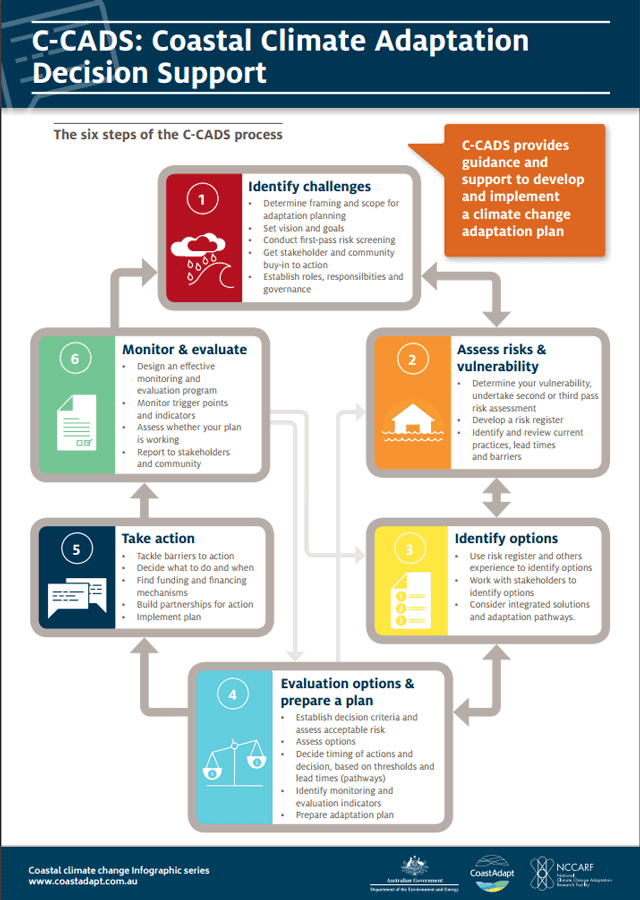
Figure 1: The six steps of the C-CADS process and some of the key components within each step. Each box represents a step in the framework, and arrows show the relationships and navigation between each step. Continuous monitoring and evaluation are integral to the cycle, allowing users to adjust plans based on performance or trigger points for action.
© NCCARF
Using C-CADS
Your use of C-CADS will depend on your needs, experience, the amount of prior adaptation knowledge, and your stage in the adaptation journey. You should consider the following points in determining how to use C-CADS to best suit your needs:
- The context: This step includes prior knowledge and experience of climate change and adaptation in your organisation and your community, including what has already been done. For example, has an adaptation strategy already been written? In a local council, does planning policy already seek to limit development in coastal locations exposed to risks from sea-level rise? Are there any actions or processes that your jurisdiction requires you to undertake? Have you considered what just and fair adaptation means in your context?
- The goal of your exercise: What are you trying to achieve? Is this a first foray into adaptation and so the goal is to just understand the risks and if action is necessary in the short-term? Or are the risks known and so the goal is to identify and implement action?
- Available resources: What are the available resources available (both human and financial capital)?
- Evaluation of risk: A rapid first-pass risk assessment (Understanding risk assessment) can be performed to evaluate the level of risk.
Is this a coastal council with soft shores that are prone to erosion and dense high-value coastal development? In this case, it is likely to require a full and costed evaluation of adaptation options, together with an implementation plan. All steps in C-CADS may need to be followed.
Or, is it an urban council with a rocky shoreline? In this case, it may be possible to undertake only the first two steps of C-CADS to pinpoint the risks and assess likely timing – for instance, when is it likely that sea level rise will create risks that require action to maintain ecosystem services and human well-being and safety?
Important to keep in mind:
1. Engage and learn throughout
Engagement and consultation should be done throughout your adaptation journey. There's many resources for engaging with the community, including case studies to inspire you. Involving Indigenous groups is increasingly key to effective adaptation.
Learn from what you do. Set clear objectives through thoughtful monitoring, evaluation and learning for each activity you undertake to assess whether you have achieved these effectively. If not, make changes.
Table 2 provides four potential use case for C-CADS, together with links in CoastAdapt to more detailed information to support the adaptation process.
2. There are many helpful resources
| Stage of planning | Most relevant C-CADS steps and CoastAdapt content |
|---|---|
| 1. Limited understanding of climate change and how it may affect an organisation. Currently no organisational commitment in place. | TBD |
| 2. Recognition of climate change and awareness that it has risks for the organisation. No formal adaptation plans or consideration of climate change in other organisational strategies or plans. Some resources available initially to explore the issues. | TBD |
3. Start broad and then focus in
Before diving into the detail of C-CADS, take time to first understand the broader C-CADS approach by scanning through the entire process. Gaining an overview of all steps and their requirements will help provide context and clarify how the pieces fit together. Understanding the broader process from the beginning will also help you to make the best of opportunities, understand where they fit and ensure that they support your needs.
When using C-CADS for the first time, begin with a light-touch assessment across the full cycle; particularly if you consider you have relatively minor climate change-related risks. This allows you to evaluate whether existing information and plans already align with some of the recommended C-CADS steps.
If you then identify your need more detailed risk assessments, you can delve deeper into all the components of C-CADS – investing more time and resources – to address your climate challenges. Similarly, if you determine there is more significant risk in some areas, a more in-depth and sophisticated approach will be necessary to guide your response.
4. Choose the level of detail that suits your need.
There are three levels of detail recommended for applying C-CADS: scan, plan and delve deeper. Regardless of the level chosen, users need to be familiar with all steps in the planning cycle before proceeding with a more detailed approach.
| Climate challenge | Typical user | Suggested approach | |
|---|---|---|---|
| Scan | Initial overview (scan): Determine challenge Develop high-level response | All | Rapid Initial overview of cycle for familiarisation. First pass risk assessment determines little climate-related risk. Initial response enabled through rapid use of C-CADS cycle. Possible to use C-CADS only with some additional information obtained from within CoastAdapt |
| Plan | Second pass risk assessment and associated responses for developing a climate adaptation strategy to address climate-related risks. | Most coastal councils. Private sector and others that have determined a medium to high risk from climate in a first pass assessment | Detailed risk assessment and planning approach using C-CADS. C-CADS followed with additional information and detail from information in CoastAdapt |
| Delve deeper | Serious and complex climate change risks and impacts sit within an organisation’s responsibility. Detailed assessment and response required. | Relatively few councils, utilities, private sector that have identified significant risk associated with climate change | Detailed risk assessment required. Usually conducted by consultants with detailed modelling and high complexity of information. C-CADS guidance supports the process with additional information obtained from within CoastAdapt and links to further resources. Additional information may be required from outside C-CADS. |
5. Many steps need to be done concurrently
C-CADS is presented as a cycle, however in practice, many things can take place simultaneously.
Although monitoring and evaluation appear at the end of the C-CADS cycle, they are essential throughout the entire adaptation planning process to help users to assess effectiveness of their work as they go. This also ensures flexibility and helps to achieve outcomes. For example, communication and engagement should take place throughout the planning cycle. By monitoring this throughout will help you to know if it is being effective and can help to guide direction and approaches that will save time, money and effort later.
The iterative nature of C-CADS encourages learning by doing: taking action, evaluating results, making adjustments, and trying again. It also supports you to select actions suited to particular conditions and to monitor various threshold indicators. Only, when a threshold is reached will this trigger the implementation of a different action (which is often more expensive or controversial). This staged approach helps avoid unnecessary costs or use of other resources and prevents alarming your stakeholders prematurely or unnecessarily or without sufficient evidence.
LEARN:
more about Rules of Thumb for each C-CADS step
What if you have limited resources?
The C-CADS process is designed to be flexible and can be followed regardless of your available budget. Each section outlines the requirements for that step and offers practical advice on how to complete it cost-effectively. To support different needs, the information is presented in three levels of detail.
In some cases, the potential risks involved may require securing additional resources to manage them effectively. Users should carefully consider what resources might be required. CoastAdapt provides guidance on:
- building a business case, including a template to get you started
- exploring financing options
Also useful
- Implications of taking no action
- What is the least you can do
- How to work effectively with consultants